When children see a numeral and hear or read its number word as connected forms of the same idea, they build a more flexible foundation for early mathematics and literacy. Try Early Mathematics Through Play Buy Now $24.00 to strengthen your strategies for making number sense active, meaningful, and accessible throughout the day. Then use the practical steps below to make independent practice purposeful—not just another worksheet.
Why does connecting numerals and number words matter?
A written numeral such as 4 and the word four are different symbols for the same quantity. Children need repeated opportunities to notice that connection alongside real sets of objects, spoken number words, and visual representations. Matching symbols is a meaningful step toward understanding number, but it should complement—not replace—counting, comparing, and play.
Research on early number learning describes foundational concepts such as the number-word sequence, one-to-one correspondence, cardinality, and relationships such as more, less, and the same. These ideas develop over time. A child may recognize a printed 5 but not yet reliably count five objects or understand that the last number said names the whole set. Observing these differences helps providers offer the right next challenge without treating developing skills as a failure.
The connection also offers a natural bridge between mathematics and emergent literacy. When children read number words, say them aloud, and represent the corresponding quantity, they coordinate visual, oral, and written information. Intentional adult language supports this learning: name the numeral, say the word, count a matching set, and invite children to explain how they know.
- It helps children connect abstract symbols with meaningful quantities.
- It gives educators a glimpse of number recognition, word recognition, and counting strategies.
- It creates engaging opportunities to use mathematical vocabulary in everyday classroom experiences.
How can task cards support meaningful independent practice?
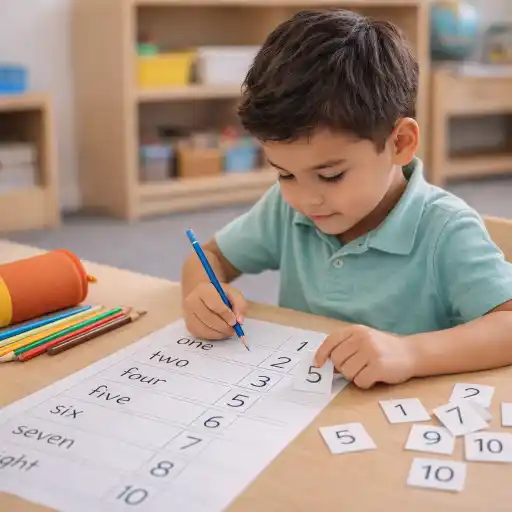
Well-designed task cards offer a clear, repeatable prompt that children can work through at a center, in a small group, or after completing another activity. ChildCareEd’s Task Cards - Number Words Buy Now $2.49 set includes 24 cards, a recording sheet, and an answer key. Cards show either a numeral or a number word; children write the matching form. This format gives children a structured opportunity to practice both number recognition and early word reading.
Independent does not mean unsupported or disconnected from teaching. Before introducing a task-card set, model one example aloud: “I see the numeral 6. I’ll say ‘six,’ then find or write the matching number word.” Invite children to explain their own strategy when they are ready. Keep the purpose focused: accurate connections matter more than finishing quickly.
Prepare the cards by printing and cutting them apart; laminating is optional if you plan to reuse them. Place them at a center or small-group table, or arrange them around the room for a “write the room” activity. Children record answers on the sheet and can check completed work with the included key, with adult guidance as needed.
- Preview the card format and provide a completed example.
- Make pencils, recording sheets, and any visual supports easy to access.
- Let children work at a comfortable pace; observe instead of turning the task into a race.
How should providers introduce and scaffold the activity?
Begin with the skills children already demonstrate. Some may match a few familiar numerals to number words; others may need picture cues, a smaller set of cards, or access to a number line or numeral chart. A shared learning goal can include varied entry points so every child can participate with an appropriate level of challenge.
Start by choosing a manageable group of cards. Model how to look carefully at a numeral or read a number word, say the corresponding form aloud, and write the match. Connect the symbols to objects when useful—for instance, place four counters beside the numeral 4 and say, “This is four; the word is ‘four’; here are four counters.” Gradually reduce prompts when children demonstrate confidence.
Think of practice as a progression, not a one-time test. The What Works Clearinghouse toolkit for teaching math to young children emphasizes developmental progressions, integrating math throughout the day, and monitoring progress so instruction builds on what children know. Use these principles to adjust the number range, amount of support, and frequency of practice. Letter & Number Planning in Child Care  Buy Now $24.00 is another course option for providers seeking support in planning math and literacy activities around children’s individual needs.
- Offer fewer cards or a smaller number range when the task is new.
- Use a numeral chart, manipulatives, or oral prompts as temporary scaffolds.
- Extend practice by asking children to find that many objects or use the number in a classroom routine.
How can educators observe learning and respond to common pitfalls?
Use the activity as a window into children’s thinking, not simply a score sheet. Notice whether a child recognizes numerals, reads number words, copies carefully, or uses a chart to check a response. If a match is incorrect, ask a neutral question such as, “How did you decide?” The answer may show that the child needs support with symbol recognition, word reading, writing, or connecting the two forms.
Brief, specific observations can inform your next step: “Jordan recognizes 1–5 and matches one, two, and three without help; offer a small set including four and five next time.” Keep notes concise and focused on observable strategies. Use completed sheets as one source of information, alongside conversations, play, and everyday routines.
A few common pitfalls are easy to avoid:
- ⚠️ Avoid treating speed or a perfect recording sheet as proof of complete number understanding.
- Keep the activity short enough to sustain interest, and make room for movement, conversation, and hands-on materials.
- Do not assume every child is ready for the same number range or amount of writing.
- Offer accessible tools and more than one way to respond, including pointing, saying the answer, or using manipulatives when appropriate.
Independent work is most productive when it complements teacher interaction. Research on early number learning in play highlights the value of adults noticing children’s ideas, using explicit math language, and drawing on observations to decide how to extend learning.
How can programs extend this learning beyond the cards?
Children strengthen connections when they encounter numerals and number words in varied, meaningful settings. Pair task cards with counters, dot cards, books, blocks, and everyday routines. A child who matches the word three to the numeral 3 can also make a set of three blocks, count three snack items, or look for the numeral on a classroom calendar. These varied representations help keep practice connected to quantities rather than isolated symbols. For more ideas on weaving mathematics into classroom experiences, see ways to add math to the early childhood classroom.
Invite children to talk about their choices. Ask “What does this numeral tell us?” “How could you show this number with blocks?” or “Where have you seen this number today?” The goal is not to demand a single explanation; it is to make children’s thinking visible and encourage them to use mathematical language. In a multilingual classroom, honor children’s home languages while also introducing English number words. Children may demonstrate understanding before they can express it fluently in English.
Families can extend the same ideas through ordinary activities: matching a number on a page to that many spoons, finding numerals on signs, or counting steps together. Share a simple suggestion rather than assigning extra work. For broader professional learning on number sense, counting, and developmentally appropriate math through play, explore Math Foundations in Early Childhood Buy Now $16.00 and No Such Thing as Boring Math Buy Now $24.00. State requirements vary - check your state licensing agency when documenting or selecting required training.
- Pair symbol matching with concrete objects and meaningful classroom purposes.
- Use children’s interests and family routines to make examples familiar and inviting.
- Repeat the connection across different materials over time instead of relying on one practice sheet.
Conclusion: What is the best way to connect numerals and number words?
Effective independent practice combines clear directions, a suitable level of challenge, accessible materials, and thoughtful observation. Task cards can provide a convenient structure for matching numerals with number words, while recording sheets and an answer key support follow-through. The deeper goal, however, is helping children connect written symbols with spoken language and quantities they can count, represent, and use.
Start with a short set of cards, model the matching process, and offer support that can fade as children gain confidence. Watch how each child approaches the task, then use what you learn to plan the next opportunity—whether that means revisiting familiar numbers, adding manipulatives, or extending the activity into play and routines. With repeated, encouraging practice, children can build stronger connections across mathematics and early literacy. For a more complete foundation in play-based number learning, consider Early Mathematics Through Play Buy Now $24.00.
- 45 Hour Child Growth and Development
- Early Mathematics Through Play
- 45 Hour Preschool Methods and Materials
- Language and Literacy Foundations in Pre-K
- Setting the Stage: Story Time
- 45 Hour School Age Methods and Materials
- Connections That Count: Building Relationships in Child Care
- Texas Director Credential
- Letter & Number Planning in Child Care
- Montessori Cultural Activities: Exploring the World Through Play and Learning
- CDA Certification en Español: Recursos y Consejos para Educadores Bilingües
- 10 Ejemplos de Cómo la Cultura Influye en el Desarrollo Infantil
- Proporciones de Cuidado Infantil y Tamaños de Grupo por Edad en Virginia (Guía Rápida para Centros y Hogares)
- Canciones, juegos y preguntas de círculo para niños
- Cómo simplificar la capacitación para sus empleados de daycare
- Teaching Math to Young Children: Why Counting to 20 Doesn’t Mean They Understand 20
- Why Are Self-Checking Clip Cards Great for Independent Practice?
- How Can You Create Easy Preschool Math Centers with Print, Prep, and Start Learning?
- How Can Early Math Activities Build Young Children’s Mathematical Thinking?
- How Does Counting Shapes Build Early Number Sense Through Play?
- How Can You Teach Numbers to Ten with Ten-Frames and Visual Models?
- How Can Child Care Providers Extend Ten-Frame Learning from 11 to 20?
- How Can Child Care Providers Introduce Even and Odd Numbers Through Visual Patterns?
- How Can Short, Focused Practice Build Subtraction Fluency Within 10?
- How Do Dot-to-Dot Activities Support Number Order and Pencil Control?
- How Can Dot Markers Make Number Recognition Practice More Meaningful?
- How Can Patterned Practice Help Young Children Master Subtraction Facts?
- How Can Independent Practice Connect Numerals and Number Words?
- Why Can a Child Compare Two Piles but Struggle with Greater-Than Symbols?
