Children are natural explorers, constantly curious about the world around them. One crucial aspect of their #development is #mathematical thinking. While mathematics is often associated with formal schooling, early experiences in care settings shape number sense, spatial reasoning, and quantitative problem-solving. How can child care providers intentionally support that development? Enrollments such as No Such Thing as Boring Math  Buy Now $24.00 and Letter & Number Planning in Child Care Buy Now $24.00 model practical strategies providers can adapt in daily routines and play. This article explains concrete activities, assessment approaches, family partnerships, and evidence-based resources to help early-childhood professionals boost young children's mathematical thinking.
How do we build a foundation for mathematical thinking in early childhood?
- Everyday Experiences: Simple daily routines, such as counting toys, setting the table, or measuring ingredients for a recipe, can be powerful opportunities for mathematical learning.
- Sensory Exploration: Activities involving touch, sight, and hearing can help children develop essential mathematical concepts like size, shape, and quantity. For instance, sorting objects by color or size, or playing with shape sorters, can be both engaging and educational.
- Problem-Solving: Encourage children to think critically and solve problems. Puzzles, games, and building blocks can stimulate their problem-solving abilities and their ability to reason mathematically.
- Number Sense: Introduce children to numbers in a fun and interactive way. Counting songs, rhymes, and games can help them develop a strong number sense and understand the relationship between numbers.
How can we create a supportive learning environment for early math?
- Positive Reinforcement: Praise children for their efforts and celebrate their successes. This positive reinforcement can encourage their mathematical curiosity and confidence.
- Open-Ended Questions: Ask open-ended questions that stimulate deeper thinking. For example, instead of asking "How many blocks are there?", ask "Can you build a tower taller than your friend?"
- Real-World Connections: Relate mathematical concepts to children's everyday lives. This helps them understand the relevance of math and its practical applications.
How can providers collaborate with famili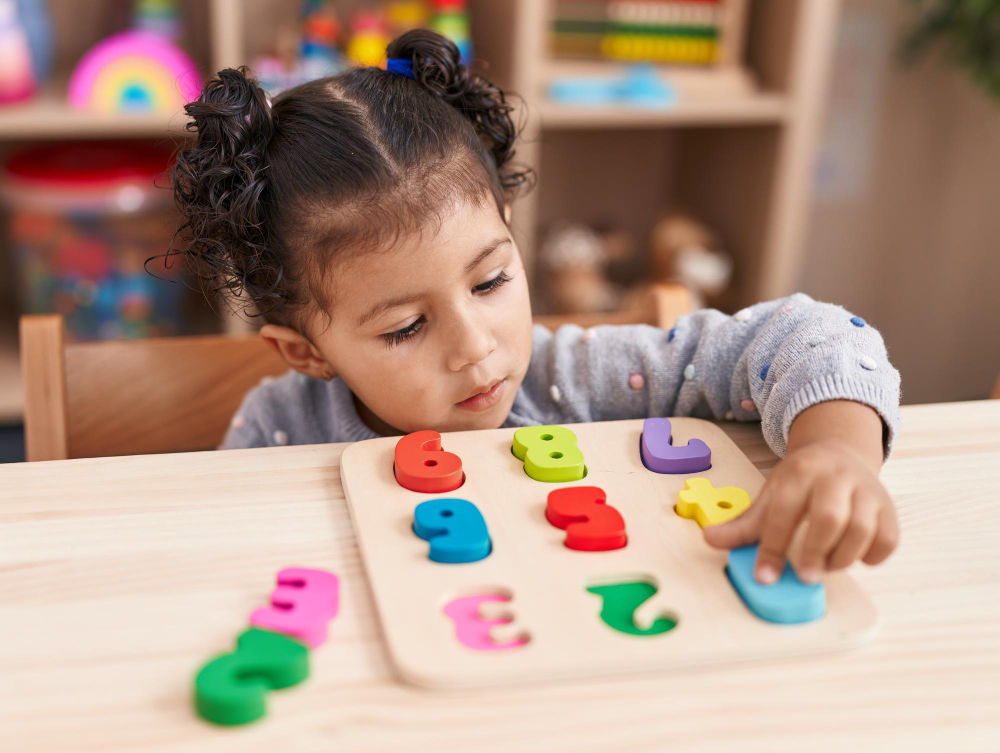 es to support early math learning?
- Home-School Partnerships: Encourage #parents to support their child's mathematical development at #home. Share simple activities and games that they can do together.
- Regular Communication: Maintain open communication with parents about their child's progress and any concerns they may have.
- Parent Education: Provide parents with resources and information about #early-childhood math education.
What math milestones should providers monitor, and how can they assess progress?
Providers should observe age-linked indicators of number sense and spatial reasoning rather than relying on a single checklist. Typical early indicators include: subitizing and matching small sets (infant/toddler), purposeful counting and one-to-one correspondence (older toddlers/preschoolers), beginning operations (combining and separating small sets), use of comparative language, and appropriate use of measurement units. Use focused observations, short play-based probes, and anecdotal notes to document each child's progress across domains.
Assessment should be formative and integrated into routine contexts. Examples: record a child counting during snack (note cardinality and error patterns), photograph block constructions and ask the child to explain how they chose pieces (spatial language), or conduct a quick sorting task to capture attribute reasoning. Use those notes to plan next-step provocations and to communicate progress to families.
Research-based curricula use learning trajectories to sequence instruction and assessment; providers can adapt those sequences into classroom routines to support incremental growth. For a concise overview of the early mathematical domains and examples of play-integrated assessment, see the Eastern Connecticut Center for Early Childhood Education's Mathematical Development series and program foundations that describe learning trajectories. Connecticut providers can also fulfill professional training requirements and access locally relevant online courses through high-quality trainings in Connecticut.
For classroom-level strategies and activities that align with developmental progressions, see How Can Preschool Teachers Effectively Support Early Math Skills in the Classroom? and consider the course Math Foundations in Early Childhood Buy Now $16.00 to deepen assessment-driven lesson planning.
What classroom activities build number sense and spatial reasoning?
Concrete, play-based activities give children multiple entry points for mathematical thinking. Offer short, repeated routines that foreground counting (for example, counting steps during transitions), comparison (which basket has more apples?), and measurement (who is taller using nonstandard units). Use tangible materials—counters, blocks, loose parts—and design tasks children can repeat with increasing complexity: sorting objects by more attributes, re-creating a simple pattern from memory, or describing a block structure using spatial language. These activities let providers observe subitizing, one-to-one correspondence, and emerging operations during authentic play. For ready-to-use activities that scaffold arithmetic discovery, see the preschool arithmetic activity guide that provides simple probes and adaptations for different ages (Preschool Arithmetic Activity).
How can providers adapt math experiences for different ages and learners?
Different developmental stages require different supports. For infants and very young toddlers, emphasize perceptual comparisons (bigger/smaller), object permanence games, and simple quantity language. Older toddlers benefit from one-to-one counting routines and guided play with counting songs. Preschoolers can tackle estimation, basic operations with manipulatives, and data collection through simple surveys. Differentiate by adjusting task complexity, using visual scaffolds, and offering language prompts that build mathematical vocabulary (e.g., more/less, sum, difference, longer/shorter). Consider classroom models—Montessori materials, for instance, intentionally move children from concrete materials to abstraction; see how Montessori math prepares children for abstract thinking (Montessori Math: Preparing Children for Abstract Thinking). Also integrate short STEM investigations to strengthen measurement and data skills (STEM-sational Fun).
How can programs put daily math plans into practice?
Turn routines into mini-lessons: plan quick provocations tied to snack, outdoor play, or arrival times that assess a targeted skill (for example, a 2-minute sorting challenge to check attribute reasoning). Document the child's response and use the note to plan the next scaffolded activity. At the program level, align your daily math plan with program goals—see practical recommendations on embedding math across the day in program-wide guidance (How Can Preschool Programs Intentionally Support Early Math Skills Every Day?) and classroom-level practices (How Can Preschool Classrooms Effectively Support Early Math Skills?). For summer-specific outdoor provocations and seasonal activity plans tailored to childcare settings, see planning summer activities for Texas child care providers.
What are the key takeaways for supporting early math development?
Key takeaways for child care professionals: make math visible in play and routines, use learning trajectories to scaffold from concrete to abstract ideas, prioritize mathematical language and documentation, partner with families to extend learning at home, and use short, play-based assessments to guide instruction. Embed measurement, sorting, comparison, and counting into real activities and record children's problem-solving strategies to plan next steps. For practical training, explore ChildCareEd courses linked in this article to translate concepts into daily practice.
What are the main takeaways and next steps?
Summary: Prioritize short, repeatable math experiences embedded in daily routines; scaffold tasks using learning trajectories; document observations and share simple activities with families to create home-school continuity. Use formative, play-based probes to inform next steps rather than relying on single checklists. Next steps for the reader: try one new provocation per week, document one learning trajectory per child, and review the linked ChildCareEd resources and classroom articles for activity templates and planning tools. Consider the Math Foundations course for deeper planning and assessment strategies and review the Eastern Connecticut center videos for concrete examples that align with Connecticut practice.
- 45 Hour Child Growth and Development
- Early Mathematics Through Play
- CDA Home Visitor Subject Area 3 Part 3 Birth to 5
- Birth to Five CDA Credential with Portfolio Review
- Children at the Wheel: Emergent Curriculum
- Emergent Learning & Development
- Creating Environments that Nurture Growth and Community
- Texas Director Credential
- Enhancing STEM Education for Infants and Toddlers
- Teaching Math to Young Children
- Mathematical Skill Development
- ¿Cuáles son las mejores actividades de primeros auxilios para adultos?
- Pumpkin Math Without the Worksheets: Hands-On Pre-K Learning
- Teaching Math to Young Children: Why Counting to 20 Doesn’t Mean They Understand 20
- How Can Preschool Math Become Meaningful, Playful, and Part of Every Day?
- How Can Child Care Providers Build Strong Early Math Skills Every Day?
- How Can Hands-On Sorting Support Math and Language Together?
- How Can Early Math Activities Build Young Children’s Mathematical Thinking?
- How Can Children Connect Multiplication Facts to Visual Patterns?
- How Can Color-Coded Practice Reinforce Early Division Skills?
- How Can You Make Addition Practice More Engaging Without Losing the Learning Goal?
- How Can Child Care Providers Make Counting and Simple Operations Playful?
- How Can Familiar Objects Make Addition Concrete for Young Children?
- How Do Dot-to-Dot Activities Support Number Order and Pencil Control?
- How Can Children Practice Division Without Overloading Working Memory?
- How Can Child Care Providers Teach Zero Through Empty Collections?
- How Can Toddler Classroom Jobs Build Early Math Beyond Counting?
