When preschoolers eagerly ask for “one more round,” a simple bingo board is doing more than entertaining them—it is creating repeated opportunities to listen, think, communicate, and connect ideas. Thoughtfully facilitated bingo can strengthen classroom practice while preserving children’s agency and joy; The Best Promotion is Play  Buy Now $24.00 offers practical professional learning on using play to support cognitive, social, emotional, and physical development.
Bingo is especially valuable because it sits between free play and direct instruction. It has enough structure to support an intentional learning goal, yet enough flexibility for children to make choices, talk with peers, move, experiment, and try again. The question is not whether bingo is “academic” or “fun.” With responsive teaching, it can be both.
Why does bingo make learning feel playful?
Playful learning is defined less by the material than by the quality of the experience. NAEYC describes playful learning as active, engaging, meaningful, socially interactive, and iterative. A bingo game can embody all five characteristics: children actively scan and respond; the shared routine sustains engagement; the images connect to familiar experiences; peers interact; and repeated rounds allow children to refine their understanding.
Research on game-based learning also suggests that well-designed games can support cognitive, social, emotional, motivational, and engagement outcomes. However, the game itself is not automatically effective. The educator’s decisions—what to call, how quickly to proceed, whether to invite explanations, and how to respond to mistakes—determine whether bingo becomes a worksheet in disguise or a genuine learning experience.
For child care providers and directors, this distinction matters. A playful activity can meet curriculum goals without asking young children to sit passively for long periods. It also gives teachers a natural context for observing attention, language, problem-solving, self-regulation, and peer interaction.
How can providers connect bingo to meaningful learning goals?
Begin with one developmentally appropriate goal rather than trying to teach everything at once. A color game might focus on matching and naming; a shape game might emphasize attributes; an animal game might introduce habitats or classification; and a sound game might strengthen listening or beginning-sound awareness.
Once the goal is clear, choose materials and prompts that make children think beyond simply covering a square. For example, instead of calling “triangle,” describe it as “a shape with three straight sides.” Rather than saying “dog,” offer a clue about the animal’s sound, movement, or habitat. These small changes increase the cognitive demand while maintaining the playful format.
- Use familiar images and vocabulary before introducing less familiar concepts.
- Connect cards to objects children can touch, sort, build, or find in the classroom.
- Invite children to explain how they know a match is correct.
- Follow the game with a hunt, story, construction activity, art experience, or investigation.
Planning should also account for children’s interests, languages, abilities, and experiences. State requirements vary - check your state licensing agency when documenting curriculum or professional development expectations. For deeper support with intentional activity design, explore Lesson Planning for Preschoolers Buy Now $24.00.
Which bingo variations support language, math, and science?
Bingo can be adapted across learning domains. In color bingo, children can match, name, compare shades, and search for classroom objects. In shape bingo, they can identify attributes, use positional language, rotate forms, and build shapes with craft sticks or magnetic tiles. Animal bingo can support #vocabulary, habitat knowledge, movement, and classification by observable characteristics.
Literacy-focused bingo can feature pictures that share a beginning sound, rhyming pairs, story elements, or environmental print. A provider might say, “Find a picture that begins with /m/,” then invite children to name the object and identify another item in the room with the same sound. Keep the emphasis oral when the goal is phonological awareness; children should hear and discuss the sound before being expected to identify a printed letter.
Mathematics bingo can include quantities, numerals, patterns, or spatial relationships. Call a quantity and ask children to count the matching objects, or describe a pattern that children must locate. Science bingo might feature weather, living things, materials, or animal needs. In each case, the strongest learning occurs when children explain, compare, predict, and investigate.
Use the color, shape, and animal bingo guidance as a starting point, then extend each game beyond the board. The post-game conversation is often where the richest learning appears.
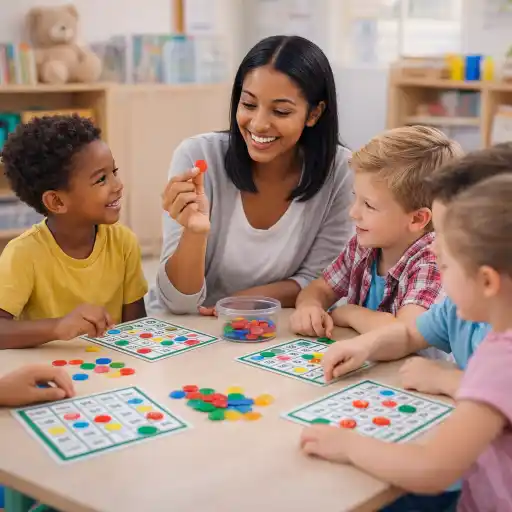
How can bingo strengthen social-emotional development?
Every round creates authentic practice with listening, waiting, turn-taking, sharing materials, communicating needs, and managing disappointment. These skills are still developing in preschoolers, so grabbing a marker or calling out should be understood as information about a child’s need for structure and support—not as a character flaw.
Make the social goal explicit. Model a predictable sequence: listen, find, mark, check, and wait. Use consistent language such as, “My turn to call; your turn to find.” A turn token, name card, or visual sequence can help children understand what is happening and anticipate their role.
- Try partner bingo, with one child calling and another locating the image.
- Use a cooperative class board when competition creates stress.
- Teach scripts such as “Can you help me?”, “Your turn,” and “Good game.”
- Celebrate careful listening, persistence, encouragement, and teamwork—not only speed.
Children who communicate through gestures, signs, eye gaze, pointing, or AAC should have equal opportunities to participate. A child who does not want to call “Bingo” can raise a card or signal an adult. Inclusion preserves the learning objective while honoring different communication and regulation needs. For more guidance, consider Supporting Social Learning: Creating Classrooms that Care Buy Now $24.00.
What makes bingo inclusive, engaging, and developmentally appropriate?
Effective bingo materials are visually clear, durable, culturally responsive, and accessible. Use large images, generous spacing, and markers that are easy to grasp. Avoid relying on color alone; pair colors with pictures, symbols, textures, patterns, or words so children with color-vision differences or varied visual processing can participate.
Adjust complexity without changing the central goal. A beginner may use a three-by-three board and two choices. Another child may be ready for descriptive clues, multiple attributes, or the opportunity to lead. Provide wait time, repeat directions without embarrassment, and reduce background noise when listening is the focus.
Representation also matters. Include foods, animals, objects, names, and settings that reflect children’s families and communities. Invite families to contribute home-language labels or culturally meaningful examples. For dual language learners, gestures, real objects, peer models, and home-language connections make the game more equitable.
Common pitfalls include making bingo too long, rushing calls, treating winning as the primary outcome, correcting every error publicly, and using the game as a formal test. Keep rounds brief, observe thoughtfully, and remember that state requirements vary - check your state licensing agency. Inclusive Lessons for Preschoolers Buy Now $16.00 can support further planning for varied learners.
How can educators use bingo to observe and extend learning?
Bingo provides a natural window into children’s developing skills. Rather than recording only who wins, observe the process. Does the child attend to the clue? Scan the board carefully? Match accurately? Use descriptive language? Wait for a turn? Ask for help? Recover after disappointment? These observations can guide the next experience.
- Document objective notes, such as “identified three colors independently” or “needed a picture choice to identify the beginning sound.”
- Compare performance across small groups, partners, and classroom routines.
- Plan follow-up experiences based on what children can almost do.
- Share strengths and next steps with families in accessible language.
Extend the learning immediately. After shape bingo, invite children to build a shape or find one outdoors. After animal bingo, create habitats with blocks and natural materials. After sound bingo, take a listening walk or make a class sound book. After color bingo, mix paint, sort classroom objects, or create a shade collage.
For providers who want to strengthen objective documentation and individualized planning, Preschool Assessments & Observations Buy Now $24.00 offers relevant professional learning. The goal is not to rank children but to use playful evidence to make teaching more responsive.
Summary: How can bingo games make learning feel like play?
Bingo makes learning feel like play when it is purposeful without being rigid, social without being high-pressure, and challenging without being discouraging. Clear goals, inviting materials, open-ended questions, movement, repetition, and inclusive response options transform a familiar game into a rich learning context.
The most important outcome is not who calls “Bingo” first. It is whether children become more confident listeners, communicators, problem-solvers, collaborators, and curious investigators. When providers connect the game to meaningful classroom experiences and use observations to plan next steps, bingo becomes a small but powerful example of #playful #learning.
Five additional course connections for professional growth
- The Best Promotion is Play Buy Now $24.00 — supports play-based classroom practice.
- Supporting Social Learning: Creating Classrooms that Care Buy Now $24.00 — strengthens turn-taking and peer interaction strategies.
- Lesson Planning for Preschoolers Buy Now $24.00 — connects games to intentional goals and adaptations.
- Inclusive Lessons for Preschoolers Buy Now $16.00 — helps providers design accessible learning experiences.
- Preschool Assessments & Observations Buy Now $24.00 — supports objective observation and responsive planning.
- 18-Hour Train the Trainer
- CDA Preschool Credential with Portfolio Review
- Hidden in Plain Sight: Depression in Young Children
- Building Equity: Inclusionary Practices in Preschool
- Birth to Five CDA Credential with Portfolio Review
- CDA Bridge Bundle: Preschool
- The Best Promotion is Play
- Connections That Count: Building Relationships in Child Care
- Texas Director Credential
- Canciones, juegos y preguntas de círculo para niños
- Emotion Sorting for Kids: Learning Feelings Through Play
- How Can Fun Bingo Games Teach Colors, Shapes, and Animals to Preschoolers?
- How Can Sound Bingo Sharpen Listening Skills in Preschoolers?
- How Can Bingo Games Support Turn-Taking and Social Skills?
- Why Is Animal Bingo a Great Way to Introduce Habitats and Classification?
- How Can Color Bingo Reinforce Vocabulary and Visual Discrimination?
- Why Is Beginning-Sound Bingo a Smart Step Toward Reading?
- How Can Bingo Games Make Learning Feel Like Play?
- What Skills Can Preschoolers Build Through Bingo?
- How Can You Teach Sight Words Through Games, Movement, and Play?
- How Can Child Care Providers Teach Beginning Sounds with Tracing, Pictures, and Repetition?
- How Can You Differentiate Sight-Word Bingo for Mixed-Ability Groups?
- How Can Farm-Animal Games Build Listening and Vocabulary?
- How Can Cooperative Sight-Word Games Help Early Readers Learn Together?
- How Can Interactive Group Play Build Ocean Vocabulary in Preschool?
- How Can Animal-Themed Bingo Build Descriptive Language in Preschoolers?
- How Can Listening and Movement Games Build Children’s Shape Recognition?
- How Can Dinosaur-Themed Group Games Build Vocabulary and Turn-Taking?
- How Can You Make a Group Listening Game Accessible to a Child with Hearing Loss?
