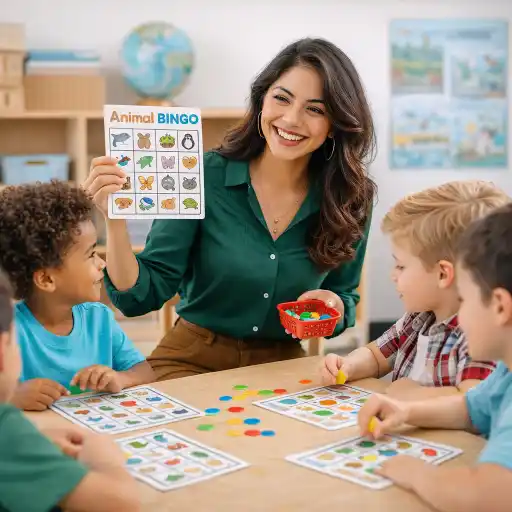
How can a simple game help children connect animal names with the places and characteristics that make each species unique? Animal bingo transforms science vocabulary into an interactive experience while giving providers repeated opportunities to encourage observation, conversation, and #curiosity. For practical strategies to strengthen inquiry-based science experiences, explore Basic Science in Early Childhood Buy Now $25.00, a two-hour training that can help you plan meaningful investigations and support children’s scientific reasoning.
For educators who want to connect playful experiences to intentional preschool planning, Lesson Planning for Preschoolers  Buy Now $24.00 offers guidance on developmentally appropriate goals, activities, and adaptations. Together, these learning opportunities can make animal bingo more than a game: they can help you build a coherent science experience that supports professional practice and children’s learning.
Why does animal bingo matter in early childhood science?
Young children are naturally interested in animals, but knowing an animal’s name is only a starting point. Animal bingo can help children notice relationships: a fish is associated with water, a bird may have feathers, and a camel has features that support life in dry environments. When educators use thoughtful prompts, the activity moves from simple recognition toward early scientific reasoning.
Bingo is especially useful because it provides repetition without feeling like a worksheet. Children listen, scan, compare, make choices, and communicate with peers. They may point to a picture, imitate an animal, explain a habitat, or ask whether an animal could live somewhere else. Each response gives the teacher information about children’s developing knowledge.
The game also creates a welcoming entry point for children with different language abilities and developmental strengths. A child may participate by matching a picture, using a gesture, naming an animal in a home language, or selecting between two choices. The learning goal remains stable while the pathway to participation becomes flexible.
- 🦁 Encourages active listening and visual discrimination.
- Builds animal and habitat vocabulary.
- Creates opportunities for turn-taking and cooperation.
- Supports memory, attention, and early reasoning.
How does bingo introduce the concept of habitat?
A habitat is the environment that provides an animal with essentials such as food, water, shelter, space, and suitable conditions. For preschoolers, this definition can be made concrete through photographs, books, toy animals, natural materials, and classroom conversations. Rather than asking children to memorize a long list of ecosystems, begin with a few familiar categories such as forest, ocean, farm, desert, and pond.
Habitat bingo cards can show animals alongside their environments, or they can show animals only and invite children to infer where each one might live. Call an animal with a clue: “I have fins, live in water, and use my tail to move.” After children find the fish, ask, “What does the fish need from its habitat?” This question encourages children to connect an animal with environmental resources.
Use habitat language carefully. Some animals live in more than one environment, and habitats are more complex than a single label. If a child places an animal in an unexpected category, respond with investigation rather than immediate correction: “What makes you think it could live there? What could we look up or observe?”
Follow bingo with hands-on extensions:
- Build a habitat with blocks, fabric, and toy animals.
- Sort photographs by land, freshwater, and marine environments.
- Create a class mural showing what animals need to survive.
- Observe local birds, insects, plants, or animal tracks outdoors.
How does animal bingo support classification?
Classification involves grouping objects according to shared characteristics. Animal bingo gives children a playful context for practicing this process. Begin with accessible categories based on observable attributes, such as where animals live, how they move, what covers their bodies, or how many legs they have. These categories are developmentally meaningful because children can investigate them directly.
After a round of bingo, place several animal cards on the floor and invite children to create a group. Ask, “What do these animals have in common?” A child might group animals that fly, have feathers, live in water, or move by hopping. There may be multiple reasonable systems, which makes classification a conversation rather than a single-answer exercise.
As children gain experience, introduce more specific scientific categories in simple language. You might explain that mammals usually have hair or fur and feed their young milk, while birds have feathers and beaks. Avoid overwhelming children with formal taxonomy. The goal is to develop a habit of noticing attributes and using evidence to explain a category.
Classification can also connect to mathematics and language:
- Count how many animals are in each group.
- Compare which group has more or fewer members.
- Describe similarities and differences.
- Invite children to rename or reorganize a category.
- Record children’s explanations through dictation.
A useful extension is a “Which One Does Not Belong?” round. Present three or four animals and invite children to identify one that differs according to a chosen rule. Accept different answers when children can explain their reasoning.
How can providers design an engaging and inclusive game?
Effective animal bingo begins with a clear instructional purpose. Decide whether the focus is habitat vocabulary, animal attributes, listening comprehension, or classification. Select a limited number of images that are large, recognizable, and visually distinct. Too many pictures can make scanning difficult and shift attention away from the conversation.
Use calling cards with clues rather than names alone. For example: “Find an animal that lives in a pond and has webbed feet.” Children can cover the matching image and explain their choice. For younger children, show the picture and name it. For older preschoolers, offer sound clues, movement clues, or attribute descriptions.
Inclusive design allows all children to participate. Consider:
- Picture cards paired with spoken, written, or home-language labels.
- Large markers, slanted boards, or magnetic pieces for motor access.
- Extra processing time and reduced choices for children who need them.
- Partner or cooperative play instead of competition.
- Alternative responses such as pointing, eye gaze, gestures, or drawing.
Representation also matters. Include animals familiar to children’s families and communities as well as species from different regions. Use accurate images and avoid implying that every animal fits only one category. A classroom can honor children’s existing knowledge while expanding it through books, photographs, and real-world observations.
State requirements vary - check your state licensing agency before counting a course or activity toward a specific professional requirement.
What common mistakes should educators avoid?
The first common mistake is treating bingo as a race. Competition may cause some children to disengage, rush, or feel unsuccessful. A cooperative board, in which the group works toward completing a shared pattern, often better supports preschool learning. Celebrate careful listening, thoughtful explanations, and helping peers rather than simply being first.
A second mistake is focusing only on animal names. Naming is valuable, but it does not demonstrate understanding of habitats or classification. Add one open-ended prompt after each call: “What do you notice?” “Where might it live?” or “How is it similar to the last animal?” Keep the discussion brief enough to maintain momentum.
A third mistake is presenting inaccurate or overly rigid information. Some animals occupy several habitats, migrate, or change their behavior across seasons. Avoid statements such as “all birds fly” or “every animal has one home.” When uncertainty arises, model scientific humility: “We have a question. Let’s investigate.”
Finally, avoid using a worksheet as the only evidence of learning. Observe children during play. Document whether they can:
- Match an animal to a picture, habitat, or attribute.
- Use descriptive vocabulary.
- Explain a grouping rule.
- Listen and respond to peers.
- Revise an idea after new information.
These observations can guide the next experience. Children who know animal names may be ready for attribute sorting, while children who need more vocabulary may benefit from repeated picture-book readings and small-group play.
How can animal bingo become a broader learning sequence?
Animal bingo is most powerful when it serves as one part of a larger inquiry. Begin by introducing a few animals through books, photographs, songs, or classroom objects. Play a short bingo round to activate prior knowledge. Then invite children to investigate a question that emerges from the game, such as “Why does the duck have webbed feet?” or “What does a desert animal need when there is little water?”
Extend the investigation across learning centers. In the science area, provide magnifiers, animal figures, habitat photos, and sorting trays. In blocks, invite children to construct animal homes. At the art table, children can create habitat collages. During movement, they can imitate animal locomotion and discuss whether the movement occurs on land, in water, or in the air.
Use documentation to connect experiences over time. Display children’s predictions, drawings, photographs, and dictated explanations. Revisit the original bingo cards after several days and ask whether children would change any groupings. This supports reflection and shows that scientific knowledge develops through observation and revision.
A practical sequence might look like this:
- Introduce three to five animals and read a related book.
- Play clue-based animal bingo.
- Sort the cards by habitat or observable attributes.
- Build, draw, or dramatize one habitat.
- Document children’s explanations and plan a follow-up question.
For additional professional learning, CDA Subject Area 2 Buy Now $80.00 explores strategies related to science, language, mathematics, and intellectual development. The course can help providers connect playful activities with intentional planning and broader developmental goals.
Conclusion: Why is animal bingo a strong introduction to habitats and classification?
Animal bingo works because it combines repetition, movement, language, visual matching, and social interaction in one flexible experience. When providers use descriptive clues and thoughtful questions, children move beyond naming animals to considering where they live, what they need, and how their characteristics help them function in different environments.
The game also introduces classification as a process of observing, comparing, grouping, and explaining. Children can sort animals by habitat, movement, body covering, number of legs, or other visible traits. Most importantly, educators can welcome multiple ideas and encourage children to support their thinking with evidence.
Keep the activity accessible, accurate, cooperative, and connected to hands-on follow-up experiences. The strongest learning may happen after the final call, when children build a habitat, revise a category, ask a new question, or explain their thinking to a friend. In this way, animal bingo becomes a lively beginning to scientific inquiry and a meaningful tool for #learning, communication, and belonging.
- CDA Home Visitor Subject Area 3 Part 3 Birth to 5
- CDA Home Visitor Subject Area 2 Part 3 Birth to 5
- Building Early Science Foundations
- Birth to Five CDA Credential with Portfolio Review
- Money Matters in Medicine
- Pediatric RSV First Aid & CPR/AED
- Texas Director Credential
- Montessori Cultural Activities: Exploring the World Through Play and Learning
- Every Moment Matters: Schedules and Transitions
- CDA Certification en Español: Recursos y Consejos para Educadores Bilingües
- 🚌❄️ Ideas de excursiones en Dakota del Norte
- 🚌🌄 Ideas de excursiones atractivas en Nevada
- 🚌🍑 Ideas de excursiones en Georgia
- Que es Título 22 en California?
- Regulaciones de Licenciamiento de Cuidado Infantil en California para Centros y Hogares de Cuidado Infantil Familiar
- Consejos de Supervisión Activa para Salones de Preescolar y el Juego al Aire Libre
- Las Mejores Ideas de Excursiones para Guarderías en Dakota del Norte
- Las Mejores Ideas de Excursiones para Guarderías en Georgia
- How Can Fun Bingo Games Teach Colors, Shapes, and Animals to Preschoolers?
- How Can Sound Bingo Sharpen Listening Skills in Preschoolers?
- Why Is Animal Bingo a Great Way to Introduce Habitats and Classification?
- Why Is Wild vs. Farm Animal Sorting a Favorite Preschool Activity?
- How Can Bingo Games Make Learning Feel Like Play?
- What Skills Can Preschoolers Build Through Bingo?
- How Do Animal Classification Activities Build Early Science Thinking?
- How Do Classification Questions Build Marine Science Vocabulary?
- How Can Child Care Providers Introduce Reptiles Through Art, Observation, and Conversation?
- How Can Animal-Themed Bingo Build Descriptive Language in Preschoolers?
- How Can We Explore Animal Habitats Beyond Farm-and-Wild Labels?
