Farm-animal bingo can turn a familiar theme into meaningful practice with listening, new words, and joyful classroom interaction. Pair the game with the Assessment of Language and Literacy Skills  Buy Now $24.00 course to strengthen your ability to observe children’s communication and plan responsive next steps; the ideas below will help you put those skills into action.
Why are farm-animal games useful for language learning?
Young children learn words through repeated, meaningful encounters. A farm game offers more than a chance to name a cow or hear a “moo”: children listen for a cue, connect spoken language with an image, make a choice, and communicate what they noticed. The shared context makes new words easier to understand and remember.
A playful round also gives providers a natural window into children’s strategies. Who recognizes an animal immediately? Who benefits from a repeated clue or visual support? These observations can help you adapt the next round without turning a lively game into a test. The goal is participation and language growth—not speed or a perfect score.
- Repeated calls reinforce animal names and related words.
- Matching a spoken clue to an image practices attention and listening.
- Describing a choice invites children to use language in context.
- Shared play gives children reasons to communicate with peers.
How can you prepare a purposeful farm-animal bingo game?
Start with one clear goal: for example, recognizing animal names, listening for descriptive details, or using words for animal features and actions. Select a manageable set of familiar pictures, such as cow, pig, horse, sheep, duck, and chicken. A board with fewer choices can make scanning less demanding for younger children or children who benefit from simplified visual information.
The ChildCareEd Bingo Cards - Farm Animals Edition Buy Now $1.99 is a printable cut, color, paste, and play activity. Children personalize a blank grid with picture cards, then listen as the teacher calls out each animal. This setup can add fine-motor practice to the language experience and works for circle time, learning centers, or a small group.
Before playing, introduce the pictures and words in an unhurried way. Show each image, say the animal’s name, and invite children to repeat, point, sign, or make its sound. Pair the picture with a toy animal or a movement where helpful. Prepare simple markers and ensure the cards are large and clear enough for children to see.
- Choose just a few target words for the first round.
- Use picture clues and spoken words together when introducing the game.
- Explain and model the sequence: listen, find, cover, and wait.
- 🧩 Invite children to color or arrange their cards before play to build ownership and fine-motor practice.
How can calls and clues grow vocabulary?
Begin with direct naming: “Find the cow.” Once children understand the routine, vary your language. Offer a sound clue (“Which animal says ‘oink’?”), an action (“Find the animal that can lay eggs”), or a description (“Look for the animal with woolly fleece”). Clues encourage children to listen for meaning rather than simply wait for an exact label.
Model rich but accessible words, then repeat them naturally across the game. A cow may be “large,” “spotted,” or “standing in the barn”; a chicken may “peck,” “scratch,” or “cluck.” If a child says “sheep,” you can expand: “Yes, you found the sheep. Its wool looks fluffy.” This gentle extension validates the child’s contribution while adding useful language.
- Ask “What do you notice?” or “How did you know?” after a match.
- Contrast useful words: “The duck is waddling; the horse is trotting.”
- Accept animal sounds, pointing, signs, and speech as meaningful participation.
- Repeat key words during books, songs, dramatic play, and daily routines.
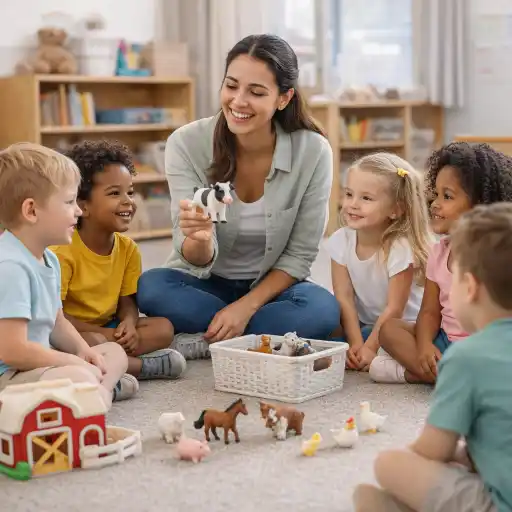
How can you make the game inclusive and socially supportive?
Keep the game welcoming by focusing on shared attention and discovery rather than racing to win. Cooperative bingo—where the group completes a common board—can reduce pressure while maintaining excitement. Use a predictable rhythm and short rounds so children can anticipate what happens next and rejoin after a missed turn.
Adapt materials and responses to children’s needs. Offer fewer squares, high-contrast images, larger markers, a slanted board, or extra time to look. Avoid relying on color alone to distinguish a picture. A child may point, touch a card, use eye gaze, sign, vocalize, or ask a peer for help; participation does not have to look identical for every child.
Use the game’s social moments to model turn-taking and kind communication. Children can pass the caller card, ask for a marker, or celebrate a peer’s careful listening. If a child becomes frustrated, acknowledge the feeling and support a fresh start: “You wanted that picture. Let’s listen for the next one together.” This keeps the group connected while helping children practice self-regulation.
- Preview the rules with a brief demonstration or picture sequence.
- Offer partner play or a shared board when individual boards feel challenging.
- Allow movement breaks and a quieter place to participate if helpful.
- Celebrate persistence, thoughtful listening, and helping—not only getting bingo first.
How can you observe language growth during play?
A bingo round can provide useful formative information when you observe without interrupting the play. Notice whether a child identifies an animal by name, matches a clue, attends to a spoken direction, or uses a gesture or word to show understanding. Record what you actually see or hear rather than making broad judgments from one response.
For example, a brief note might say, “During farm bingo, Leo matched cow and duck from spoken names; he matched sheep after a sound clue and a second wait period.” Another might read, “Amaya pointed to the chicken and imitated ‘cluck’; she used the picture card to request another turn.” Such notes capture strengths and identify a useful next step.
Use patterns over several experiences to plan follow-up. A child who recognizes pictures but rarely uses words may benefit from partner play, animal props, and modeled phrases. A child who knows the names might be ready for descriptive clues, categories, or a story about animal care. The ChildCareEd Assessment of Language and Literacy Skills Buy Now $24.00 course explores objective observation, assessment approaches, and translating information into meaningful learning goals. State requirements vary - check your state licensing agency when determining whether training meets a specific professional-development requirement.
- Which animal words does the child understand or use?
- Does the child respond to names, sounds, or descriptive clues?
- What communication mode does the child choose?
- Which prompt or adaptation helped the child participate?
How can you extend farm bingo beyond the game?
Keep new words alive by revisiting them in connected experiences. After bingo, read a farm picture book and pause when a familiar animal appears. Add toy animals to a dramatic-play area, sing a farm song, or invite children to sort pictures by where animals live, what they eat, or how they move. Repetition across settings supports deeper understanding than a single game alone.
Use children’s questions to guide the next activity. If they wonder what a chicken eats, look at an age-appropriate book or photograph together. If they are interested in animal babies, match adult and young-animal pictures and introduce a few related names. Keep information accurate and avoid presenting every animal as having only one habitat or behavior.
Families can extend the conversation at home by sharing a favorite animal word, song, or story from their household language. Invite those contributions without making families responsible for formal instruction. A brief shared exchange helps connect the classroom theme with children’s lived experiences and languages.
- Set up a small-world farm with figures, fences, and pretend food.
- Use movement prompts: waddle like a duck, trot like a horse, or flap like a chicken.
- Invite children to dictate a sentence about a chosen animal.
- Revisit target words during transitions, outdoor play, or snack conversation.
Conclusion: What makes farm-animal games effective?
Farm-animal games build listening and vocabulary when providers make the play purposeful, conversational, and accessible. Begin with a manageable set of familiar animals, use clear names and engaging clues, allow generous wait time, and welcome children’s different ways of responding. Extend the words into books, movement, pretend play, and conversation so children meet them repeatedly in meaningful contexts.
Most importantly, treat the game as an opportunity to notice each child’s strengths and decide what support or challenge could come next. A printable bingo activity can make preparation simple, while thoughtful facilitation turns each call into a chance to listen, connect, describe, and belong. For a deeper foundation in documenting children’s language and literacy development, explore the Assessment of Language and Literacy Skills Buy Now $24.00 course.
- Reading Aloud and Storytelling
- Language and Literacy Foundations in Pre-K
- Working Together: Teachers & Preschoolers
- Assessment of Language and Literacy Skills
- Texas Director Credential
- Building Vocabulary
- Building Bridges for Dual Language Learners
- Classroom Tools for Emergent Literacy
- Supporting Families and Caregivers in Language and Literacy
- Resources: Building Blocks to Excellence
- 💛🧩 ¿Cómo puedo hacer que mi enseñanza sea inclusiva para los niños con autismo?
- 👶 ¿Cuáles son las proporciones y grupos requeridos en Dakota del Norte? 🏫
- Juegos de Motricidad Gruesa
- Celebra El Cumpleaños de Dr. Seuss En Tu Guardería Con Actividades Fáciles y Divertidas!
- Actividades de Motricidad Gruesa que Desarrollan el Equilibrio, la Coordinación y la Fuerza
- Proporciones de Cuidado Infantil y Tamaños de Grupo por Edad en Virginia (Guía Rápida para Centros y Hogares)
- Which Oklahoma Farms and Ranches Offer Preschool Field Trips That Teach About Animals and Community?
- Animal Races for Kids: Fun Movement Activities
- Canciones, juegos y preguntas de círculo para niños
- Cómo simplificar la capacitación para sus empleados de daycare
- No Sitting Required! Toddler Circle Time Ideas That Get Little Bodies Moving
- How Can Fun Bingo Games Teach Colors, Shapes, and Animals to Preschoolers?
- Why Is Animal Bingo a Great Way to Introduce Habitats and Classification?
- Why Is Wild vs. Farm Animal Sorting a Favorite Preschool Activity?
- How Can Repetitive Text Introduce Farm-Animal Vocabulary?
- How Can Word-Finding Games Strengthen Preschoolers’ Animal Vocabulary?
- How Can Farm-Animal Games Build Listening and Vocabulary?
- How Can You Support a Dual Language Learner Who Knows the Idea but Not the English Word?
- How Can We Explore Animal Habitats Beyond Farm-and-Wild Labels?
- How Can Read-Aloud Questions Help Children Who Give One-Word Answers?
