When sight-word practice feels repetitive, young children can disengage before the learning has a chance to stick. Playful, purposeful routines can make repeated reading meaningful; Science of Reading Foundations in the Pre-K Classroom Buy Now $16.00 can deepen your understanding of phonological awareness, print knowledge, vocabulary, and emergent literacy while you earn professional learning hours. Use the ideas below to turn everyday games and movement into stronger literacy experiences.
Why does playful sight-word instruction matter?
Children learn words best when they encounter them repeatedly, connect print to sounds and meaning, and have opportunities to respond actively. A sight word is a word a reader recognizes automatically, while a high-frequency word is one that appears often in print. Some high-frequency words are easily decodable; others contain spelling patterns that require explicit attention. The goal is not simply to promote memorization, but to help children build accurate, efficient connections among letters, sounds, pronunciation, and meaning.
Research-informed instruction therefore pairs playful practice with explicit teaching. Before a game, briefly introduce the target word, pronounce it clearly, identify regular sound-spelling relationships, and point out any unusual or “heart” part that children need to remember. Then let children practice in a context that feels joyful and socially meaningful.
Play also supports persistence. A child who misses a word during a movement game can try again without the emotional weight of a formal test. NAEYC’s discussion of word play emphasizes that movement, songs, books, and manipulatives can be integrated throughout the day to strengthen early language and phonological awareness. For providers, this approach protects children’s agency while keeping instruction intentional.
How should providers select and introduce target words?
Begin with a small, useful set connected to children’s current phonics instruction and classroom texts. Choose words children are likely to see in shared reading, labels, songs, names, and simple sentences. Avoid presenting a long list at once; three to five words can provide substantial practice when children meet them across several activities.
- Say the word naturally and invite children to repeat it.
- Display the word in a clear, uncluttered font.
- Map the sounds to letters or letter groups when appropriate.
- Identify an irregular spelling feature without asking children to memorize every letter blindly.
- Use the word in a short, meaningful sentence.
- Revisit the word during transitions, read-alouds, centers, and outdoor play.
For example, when teaching said, children can say the word, tap its sounds, notice that the spelling does not fully match the expected sound pattern, and place a heart over the unusual part. When teaching and, children can blend the sounds and then practice recognizing the whole word efficiently.
Use children’s names, interests, home languages, and familiar experiences as bridges to print. Multilingual learners may benefit from pictures, gestures, translations, and opportunities to discuss meaning before focusing on rapid recognition. State requirements vary - check your state licensing agency when aligning literacy activities or professional development with local expectations.
Which movement games make sight-word practice memorable?
Movement turns recognition into an active event while giving children many brief repetitions. Keep the target words visible, define boundaries, and model the routine before children begin. The purpose is accurate reading, not speed alone.
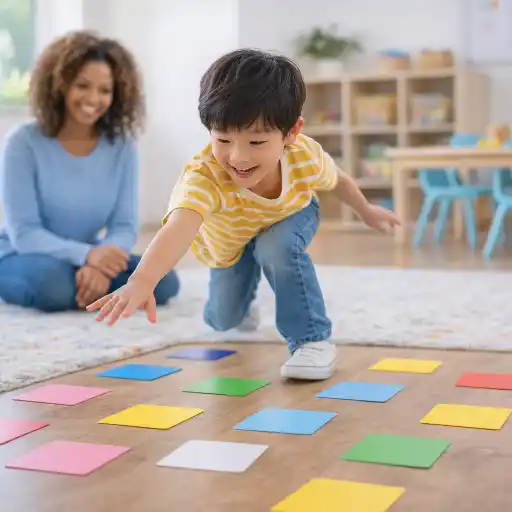
- Word hopscotch: Write target words in floor squares. Call a word, and invite a child to hop to it, read it, and use it in a phrase.
- Word path: Place cards along a pathway. Children walk, crawl, or tiptoe from card to card, reading each word before moving forward.
- Beanbag match: Spread cards on the floor. Name a word and have children toss a soft beanbag onto the matching card, then read it aloud.
- Musical words: Place cards around the room. When the music stops, children find the nearest card and read it with a partner.
- Flashlight hunt: Post cards around a dimmed room or learning area. Children shine a flashlight on one card, read it, and record or illustrate it.
- 🕺 Simon Says literacy: Give directions such as “Simon says find the and clap three times.” Children must listen, locate, and respond.
Adapt each game for safety and inclusion. Offer walking instead of running, allow children to point or use AAC, and provide a partner or adult model when needed. Short rounds of one to three minutes often produce more successful practice than a lengthy competitive game.
How can sensory and hands-on play strengthen word learning?
Multisensory activities invite children to see, hear, touch, and produce words. These experiences should reinforce—not replace—explicit attention to sound, spelling, and meaning. A child might first examine a word card, say the word, build it with letters, and then read it in a sentence.
- Play-dough building: Children form letters with dough or press magnetic letters into a dough mat. Ask them to touch each part while saying the word.
- Sand or salt writing: Children trace a displayed word with a finger, then smooth the surface and try again from memory.
- Sensory-bin search: Hide word cards or letter tiles in rice, oats, or another developmentally appropriate filler. Children find, read, and sort the words.
- Magnetic mapping: Use chips or magnets to mark each sound or spelling unit before children blend and read the complete word.
- Word puzzles: Cut familiar words into large pieces. Children reconstruct the word, read it, and match it to a sentence or picture.
- Water writing: Children write target words with a wet paintbrush on a chalkboard or sidewalk and watch the words disappear.
Check allergies, choking risks, sensory preferences, and supervision needs before introducing materials. Some children may dislike messy textures or need tools such as paintbrushes, tongs, or gloves. Offer equivalent ways to participate so the literacy goal remains accessible.
How can games connect sight words to authentic reading?
Automatic recognition becomes more useful when children apply words in meaningful text. After a game, read a short shared text containing the target words. Invite children to find, highlight, act out, or illustrate the words. The connection between isolated practice and connected reading helps children understand why the words matter.
Try these extensions:
- Create a class sentence using two or three target words.
- Play “word detective” during a read-aloud and place a sticky note beside each discovery.
- Build a dramatic-play menu, sign, recipe, or map that includes familiar high-frequency words.
- Make a simple class book in which each child contributes a drawing and dictates or writes a sentence.
- Use bingo, memory, or Go Fish, requiring children to read the word before taking a turn.
- Send home a small word ring with one playful family activity rather than a large worksheet packet.
Context also supports vocabulary and comprehension. Ask questions such as, “What does they mean in this sentence?” or “Who is we referring to?” Children need to connect the printed word to a message, not merely pronounce it.
For additional support with language-rich classrooms and interactive literacy materials, explore Classroom Tools for Emergent Literacy  Buy Now $16.00. It can help providers plan print-rich experiences that extend beyond isolated word drills.
How can educators differentiate, observe, and avoid common mistakes?
Playful instruction is strongest when teachers use observation to adjust the challenge. Track which words children recognize independently, which they read with a prompt, and which remain unfamiliar. Note whether errors involve sound confusion, visual confusion, lack of meaning, or difficulty sustaining attention.
- For beginners: Use two or three words, large print, picture cues, and an adult model.
- For developing readers: Add sound mapping, short phrases, and partner games.
- For advanced readers: Use sentences, word sorting, dictation, and brief connected texts.
- For multilingual learners: Pair words with gestures, objects, home-language connections, and repeated oral conversation.
- For children needing additional support: Reduce visual clutter, provide predictable routines, and offer alternative response methods.
Common mistakes include teaching too many words, using games as speed tests, correcting publicly, and treating decodable words as arbitrary memorization tasks. Another pitfall is allowing competition to overshadow learning. Cooperative boards, partner goals, and praise for careful listening or persistence can create a more supportive climate.
Document brief observations rather than ranking children. A note such as “read the independently in a sentence but needed a prompt for said” gives you a useful next step. Assessment of Language and Literacy Skills Buy Now $24.00 offers additional professional learning on observation, documentation, and individualized literacy goals.
Conclusion: How can sight words become joyful daily practice?
Teach sight words through a balanced routine: introduce a small set explicitly, connect letters and sounds, practice through movement and sensory play, and return to the words in authentic books and classroom messages. Games such as hopscotch, scavenger hunts, bingo, musical words, play-dough building, and flashlight searches create repeated opportunities without making practice feel like a drill.
The most effective activities are brief, inclusive, and purposeful. They allow children to move, talk, make choices, try again, and connect print with meaning. When educators observe carefully and adjust the challenge, playful literacy becomes both joyful and instructionally sound. For help translating these ideas into developmentally appropriate plans, consider Lesson Planning for Preschoolers Buy Now $24.00 to strengthen your classroom planning and implementation.
- Hidden in Plain Sight: Depression in Young Children
- Setting the Stage: Story Time
- Pediatric RSV First Aid & CPR/AED
- The Best Promotion is Play
- Emergent Learning & Development
- Creating Engaging and Meaningful Learning Experiences
- Texas Director Credential
- Wellness in Action: Teaching Healthy Habits to Children
- Actividades de Motricidad Gruesa que Desarrollan el Equilibrio, la Coordinación y la Fuerza
- How can child care programs boost physical activity for young children?
- Celebrando la amistad en el cuidado infantil durante el Día de los Mejores Amigos
- Canciones, juegos y preguntas de círculo para niños
- Indoor and Outdoor Activities for School-Age Children
- How can I build gross motor skills indoors and outdoors for the children in my program?
- Get Moving: How Can Child Care Programs Build Physical Activity Into the Daily Routine?
- Preschool Schedule That Works: When to Plan Centers, Circle Time, and Outdoor Play
- How Can Child Care Providers Support Gross Motor Development in Every Child?
- How Can Child Care Providers Support Memory Development in Young Children?
- How Can Bingo Games Support Turn-Taking and Social Skills?
- How Can Child Care Providers Teach Sharing Without Forcing It?
- How Can Child Care Providers Teach Emotional Regulation to Toddlers and Preschoolers?
- How Can You Teach Sight Words Through Games, Movement, and Play?
- How Can Kindergarten Teachers Strengthen Sight Word Recognition with Low-Prep Activities?
- How Can Farm-Animal Games Build Listening and Vocabulary?
- How Can Cooperative Sight-Word Games Help Early Readers Learn Together?
- How Can Dinosaur-Themed Group Games Build Vocabulary and Turn-Taking?
- How Can Child Care Providers Keep Indoor Play Manageable When Rain Lasts All Week?
