When sight-word practice feels like a drill, young readers can lose interest before the learning takes hold. Cooperative games turn repeated reading into shared, low-pressure practice—and Classroom Tools for Emergent Literacy  Buy Now $16.00 can help you extend that practice with literacy-rich classroom strategies; explore the course to build practical knowledge you can use during read-alouds, centers, and everyday routines.
Why use cooperative sight-word games with early readers?
Early readers need frequent, meaningful encounters with printed words. A cooperative game creates a reason to look closely, listen, say a word, and return to it again—without making every response feel like a test. Children also experience literacy as something they do together: they can help a partner find a match, celebrate a peer’s discovery, and keep trying when a word is unfamiliar.
It helps to distinguish sight words from high-frequency words. A sight word is one a reader recognizes automatically; high-frequency words appear often in print. Many high-frequency words follow spelling patterns children can decode, while others include an unexpected spelling feature. Rather than teaching all words as shapes to memorize, guide children to connect the word’s letters, sounds, pronunciation, and meaning. ChildCareEd’s discussion of sight-word games, movement, and play also emphasizes purposeful repetition linked to explicit teaching.
Cooperation matters as much as the game mechanic. When the group works toward a shared goal, children get practice with #listening, patience, turn-taking, and encouragement. These social experiences can make literacy practice more welcoming for hesitant readers and help educators notice what support each child needs.
How should educators prepare children and materials?
Start with a small set of words that children have encountered in books, shared writing, labels, or phonics instruction. Three to five targets are often enough for a short game. Introduce the words before play: say each one naturally, explain its meaning in a simple sentence, and draw attention to regular spelling patterns or any unexpected part that children may need to remember.
For a ready-to-use option, Bingo Cards - Sight Words 2 Buy Now $1.99 offers a cut, color, paste, and play activity. Children make their own bingo grids from picture cards, then listen as the educator calls each name. The printable is designed for circle time, centers, small groups, or a rainy-day activity, and combines word practice with listening and fine-motor work.
- Show a sample board and model how to listen, find a match, mark it, and wait.
- Use clear, large print and enough space between items.
- Check that pieces are age-appropriate and supervise cutting and small materials.
- Offer choices such as pointing, placing a marker, or responding with an assistive communication method.
- 📚 Keep the goal visible: careful word reading and shared participation matter more than speed.
Where a word’s printed form is the focus, say the word aloud and display the spelling clearly alongside the picture or cue. Pictures can support meaning and engagement, but they should not replace attention to the word itself. Keep the activity short enough that children finish with energy for one more round.
What cooperative bingo routines build both literacy and community?
Cooperative bingo can be arranged so children pursue a class goal rather than competing to finish first. Place a large shared board on the floor or table and invite children to take turns locating the word the caller names. The group might aim to complete one row together, or find every target word before the end of a short timer. Each child can contribute in a way that works for them.
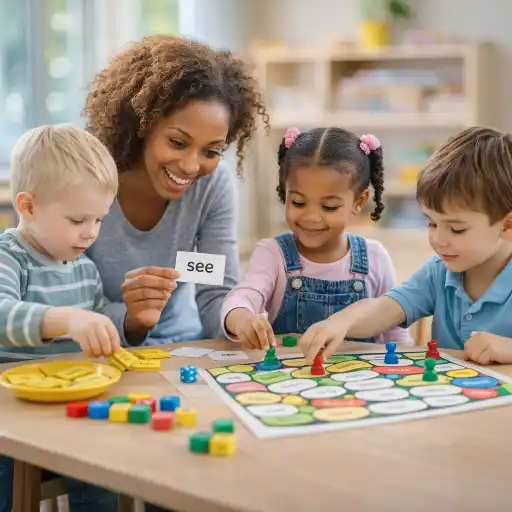
Partners can also share roles. One child listens for the spoken word and finds it on the board; the other checks the match and places the marker. Switch roles regularly so each child has opportunities to respond and support a peer. Use predictable language such as, “Let’s listen, find the word, read it together, and help our partner.”
- Invite the group to read a matched word together, then use it in a short phrase.
- Pause for a partner prompt: “Which letters helped you find it?”
- Celebrate strategies—looking carefully, asking for help, or encouraging a friend—not only completed rows.
- Use a turn token or visual sequence if children benefit from seeing whose turn comes next.
This structure supports #cooperation while keeping the reading objective clear. Children can practice being a caller, checker, marker, or encourager, and educators can coach friendly language in the moment. A shared win helps shift attention away from who finishes first and toward the group’s growing word knowledge.
How can teachers make practice inclusive and developmentally responsive?
Children enter literacy activities with different language backgrounds, reading experiences, attention spans, motor skills, and communication preferences. The same bingo routine will not be equally accessible to everyone without thoughtful adjustments. Begin by observing what helps each child participate: a smaller board, repeated directions, additional wait time, a visual cue, a peer model, or a quieter setting may make a substantial difference.
For children just beginning, use two or three familiar words and offer an adult model or a choice between two cards. Children who are ready for more can read the word in a sentence, explain a spelling feature, or take a turn as caller. Multilingual learners may benefit from a discussion of a word’s meaning, gestures, objects, and family or home-language connections. Accept pointing, eye gaze, signing, or AAC as valid ways to respond.
- Reduce the number of squares or cards when visual scanning feels difficult.
- Use high-contrast print and avoid making color the only way to distinguish items.
- Provide large, easy-to-grasp markers or an alternative marking method.
- Build in movement breaks and keep rounds brief.
Do not interpret a child’s hesitation as lack of interest or ability. It may signal that the pace, group size, or response demand needs adjustment. Cooperative formats can lower performance pressure, but children should never be forced to speak or demonstrate a skill publicly. State requirements vary - check your state licensing agency when aligning activities or professional development with local expectations.
How can educators connect the game to meaningful reading?
Recognition during a game is a useful opportunity, not the endpoint. After bingo, revisit the target words in a shared book, a morning message, labels, or a simple class-made sentence. Ask children to locate a word they saw on the board and consider what it means in that particular context. These connections help children understand that words carry messages, not just game pieces to cover.
Keep the follow-up conversational and encouraging. If a child finds a word in a book, invite them to point to its letters, say it, and read the whole sentence with support. Ask open prompts such as, “What helped you recognize that word?” or “Who does we refer to here?” Avoid turning every discovery into a quiz; sharing a word in context should feel like a natural extension of the game.
- Make a class sentence using two or three target words and read it aloud together.
- Use a “word detective” sticky note during a read-aloud to mark a familiar word.
- Set up a dramatic-play sign, menu, or map that includes familiar words.
- Send home a small selection of words with one simple game families can try together.
These steps support transfer from isolated practice to connected text and everyday print. For a broader foundation in language- and print-rich practice, explore Science of Reading Foundations in the Pre-K Classroom Buy Now $16.00, Reading Aloud and Storytelling Buy Now $16.00, and Language and Literacy Foundations in Pre-K Buy Now $16.00.
What common pitfalls should providers avoid, and what should they observe?
Games work best when adults protect the literacy purpose and the emotional climate at the same time. Avoid teaching a long list of words in one sitting, rushing through calls, or treating speed as the main sign of learning. Publicly correcting each mistake or making the winner the only focus can discourage children who need more time. Instead, offer a prompt: “Let’s look at the letters together,” then provide another chance to find and read the word.
Use the game as an informal window into learning, not a high-pressure test. Notice whether a child recognizes a target word independently, benefits from hearing it again, uses a clue, or asks a peer for help. Make a brief, objective note—for example, “matched and read two target words independently; needed a model for one”—and use it to plan the next experience. For deeper professional learning about objective observation and individualized goals, see Assessment of Language and Literacy Skills Buy Now $24.00.
- Did the child attend to the spoken cue and locate the correct word?
- Could the child read the word alone, with a prompt, or with a peer?
- Did the child connect the word to a phrase, sentence, or meaning?
- What supports helped the child remain engaged and recover from an error?
Use observations to adjust the next round: revisit a tricky word, simplify the board, or offer a more challenging sentence. Small changes, made responsively, keep practice both purposeful and joyful.
Conclusion: How can cooperative sight-word games support early readers?
Cooperative sight-word games can make repeated word practice engaging, supportive, and socially meaningful. Choose a few useful words, connect print with sounds and meaning, teach the game routine explicitly, and adapt materials so each child can contribute. Bingo offers an especially flexible format: children listen, locate, read, take turns, and work toward a shared outcome.
Most of all, keep the focus on growth rather than speed or winning. Extend words from the board into stories and classroom print, observe the strategies children use, and let those observations guide your next steps. With playful repetition and responsive support, early readers can build confidence and learn that reading is something a community can enjoy together.
- Hidden in Plain Sight: Depression in Young Children
- TEAM: Together Everyone Achieves More
- Setting the Stage: Story Time
- Pediatric RSV First Aid & CPR/AED
- Emergent Learning & Development
- Early Childhood Education
- 45-Hour Infant and Toddler Curriculum
- Texas Director Credential
- Classroom Tools for Emergent Literacy
- Classroom Tools for Emergent Literacy
- CDA Certification en Español: Recursos y Consejos para Educadores Bilingües
- Retraso del Habla en la Guardería: Cómo Pueden Ayudar los Proveedores
- Cómo Trabajar en el Cuidado Infantil en Carolina del Norte: Requisitos y Pasos
- Celebrando la amistad en el cuidado infantil durante el Día de los Mejores Amigos
- Canciones, juegos y preguntas de círculo para niños
- How can we use team activities to help preschoolers learn and cooperate?
- Cómo simplificar la capacitación para sus empleados de daycare
- How can we host a Daycare Mini Olympics that builds movement and teamwork?
- Can Screen-Free Board and Movement Games Help Young Children Learn and Stay Calm?
- How Can Child Care Programs Best Prepare Little Ones for the Kindergarten Transition?
- After School Activities for Elementary Kids Who Finish Homework Early
- How Can Bingo Games Support Turn-Taking and Social Skills?
- How Can You Teach Sight Words Through Games, Movement, and Play?
- How Can Kindergarten Teachers Strengthen Sight Word Recognition with Low-Prep Activities?
- How Can Repetitive Early Readers Help Children Learn Color Words?
- How Can Holiday Word Games Strengthen Visual Scanning and Spelling?
- How Can Reading Games Build Wildlife Vocabulary in Early Childhood?
- How Can You Differentiate Sight-Word Bingo for Mixed-Ability Groups?
- How Can Cooperative Sight-Word Games Help Early Readers Learn Together?
- How Can Dinosaur-Themed Group Games Build Vocabulary and Turn-Taking?
