When a child calls out, grabs a marker, or becomes upset while waiting, a predictable game can turn a difficult moment into meaningful practice. Bingo offers repeated, low-pressure opportunities to listen, wait, communicate, celebrate peers, and manage disappointment; for deeper guidance strategies, explore Supporting Social Learning: Creating Classrooms that Care  Buy Now $24.00 to strengthen relationship-based classroom practices and earn professional development training.
Bingo is familiar, flexible, and easy to adapt. Although it is often associated with academic review, its greatest social value comes from the interaction surrounding the cards: children attend to a shared routine, respond to cues, wait for outcomes, and practice being part of a group. Used intentionally, bingo can support #turn-taking without turning social development into a lecture or a compliance exercise.
Play-based learning is especially powerful because children repeat skills in meaningful contexts. Research summarized in the evidence on play and social-emotional development connects play with cooperation, negotiation, self-control, problem-solving, and emotional growth. Bingo is one small tool within that broader curriculum.
Why does bingo matter for young children’s social development?
Turn-taking requires several abilities at once: noticing another person’s action, inhibiting an impulse, remembering the rules, waiting, and rejoining the activity. Preschoolers are still developing these capacities, so grabbing or calling out is often a sign that the child needs more structure and practice—not a sign of defiance.
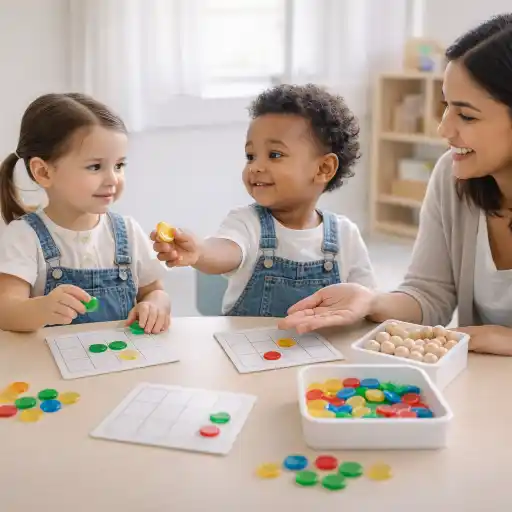
Bingo creates a clear beginning, middle, and end. Everyone can participate simultaneously, which reduces long waits and gives children an immediate reason to listen. A child may search for a picture, place a marker, watch a peer, and then wait for the next call. These small cycles provide authentic rehearsal for conversation, group work, and shared materials.
The game also creates opportunities to practice emotional responses. Children may feel excited when they are close to winning or disappointed when another player finishes first. With calm adult coaching, these experiences become manageable practice in self-regulation and perspective-taking.
- Listening for a cue supports attention and receptive language.
- Waiting for the next call supports impulse control.
- Watching peers supports social awareness.
- Winning and losing supports emotional flexibility.
- Responding to others supports belonging and connection.
How should providers design bingo for successful participation?
Begin with the social goal rather than the decoration. Decide whether children are practicing waiting, asking for help, congratulating a peer, or sharing materials. Then design the game so that the goal is achievable. A smaller three-by-three board, fewer players, and brief rounds are often more appropriate for beginners than a large, crowded card.
Use clear images, generous spacing, and markers that are easy to grasp. Picture-based boards allow children to participate even when they are not yet reading. Avoid relying on color alone; pair colors with pictures, labels, textures, or shapes when possible. Inclusive game design reflects the recommendations of NAEYC’s inclusion resources, which emphasize adapting environments and materials to children’s diverse strengths and needs.
- Choose a consistent phrase: “My turn to call; your turn to find.”
- Use a visual turn card, soft object, or name card to show who leads.
- Provide large counters, adapted holders, or alternative marking methods.
- Offer extra processing time before moving to the next clue.
- Use a quiet version in which clues are displayed rather than announced.
- Prepare a cooperative class board for children who are not ready for competition.
These adaptations preserve the learning goal while changing the way children access it. State requirements vary - check your state licensing agency before counting any related training toward required hours.
Which bingo routines directly teach turn-taking?
Traditional bingo can support waiting, but providers can make the social learning more explicit through carefully chosen routines. Model the entire sequence before beginning: listen, find, mark, check, and wait. Use the same language each round so children can anticipate what happens next.
In a teacher-led game, the educator calls each clue while children mark their own cards. This parallel format is a gentle entry point for children who find direct peer interaction overwhelming. Once the routine is familiar, invite children to take leadership roles.
- Child caller: A child chooses or reads a picture card while peers search.
- Partner bingo: One child calls and the other locates the image; then partners switch.
- Turn-token bingo: The child holding a token gets to select the next card.
- Pass-and-mark: Children share one container of markers and pass it after each turn.
- Cooperative bingo: The group completes one large card together.
For children who struggle with waiting, keep the interval short and visible. Say, “You are waiting. First Maya finds her picture, then you choose a marker.” A timer may help when a child must share a caller role, but it should support—not replace—adult coaching.
The practical turn-taking activities described in this guide to turn-taking games reinforce the value of modeling, visual cues, social stories, and repeated opportunities. Bingo works best when these supports are integrated into the routine.
How can bingo build communication, empathy, and cooperation?
Social skills are more than waiting quietly. Children also need language for joining, requesting, encouraging, repairing, and responding. Bingo provides natural moments to teach short scripts without requiring children to perform in an artificial conversation.
Before play, introduce phrases such as “Can you help me?”, “I found it,” “Your turn,” “Good job,” and “I need a break.” Model gestures and picture symbols alongside spoken language. For dual language learners, include home-language labels and invite families to contribute vocabulary. Peer interaction can be a meaningful context for language development, as summarized in the systematic review of preschool peer interactions and language growth.
- Invite children to compliment a peer who finds a difficult picture.
- Ask, “How do you think your friend feels when they get bingo?”
- Practice a calm response when someone else wins: “Good game. I can try again.”
- Use partner boards so children solve visual searches together.
- Celebrate cooperation, not only speed or completion.
For a social-skills version, replace academic images with actions such as helping, inviting someone to play, using kind words, or waiting. However, frame each square as an opportunity rather than a behavior grade. The goal is to notice and encourage authentic connection, not pressure children to demonstrate affection or eye contact.
Cooperative games can be particularly helpful for children who become dysregulated by competition. Shared success gives children a common emotional experience and creates opportunities to name excitement, worry, disappointment, and relief while the educator models regulation.
How can providers adapt bingo for diverse learners and challenging moments?
Responsive facilitation matters more than having perfect materials. Observe what makes participation difficult: Is the board visually crowded? Is the calling pace too fast? Does the child need a movement break, a partner, or a different response method? Adjust one element at a time and preserve the child’s dignity.
Children may participate by pointing, touching, using eye gaze, selecting a symbol, signing, or communicating through an assistive device. A child who does not want to call “Bingo” can raise a card or signal an adult. These choices maintain the social purpose without making speech the measure of participation.
- Start with a three-by-three board and gradually increase complexity.
- Use high-contrast pictures, tactile markers, or enlarged cards.
- Offer a seated, standing, or movement-based version.
- Provide a predictable “almost finished” and “game over” signal.
- Pair children thoughtfully rather than assigning a peer helper without preparation.
- Pause when regulation is slipping; a shorter round is a successful round.
Common mistakes include making the game too long, correcting every social error publicly, forcing children to share materials immediately, or treating winning as the only outcome. Instead, use brief coaching: “You wanted the marker. Ask, ‘May I have one when you’re finished?’” Then provide a supported opportunity to try again.
For additional support with inclusive play and communication, Play with Purpose: Supporting Children with Autism Buy Now $55.00$40.00 explores play-based approaches that promote interaction, communication, choice, and sensory regulation.
How can bingo become an intentional observation tool?
Bingo should not become a high-pressure assessment, but it can provide useful observations. During play, record what children do naturally and use those observations to plan the next experience. A simple checklist can help directors and teaching teams discuss progress consistently.
- Does the child attend to the shared cue?
- Can the child wait briefly with visual or verbal support?
- Does the child locate and mark a matching image?
- Can the child request help or communicate completion?
- Does the child respond to a peer’s success?
- Can the child recover after disappointment?
Look for patterns rather than isolated incidents. A child may wait successfully with a three-by-three board but need support when the group is larger. Another child may understand the rules but require a communication card to request a turn. These observations help educators individualize instruction and share concrete information with families.
After each round, ask one reflective question: “What helped us wait?” “How did we know whose turn it was?” or “What could we do if a friend feels disappointed?” Keep the conversation brief and concrete. You can extend the learning through block building, partner art, dramatic play, or a conversation circle.
For professional learning on responsive social environments, consider Social Foundations and Responsive Classrooms Buy Now $24.00. The course addresses self-regulation, prosocial behavior, conflict resolution, and age-appropriate problem-solving—skills that help educators move from isolated games to a consistent classroom culture.
Conclusion: How can bingo games support turn-taking and social skills?
Bingo supports turn-taking and social skills when educators use it as a structured, inclusive opportunity for practice rather than as a test of compliance. Its predictable sequence helps children listen, wait, communicate, manage emotions, and participate with peers. Small boards, short rounds, visual cues, cooperative formats, and specific language make the experience accessible to more children.
The most important learning often happens between calls: a child waits for a marker, asks for help, congratulates a peer, or tries again after disappointment. Notice those moments and name them warmly. With repetition and thoughtful adaptation, bingo can become a practical bridge from supported play to increasingly independent social participation.
Frequently asked questions
Is bingo developmentally appropriate for preschoolers?
Yes, when the board, pace, language, and group size are matched to the children. Begin with simple pictures, short rounds, and adult modeling.
Does bingo teach turn-taking if everyone plays at the same time?
Yes. Children still practice waiting for cues, following a shared sequence, responding after others, and managing the outcome. Leadership and partner variations add more direct exchanges.
What if a child becomes upset when another child wins?
Acknowledge the feeling, keep the round brief, and model a response such as “You wanted to win. It is okay to feel disappointed. We can try again or take a break.” Cooperative bingo may be a better starting point.
How can I include children who do not speak or read?
Use picture cards, gestures, signs, eye gaze, pointing, communication devices, and alternative ways to signal completion. Reading and speech should not be prerequisites for belonging.
How often should we play?
Short, predictable practice once or twice a week can be effective, especially when the same social language is used across routines. Extend the skills into snack, centers, outdoor play, and conversations.
Which ChildCareEd course is the best next step?
Supporting Social Learning: Creating Classrooms that Care Buy Now $24.00 is a strong fit for relationship-based social learning, while Social Foundations and Responsive Classrooms Buy Now $24.00 connects directly to guidance, self-regulation, and problem-solving.
Related courses for child care providers:
- The Best Promotion is Play Buy Now $24.00—explores play’s role in cooperation, creativity, and development.
- From Tantrums to Triumphs: Equipping Preschoolers with Self-Regulation Skills Buy Now $25.00—offers strategies for supporting emotional regulation and confidence.
- Effective Approaches for Autism and Inclusion Buy Now $55.00—focuses on adapting materials, communication, and environments for diverse learners.
Related resources for child care providers:
- Turning Behavior Around for Toddlers and Preschoolers
- Moving About the Classroom: Effective Transitions for Everyday
- CDA Home Visitor Subject Area 3 Part 3 Birth to 5
- CDA Home Visitor Subject Area 2 Part 3 Birth to 5
- The ABCs of Behavior: Turning Challenges into Learning Opportunities
- Birth to Five CDA Credential with Portfolio Review
- 24 Hour Texas Pre-Service
- 45-Hour Infant and Toddler Curriculum
- Brighter Futures: Social Emotional Development
- CDA: Stand With Respect and Professionalism
- CDA Certification en Español: Recursos y Consejos para Educadores Bilingües
- 🔍 ¿Qué ves cuando observas a un niño aprender?
- 💛🧩 ¿Cómo puedo hacer que mi enseñanza sea inclusiva para los niños con autismo?
- How can rainy day indoor activities help preschoolers learn kindness and cooperation in Georgia?
- Celebrando la amistad en el cuidado infantil durante el Día de los Mejores Amigos
- Canciones, juegos y preguntas de círculo para niños
- How Can Fun Bingo Games Teach Colors, Shapes, and Animals to Preschoolers?
- How Can Bingo Games Support Turn-Taking and Social Skills?
- How Can Bingo Games Make Learning Feel Like Play?
- What Skills Can Preschoolers Build Through Bingo?
- How Can Child Care Providers Teach Young Children to Take Turns?
- How Can Child Care Providers Support Children Who Always Want to Be First?
- How Can Farm-Animal Games Build Listening and Vocabulary?
- How Can Cooperative Sight-Word Games Help Early Readers Learn Together?
- How Can Animal-Themed Bingo Build Descriptive Language in Preschoolers?
- How Can Listening and Movement Games Build Children’s Shape Recognition?
- How Can Dinosaur-Themed Group Games Build Vocabulary and Turn-Taking?
- How Can You Make a Group Listening Game Accessible to a Child with Hearing Loss?
- How Can Preschool Bingo Build Shape Reasoning Beyond Naming?
- How Can Preschool Bingo Build Reasoning Beyond Naming Shapes?
