When a child moves from naming “lion” to explaining that it has a mane and powerful paws, language is growing through meaningful play. Animal bingo gives providers a simple way to invite children to listen, describe, compare, and share ideas; the Assessment of Language and Literacy Skills  Buy Now $24.00 course can help you observe those skills objectively and turn what you notice into responsive learning goals. Explore the training for a deeper foundation in language-and-literacy assessment, then use the practical strategies below to make each round count.
Why is descriptive language a valuable goal for animal bingo?
Descriptive language helps children express what they notice, organize ideas, and communicate meaning beyond a single label. In an animal-themed bingo game, a child can move from “bear” to “The bear has thick fur,” or from “snake” to “It slithers on the ground.” These statements draw on vocabulary, observation, and sentence-building in a context children often find naturally engaging.
Providers can think of language growth as a progression, not a performance test. Children may first point or match an image, then name it, add an attribute, and eventually explain a relationship. Recognizing and responding to each step helps maintain confidence while offering an appropriate next challenge. Head Start describes language as both receptive—understanding what is heard—and expressive—using language to communicate; bingo can create opportunities for both.
The value lies in the interaction around the cards, not in finishing first. A warm, conversational game lets children hear target words repeatedly, connect them to clear images, and try out ideas with peers. These exchanges build #vocabulary while giving educators a window into children’s emerging communication strengths.
Make the goal specific. For example, focus on using one descriptive word, identifying a body covering, or responding to a clue with a phrase. Keeping one primary target in view makes it easier to plan prompts and notice growth.
How can providers prepare cards and prompts for rich talk?
Choose a small set of recognizable land animals and images with clear visual details. The Bingo Cards - Land Animals Edition resource can provide a ready-to-use starting point; the educator’s prompts turn picture matching into conversation. Before playing, preview a few animals through a picture book, toy figures, or photographs so children have meaningful experiences to draw on.
Decide what descriptive language you hope to hear. Possible word groups include body features (fur, feathers, shell), size (tiny, enormous), movement (crawl, gallop, hop), and sound (growl, chirp). Introduce only a few new terms at a time, and model them naturally rather than asking children to memorize a long list.
- Use one clear clue per turn: “Find an animal with a shell.”
- Show the picture or gesture when a spoken clue may need support.
- Allow children to point, sign, use AAC, choose between images, or speak.
- Offer a brief pause after each clue so children can process and respond.
- Use large images and uncluttered boards when that improves access.
Animal images can reflect many places, families, and experiences. Ask families for familiar animal names or words in home languages, and include those words respectfully. Language and literacy can develop in a child’s home language; supporting it strengthens belonging and makes room for children’s full linguistic knowledge.
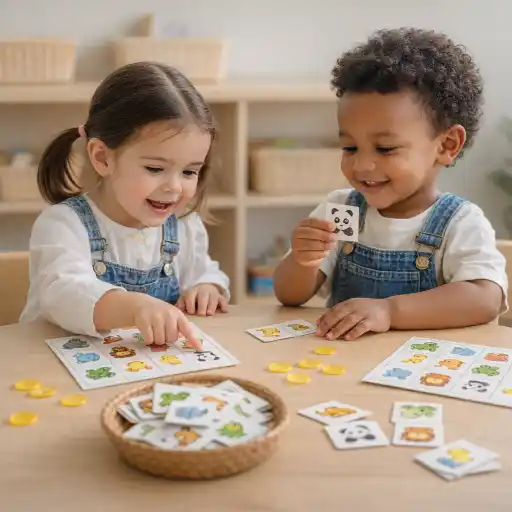
What prompts help children move from naming to describing?
Use an intentional sequence of prompts that invites increasingly detailed responses while keeping the game light. Start with recognition: “Can you find the horse?” Then invite naming: “What animal did you find?” Follow with description: “What do you notice about its body?” A further prompt can ask for reasoning: “What clue helped you decide?” Providers can expand children’s words without correcting them harshly. If a child says, “Big dog,” respond, “Yes, the wolf is large and has thick fur.”
Open questions support thinking, but avoid stacking several questions together. Ask one, wait, and listen. Some children need longer processing time, and a quiet pause is an invitation rather than a gap to fill. When children answer with a gesture or a single word, acknowledge the contribution and model a slightly fuller phrase.
- “Which animal has spots? What do the spots look like?”
- “How does this animal move—does it walk, hop, or crawl?”
- “Which two animals have something in common?”
- “Can you describe the animal without saying its name?”
How can the game stay inclusive and enjoyable?
Participation should not depend on speaking aloud, quick processing, fine-motor precision, or comfort with competition. Keep the learning objective—understanding and expressing descriptive language—while offering different ways to take part. A child may point to a picture, place a marker with help, use a sign, select a symbol on AAC, or share an answer with a trusted partner.
Consider playing cooperatively: the group works together to complete a shared pattern. This reduces pressure around winning and makes more room for peer conversation. Keep rounds brief, explain and model the routine, and offer a smaller board or fewer choices when a busy display is distracting. Use markers that are safe for the age group and supervise materials closely.
- 🦊 Invite children to act out an animal’s movement as another way to communicate a clue.
- Pair spoken words with gestures, photos, objects, or home-language vocabulary.
- Celebrate careful noticing, persistence, listening, and helping peers—not only correct answers.
- Offer a quiet or small-group option when the full group feels overwhelming.
Respond to unexpected answers with curiosity. If a child identifies a different animal than you intended, ask what features they noticed and look closely together. This protects children’s confidence and turns uncertainty into shared inquiry. Avoid claims that every animal has only one habitat or that a single clue always produces a single reasonable answer.
For additional background on responsive language experiences, review Head Start’s language and literacy guidance. State requirements vary - check your state licensing agency when determining whether professional development applies to a specific requirement.
How can educators observe language growth without turning bingo into a test?
Use the game as one informal observation opportunity among many, not as a stand-alone assessment or a way to rank children. Focus on what each child does in context: whether they attend to a clue, match an image, name an animal, use a descriptive word, communicate through an alternative mode, or respond to a peer. A brief note can be more useful than a score.
Write observations in objective language. For example: “During animal bingo, Jo matched four land-animal pictures and described the horse as ‘fast’; after a model, Jo used ‘mane’ to identify a feature.” This note records what happened without assigning a broad label such as “good at language.” Across multiple play and routine contexts, these observations can help providers choose sensible next steps.
- Record the prompt or context as well as the child’s response.
- Notice whether the child responds independently, after a model, or with a visual choice.
- Look for patterns over time rather than conclusions from one session.
- Use what you observe to adjust vocabulary, materials, group size, or support.
Extend learning after the game. Invite children to sort animals by a feature, dictate a class animal book, create a habitat with blocks, or retell a story using animal figures. This gives children fresh reasons to reuse the descriptive words introduced during bingo. For focused professional learning, the Assessment of Language and Literacy Skills Buy Now $24.00 course explores objective observations and using assessment information to develop meaningful learning goals.
How can providers extend the learning beyond the bingo board?
Use the bingo round as a launch point for a short sequence of connected experiences. Before play, introduce a few animal words through books or real-world photos. During play, encourage noticing and conversation. Afterward, revisit the same vocabulary in another context so children can hear and use it in a fresh way. This repeated, meaningful exposure helps words become part of children’s usable language.
For example, after children describe a deer as having antlers, offer drawing materials and invite them to dictate a caption. During block play, they might build a forest and explain where an animal could find shelter. A movement game can invite children to compare how animals travel—walk, scamper, or leap—while connecting descriptive words to action.
- Read an animal story and pause to notice new descriptive words.
- Make a picture sort based on coverings, body features, or movement.
- Invite children to create clues for a peer to guess an animal.
- Ask families to share an animal word, story, or experience from home.
Keep extensions responsive to children’s interest. If the group becomes fascinated by paws, compare animal feet in pictures and ask what children notice. If children want to imitate a bird or rabbit, use movement as a bridge back to words such as flutter, hop, and perch. The goal is not to stretch one game endlessly, but to connect play, conversation, and observation in purposeful ways.
Conclusion: How does animal bingo build descriptive language?
Animal-themed bingo can support descriptive language when providers go beyond calling animal names. Clear images, focused vocabulary, thoughtful clues, open-ended prompts, wait time, and flexible ways to respond give children repeated opportunities to listen and communicate. The game is most useful when it is inclusive, low-pressure, and connected to children’s interests and experiences.
Remember the practical sequence: choose a language target, model a few words, invite children to notice and describe, observe what they communicate, and extend the learning through stories, sorting, movement, or dramatic play. A child’s gesture, home-language word, short phrase, or detailed explanation can all offer valuable evidence of growing communication. The aim is not a perfect round of bingo; it is a welcoming space where every child can share what they notice and build confidence using language.
- CDA Home Visitor Subject Area 3 Part 3 Birth to 5
- CDA Home Visitor Subject Area 2 Part 3 Birth to 5
- Birth to Five CDA Credential with Portfolio Review
- Children at the Wheel: Emergent Curriculum
- Art from the Heart for Preschoolers: Open Ended Art Projects that Build Self-Esteem
- The Best Promotion is Play
- Play, Learn, Grow
- CDA: Stand With Respect and Professionalism
- Every Moment Matters: Schedules and Transitions
- Bridging Cultures: Family Communication & Collaboration
- 👶 ¿Cuáles son las proporciones y grupos requeridos en Dakota del Norte? 🏫
- Recursos en Español sobre el Sueño Seguro del Bebé
- Apoyo en Español para Capacitaciones Grupales Presenciales y por Zoom en Cursos Selectos
- 10 Ejemplos de Cómo la Cultura Influye en el Desarrollo Infantil
- Proporciones de Cuidado Infantil y Tamaños de Grupo por Edad en Maryland (Guía Rápida para Centros y Hogares)
- Actividades de Otoño Fáciles para Preescolares esta Temporada
- Apoyo en Preescolar para Retrasos del Habla: Estrategias Simples que Ayudan
- Retraso del Habla en la Guardería: Cómo Pueden Ayudar los Proveedores
- Calabazas, hojas y manzanas: actividades de otoño para preescolares
- Celebrando la amistad en el cuidado infantil durante el Día de los Mejores Amigos
- Canciones, juegos y preguntas de círculo para niños
- What No-Prep Activities Can Busy Early Childhood Teachers Use Tomorrow?
- How Can Fun Bingo Games Teach Colors, Shapes, and Animals to Preschoolers?
- How Can Sound Bingo Sharpen Listening Skills in Preschoolers?
- Why Is Animal Bingo a Great Way to Introduce Habitats and Classification?
- How Can Bingo Games Make Learning Feel Like Play?
- What Skills Can Preschoolers Build Through Bingo?
- How Can Farm-Animal Games Build Listening and Vocabulary?
- How Can Interactive Group Play Build Ocean Vocabulary in Preschool?
- How Can Animal-Themed Bingo Build Descriptive Language in Preschoolers?
