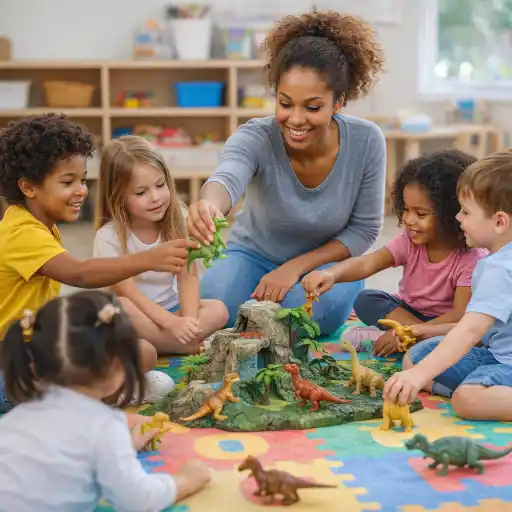
When children are excited to roar about dinosaurs, a simple group game can turn that enthusiasm into rich language practice and kinder peer interactions. Try Role of Play in Learning  Buy Now $16.00 to deepen your understanding of how play supports development; this focused course offers practical context for planning playful learning, and the game ideas below show how to put those principles to work.
Why Do Dinosaur Group Games Matter for Learning?
Dinosaurs invite children into a shared world of fascinating names, shapes, habitats, and movement. A group game gives that interest a social purpose: children listen for words, connect language to pictures or actions, and communicate with peers. When a child hears “horns,” “fossil,” or “herbivore” in a meaningful game, the word is connected to an experience rather than presented as an isolated fact.
Games with simple rules also offer repeated, low-pressure opportunities to practice waiting, watching, and responding. These skills are still developing, so a child who calls out or reaches for a card may need coaching and another chance—not a reprimand. The educator’s calm modeling helps everyone understand that taking turns is a group routine they can learn together.
Well-planned play supports several areas at once: language, attention, memory, cooperation, and self-regulation. As described in ChildCareEd’s discussion of how children learn through play, games with rules can help children practice turn-taking, attention, and flexible thinking. The aim is not to make every moment feel like a lesson; it is to prepare a welcoming experience where learning can emerge naturally.
How Can You Prepare a Vocabulary-Rich Dinosaur Game?
Begin with a small set of clear, age-appropriate words and images. For younger preschoolers, choose familiar terms such as egg, tail, teeth, and footprints. Older children may enjoy adding names such as Triceratops or Brachiosaurus, along with concept words like fossil, carnivore, and herbivore. Picture cards or dinosaur vocabulary picture-word matching can help connect spoken words to visual meaning.
Before play begins, introduce each target word in a short conversation or a book. Say the word, point to the image, and invite children to describe what they notice. Keep the word bank manageable; too many unfamiliar labels can turn an engaging activity into a memory test. Vocabulary can be expanded gradually as children become comfortable.
- Choose sturdy cards or boards with uncluttered, recognizable pictures.
- Prepare enough pieces for children to see and handle comfortably.
- Teach the game’s sequence with a quick demonstration: listen, find, mark, then wait.
- Offer picture cues, gestures, or home-language equivalents where helpful.
Dinosaur theme planning ideas can connect a game with dramatic play, movement, art, and books. That consistency gives children more chances to hear and use the same words across the day. In your #classroom, a small set of recurring vocabulary can become familiar language children confidently bring into conversation.
Which Group Games Encourage Talk and Turn-Taking?
Choose a game structure that fits the group’s age, attention, and communication needs. Bingo is a useful starting point: show or name an image, let children scan their boards, and give each child time to find a match. A dinosaur edition of Bingo Cards - Dinosaur edition can supply the visual framework; check the product page for current details. Keep the pace relaxed and celebrate careful listening, not only the first person to finish.
- Dino clue circle: Describe a dinosaur feature—“It has three horns”—and let children take turns guessing or selecting a matching picture.
- Pass the fossil: Pass a pretend fossil around the circle; the child holding it names, describes, or asks a question about a dinosaur image.
- Move-and-freeze: Draw a movement card, take turns demonstrating a stomp, stretch, or tiny-footstep walk, then pause and name the action.
- Picture sort relay: Work together to sort pictures by a visible feature, such as long necks, horns, or eggs, explaining choices as you go.
Build oral language into the rules with prompts such as “I found the…,” “I think it is…,” and “Can I have a turn next?” Encourage children to add a word, gesture, sign, or communication device response. Provide the adult support needed, then leave a pause so children can respond at their own pace. The value lies in shared participation, not speed.
How Can Educators Coach Turn-Taking Without Taking Over?
Children often understand the idea of a turn before they can consistently manage the waiting, impulse control, and emotional regulation that it requires. Make the sequence visible and predictable. A simple turn card, name strip, or object passed around the circle can show whose turn is next. Use brief language: “Maya is choosing. Then Jordan will choose.” Narrating the sequence is more helpful than repeatedly saying “Be patient.”
Model the behavior you want children to practice. Wait while a child searches, acknowledge a peer’s contribution, and show how to pass materials safely. If two children reach at once, calmly restate the order and offer each child a meaningful role—one can hold the picture while the other names it. Support does not mean removing the challenge; it means making participation possible.
Adapt the game so children with different communication, sensory, or motor needs can join in. Use larger cards, fewer choices, extra response time, visual directions, partner play, or a nonverbal way to indicate a match. Some children may prefer to watch before joining. That observation can be a comfortable first step toward participation.
- 🎲 Praise specific actions: “You waited, watched, and then found the picture.”
- Offer a short movement break if the group becomes restless.
- Keep competition optional; cooperative goals can help the group succeed together.
How Can You Extend Vocabulary Beyond the Game?
A game becomes more powerful when children encounter its words in different contexts. After Bingo, invite children to choose a card and make a movement, build a habitat with blocks, or add the pictured dinosaur to a small-world play scene. Ask open prompts such as “What do you notice?” and “What else might belong in this habitat?” These invitations encourage children to elaborate rather than repeat a single label.
Use a few target words again during read-alouds, pretend play, outdoor movement, and art. For instance, children can make “footprints” with toy dinosaur feet, describe the “fossils” they uncover in a supervised sensory activity, or compare a “long tail” and a “short tail.” Dinosaur activities across literacy, movement, and dramatic play help reinforce the connection between words and experiences, as shown in preschool dinosaur activity ideas.
Observe what children say and do. Do they recognize the word when they see the image? Do they use it spontaneously in play? Make a brief note of emerging vocabulary, questions, and preferred ways of participating. Use those observations to select the next few words or adapt the game. The goal is meaningful growth, not testing every child on every term.
What Common Pitfalls Should Providers Avoid?
Even a playful activity can become frustrating when the directions are too complicated, the vocabulary list is too long, or the pace leaves little time to think. Keep the first round brief and demonstrate each step. If children lose interest, simplify the rules, reduce the number of cards, or switch to a movement-based version. Shortening or adapting a game is responsive teaching, not a failure of planning.
Avoid turning every turn into a vocabulary quiz. Children may know a concept but need a gesture, a picture cue, or extra time to express it. Accept different forms of communication and model the word naturally: “You pointed to the fossil. Yes, that is a fossil.” Avoid making speed or winning the measure of success; focus instead on listening, trying, communicating, and participating with peers.
Also check that materials and group size suit the children. Small cards can be difficult to handle; crowded circles can make it hard to see; and long waits can challenge young learners. Keep supervision active and adjust the activity to the setting. If a game is used as part of a regulated program or training plan, state requirements vary - check your state licensing agency for applicable expectations.
Conclusion: How Can Dinosaur Games Support Both Words and Social Skills?
Dinosaur-themed group games can make vocabulary meaningful and turn-taking tangible. Choose a small set of useful words, model a predictable game routine, and create genuine opportunities for children to speak, gesture, listen, and wait. Bingo, clue games, movement turns, and picture sorts offer flexible ways to bring dinosaur enthusiasm into shared learning.
Remember that children develop these skills at different rates. Provide visual and communication supports, celebrate effort, and adapt the pace so everyone can participate. Then carry game words into books, dramatic play, art, and conversation. For providers who want to explore play as a foundation for child development more deeply, Role of Play in Learning Buy Now $16.00 is a relevant professional learning next step.
- CDA Home Visitor Subject Area 3 Part 3 Birth to 5
- Bienvenido! Welcoming All Families
- TEAM: Together Everyone Achieves More
- The ABCs of Behavior: Turning Challenges into Learning Opportunities
- Developing Program Tranquility
- Art from the Heart for Preschoolers: Open Ended Art Projects that Build Self-Esteem
- Play, Learn, Grow
- Positive Attention: Interactions & Supervision for Infants & Toddlers
- Building Vocabulary
- CDA Infants/Toddlers: Stages of Development
- 👶 ¿Cuáles son las proporciones y grupos requeridos en Dakota del Norte? 🏫
- Curso Gratis De Cuidado Infantil Con Certificado
- Celebra El Cumpleaños de Dr. Seuss En Tu Guardería Con Actividades Fáciles y Divertidas!
- Recursos en Español sobre el Sueño Seguro del Bebé
- Curso de Comunicación de 9 Horas de Maryland
- Apoyo en Español para Capacitaciones Grupales Presenciales y por Zoom en Cursos Selectos
- Que es Título 22 en California?
- Actividades de Motricidad Gruesa que Desarrollan el Equilibrio, la Coordinación y la Fuerza
- Regulaciones de Cuidado Infantil en Maryland para Centros y Hogares de Cuidado Infantil Familiar
- Proporciones de Cuidado Infantil y Tamaños de Grupo por Edad en Virginia (Guía Rápida para Centros y Hogares)
- Lista para Guardería en Casa en Texas: Cómo Iniciar una Guardería en el Hogar
- Cómo Trabajar en el Cuidado Infantil en California: Requisitos y Pasos
- Celebrando la amistad en el cuidado infantil durante el Día de los Mejores Amigos
- Canciones, juegos y preguntas de círculo para niños
- La mejor manera de hacer seguimiento a la capacitación de su equipo de daycare How to Organize Staff Training for Your Child Care Center Cómo organizar la capacitación del personal para su centro de cuidado infantil
- Cómo simplificar la capacitación para sus empleados de daycare
- Can You Guess the Feeling? Emotion Games for Pre-K Kids
- How Can Fun Bingo Games Teach Colors, Shapes, and Animals to Preschoolers?
- How Can Dinosaur Coloring Become a Science and Language Experience?
- How Can Dinosaur-Themed Group Games Build Vocabulary and Turn-Taking?
