A child’s name is more than a label: it is a familiar word tied to identity, relationships, and belonging. Using names in playful, everyday routines can help children notice print, explore letters, and begin connecting written symbols with spoken language; for a broader set of practical strategies, explore ChildCareEd’s Classroom Tools for Emergent Literacy Buy Now $25.00, which focuses on interactive read-alouds, labeling, and other classroom approaches. If you want to deepen your understanding of the skills that support later reading, the self-paced Science of Reading Foundations in the Pre-K Classroom Buy Now $16.00 course covers print knowledge, alphabet awareness, phonological awareness, and emergent writing.
Why does a child’s name make such a meaningful starting point?
Children encounter their names in emotionally significant contexts: greetings, cubbies, artwork, attendance, and family conversations. This familiarity gives them a reason to look closely at a written word and return to it. Research on using children’s names in early literacy describes how these meaningful words can support attention to print, letters, and connections between speech and writing. For many children, recognizing their own name becomes an early experience of seeing that print carries a message.
Name recognition also supports belonging. When a child sees their name represented respectfully and pronounced correctly, the classroom communicates, “You are known here.” A name-based activity can invite children to notice what makes names alike or different, while reinforcing community and respect for peers. Names may come from many languages and writing traditions; educators can ask families how names are pronounced, written, and understood in their cultural context.
These experiences are a beginning, not a shortcut to reading. Knowing one’s name does not mean a child is ready to decode every word. Rather, it provides a familiar, motivating context for noticing that print has forms, order, and meaning—ideas that can be revisited as literacy develops.
What early literacy concepts can children explore through their names?
A name offers a compact way to encounter several foundational ideas. Children may first recognize the overall shape of their name or identify it beside a photograph. With repeated, supported exposure, they can begin attending to individual letters, their sequence, and how the first letter may appear in other words around the room.
- Letter awareness: Children can find, match, and compare the letters in familiar names.
- Print awareness: A name label shows that written marks represent meaningful language and have a practical purpose.
- Letter order and word boundaries: Building a name from separate letter pieces helps children notice sequence and that a name is a whole written unit.
- Sound play: Educators can say names slowly, clap syllables, notice rhymes, or gently draw attention to an initial sound when appropriate.
- Emergent writing: Scribbles, marks, copied letters, and attempts at a name are valuable ways children explore writing.
As Kirk and Clark’s discussion of name-based learning suggests, names can connect interest in writing with letter-sound exploration while keeping activities developmentally appropriate. Children do not need to master every letter or sound during a name activity. The aim is purposeful exposure, conversation, and repeated opportunities to explore print.
How can providers make name learning playful and inclusive?
Begin with a clear name card, using the spelling and capitalization preferred by the child and family. Add a photograph for children who benefit from a visual cue, and offer several ways to participate. A child might point, match, arrange letters, trace with a finger, dictate an observation, or make marks with a crayon. Participation should not depend on fluent speech or precise fine-motor control.
Embed brief activities into familiar routines rather than setting up a long drill. A daily arrival check can invite children to find their card. At a literacy center, children can build names with magnetic letters, letter tiles, or play dough. During a group meeting, compare first letters or clap the syllables in names, taking care not to turn differences into judgments about which names are “easy” or “hard.” These ideas align with practical activities in the ChildCareEd guidance on supporting name recognition and letter awareness.
- 📸 Pair name cards with photos when useful, and gradually make the print itself the focus as children become familiar with it.
- Offer letter matching, name puzzles, name hunts, and sign-in choices with materials children can handle safely.
- Include children’s names and languages in books, labels, dramatic-play props, and family-contributed songs or stories.
- Use each child’s preferred name and pronunciation; invite family guidance rather than asking a child to carry the burden of explaining or correcting adults.
Some names may include unfamiliar letter patterns, accents, or scripts. Treat these as rich opportunities to learn about language, while ensuring each child’s name is represented accurately and respectfully.
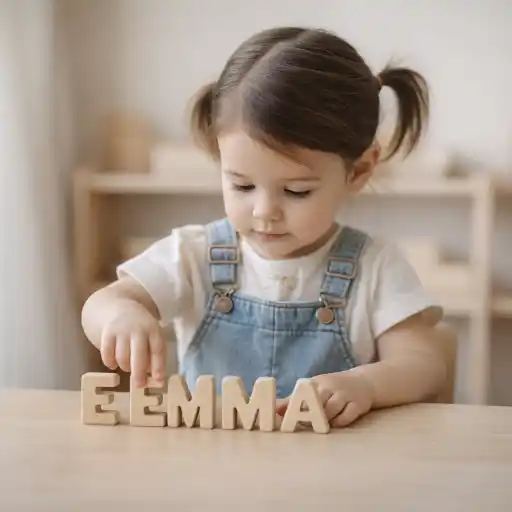
How can name activities connect identity, print, and classroom community?
Name learning can build literacy while affirming children’s identities. A name wall, class book, or greeting song can show that every child is part of the group. Invite children to share what they want about their names, but never require personal disclosure. Some children may have a name used at home that differs from the name on records; follow program policies and family preferences while protecting each child’s dignity and privacy.
Keep the activity focused on discovery rather than comparison. Children can notice that two names begin with the same letter, that one name has more letter pieces, or that a letter appears in both a friend’s name and a classroom label. Educators can model respectful language: “These names begin with different letters,” rather than ranking names by length or difficulty. When appropriate, ask families to share the story or pronunciation of a name, recognizing that family traditions vary and children may not wish to discuss them publicly.
These connections matter because early literacy grows within relationships and meaningful experiences. NAEYC emphasizes engaging materials and texts that reflect children’s voices and experiences. Name cards and personalized books can be one small part of a print-rich environment that also includes diverse stories, functional labels, and opportunities for children to communicate through speech, gesture, drawing, and writing.
How can educators observe progress without turning practice into a test?
Short, natural observations can show what a child is noticing and what support may help next. During sign-in or a letter-building activity, note whether the child finds their name independently, uses a photo cue, recognizes its first letter, matches letters to a model, or makes marks that represent writing. Record what happened and what prompt or material supported participation. One moment is not a full measure of a child’s literacy development; look for patterns over time and across contexts.
Use these observations to plan the next invitation. A child who recognizes a name card might try matching the first letter. A child who readily builds a name with a model may enjoy arranging the letters without one. Another child may prefer to point while an adult names each letter. Keep the learning goal meaningful and adjust the level of support without making children feel singled out.
Common pitfalls are easy to avoid with a strengths-based approach:
- Expecting perfect handwriting: Accept scribbles, letter-like forms, pointing, and oral responses as meaningful participation.
- Relying only on tracing: Add matching, building, noticing print in books, and playful sound activities.
- Introducing too many demands at once: Focus on one useful observation or a small set of familiar letters.
- Assuming all children learn the same way: Offer visual, tactile, spoken, and movement-based options.
Share observations with families in clear, respectful language and invite their perspective. State requirements vary - check your state licensing agency for applicable documentation or screening expectations.
How can providers turn name recognition into a steady literacy routine?
Learning a name can be an important first step toward early literacy because it brings print into a child’s world through a word that already matters. Names create opportunities to notice letters and their order, explore the function of print, experiment with writing, and strengthen a sense of belonging. These experiences are most useful when they are playful, repeated, culturally responsive, and matched to each child’s way of participating.
Start with one manageable routine: place name cards where children can reach them, invite children to find or build their names, and talk about what they notice without demanding a “correct” performance. Add family knowledge and home-language materials, observe children’s interests, and use what you see to plan a small next step. Over time, name-based experiences can connect naturally to classroom labels, books, songs, signs, and children’s own writing.
The central question is not simply whether a child can recite the letters in their name. It is whether the classroom helps them discover that print can represent people, ideas, and messages—including their own. That discovery is a meaningful foundation for continued literacy learning.
Further learning for child care professionals
- Classroom Tools for Emergent Literacy Buy Now $25.00 — classroom strategies for supporting emergent literacy.
- Science of Reading Foundations in the Pre-K Classroom Buy Now $16.00 — foundational pre-K literacy knowledge.
- Understanding Print Knowledge in Preschool
 Buy Now $16.00 — training focused on children’s understanding of how print works.
- Reading Aloud and Storytelling Buy Now $16.00 — strategies for meaningful shared reading and storytelling.
- Assessment of Language and Literacy Skills Buy Now $24.00 — approaches to observation and documenting early language and literacy.
References
- How can child care providers support name recognition and letter awareness effectively?, ChildCareEd.
- Early Literacy Toolkit: Name Practice, Observation & Rhyming Sort Buy Now $0.00, ChildCareEd.
- Understanding Print Knowledge in Preschool, ChildCareEd.
- Designing Activities to Support Literacy Development in the Early Childhood Classroom, ChildCareEd.
- How Can Child Care Providers Help Children Recognize Letters Through Play?, ChildCareEd.
- Letter Picture Sort: Beginning Sounds Activity for Ages 2–5 Buy Now $0.00, ChildCareEd.
- Five course links for continued professional learning:
- Classroom Tools for Emergent Literacy Buy Now $25.00
- Science of Reading Foundations in the Pre-K Classroom Buy Now $16.00
- Understanding Print Knowledge in Preschool Buy Now $16.00
- Reading Aloud and Storytelling Buy Now $16.00
- Assessment of Language and Literacy Skills Buy Now $24.00
- CDA Certification en Español: Recursos y Consejos para Educadores Bilingües
- 🍑 ¿Qué capacitación requiere DECAL cada año para el personal de cuidado infantil en Georgia?
- How can child care providers use the science of reading to boost early literacy in New York?
- Canciones, juegos y preguntas de círculo para niños
- Cómo simplificar la capacitación para sus empleados de daycare
- How can child care providers support name recognition and letter awareness effectively?
- How Can Child Care Programs Build Meaningful School Readiness?
- What Speech and Language Milestones Should Child Care Providers Know?
- How Can Child Care Providers Move Children from Letter Recognition to Beginning-Sound Awareness?
- How Can Meaningful Juneteenth Vocabulary Support Early Writers?
- How Can a Fourth of July Activity Pack Blend Literacy and Math?
- How Can a Picture Label Become a Real Conversation with a Preschooler?
- How Can Educators Invite Children to Revise a Story They Told Earlier?
- How Can You Help a Beginning Reader Say More Than the Sentence on the Page?
- How Can Child Care Providers Help Children Tell Their Own Stories About Family Life?
- How Can Preschool Teachers Balance Alphabet Worksheets with Conversation?
- How Can Early Literacy Experiences Introduce Children to Cultural Celebrations?
- Why Is Learning Their Own Name an Important First Step Toward Early Literacy?
