School readiness is not a race to master worksheets; it is the gradual development of communication, self-regulation, curiosity, independence, and participation skills. To strengthen your classroom practices and gain practical strategies for supporting young learners, explore Are They Ready for Kindergarten? Buy Now $35.00 and consider Science of Reading Foundations in the Pre-K Classroom Buy Now $16.00 for focused professional learning.
For child care providers and directors, the central question is not whether a child can perform every skill on a checklist. The more useful question is whether the child is developing the knowledge, behaviors, relationships, and confidence needed to participate in a new learning community. Head Start defines readiness broadly: children are ready for school, families are ready to support learning, and schools are ready for children (Head Start Approach to School Readiness).
This whole-child perspective is especially important because development is uneven. One child may tell elaborate stories but need help with dressing; another may count accurately but struggle with transitions. Responsive programs notice these patterns, build on strengths, and provide repeated opportunities to practice. State requirements vary - check your state licensing agency.
Why does a whole-child definition of readiness matter?
School readiness includes physical, cognitive, language, literacy, social-emotional, and approaches-to-learning domains. The Head Start Early Learning Outcomes Framework identifies these domains as interconnected rather than isolated categories (ELOF Framework). A child’s working memory, for example, supports following multi-step directions, while language helps children negotiate play and explain their thinking.
Relationships are equally foundational. Warm, predictable interactions help children develop confidence, curiosity, communication, cooperation, and #selfregulation. ZERO TO THREE emphasizes that these capacities emerge through everyday relationships, not through one-time preparation activities (Encouraging School Readiness From Birth to 3).
For programs, a whole-child approach produces more useful planning. Instead of asking, “How many letters does this child know?” teachers can ask:
- Can the child communicate needs, ideas, and feelings?
- Can the child engage with peers and recover from frustration with support?
- Can the child participate in routines and attempt self-help tasks?
- Does the child show curiosity, persistence, and interest in learning?
These questions guide instruction without reducing a child to a score or pass-fail label.
Which developmental domains should programs intentionally support?
A balanced readiness plan includes several mutually reinforcing domains. The Institute of Education Sciences recommends intentional instruction in social-emotional skills, executive function, mathematics, vocabulary, letters and sounds, and shared book reading (Preparing Young Children for School).
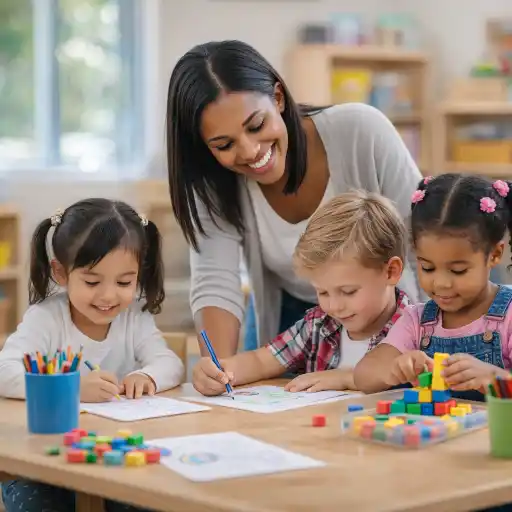
- Language and literacy: conversation, vocabulary, storytelling, listening, print awareness, rhymes, sound play, emergent writing, and enjoyment of books.
- Cognition and early mathematics: counting objects, sorting, patterns, comparison, spatial language, prediction, memory, and problem solving.
- Social-emotional development: identifying feelings, taking turns, asking for help, resolving small conflicts, and using calming strategies.
- Physical development: running, jumping, balancing, manipulating tools, drawing, cutting, and using classroom materials safely.
- Independence and approaches to learning: following routines, sustaining attention briefly, making choices, persisting, cleaning up, and caring for belongings.
Use these domains as planning lenses rather than rigid expectations. The framework is not a curriculum or a checklist for deciding whether a child is worthy of kindergarten. Children develop at different rates and may demonstrate skills in different ways, including through a home language, gestures, drawing, or pretend play.
How can teachers build readiness during ordinary routines?
The strongest readiness practices are often embedded in moments already present in the day. During arrival, invite children to locate belongings, greet a peer, and describe how they feel. At snack, count cups, compare quantities, open containers, and practice conversational turn-taking. During cleanup, use a visual sequence and give children meaningful helper roles.
- 📚 Read aloud for 5–15 minutes, pause for one open-ended question, and revisit favorite books.
- 🎵 Sing rhymes and play with syllables during transitions to build phonological awareness.
- 🧩 Use blocks, puzzles, water, and dramatic play to develop reasoning, vocabulary, measurement, and cooperation.
- 🛎 Give brief transition warnings, visual cues, and consistent language such as “First cleanup, then outside.”
- 🔧 Provide adequate time for zippers, handwashing, snack containers, and organizing personal items.
- 🏃 Offer daily opportunities for active outdoor play, balance, climbing, drawing, cutting, and manipulating small materials.
For additional ideas on building foundational reading and writing through everyday experiences, explore these strategies for fostering early literacy skills.
Protect sustained #play. NAEYC describes developmentally appropriate practice as strengths-based and play-based, recognizing children’s individuality, family context, and cultural assets (Developmentally Appropriate Practice). Guided prompts can extend learning without taking control away from children: “How could you make the bridge stronger?” or “What do you notice about these two groups?”
How can directors use planning and observation to individualize support?
Directors can make readiness work manageable by establishing a shared planning process. Ask teachers to select one or two observable goals, embed them in routines, and document brief evidence rather than completing extensive paperwork. A note such as, “Amina counted four plates and asked a peer for the fifth,” reveals more than a general mark beside “math developing.”
A practical cycle includes:
- Observe: Watch children across play, routines, small groups, and outdoor experiences.
- Interpret: Consider what the child understands, what support was available, and how language or culture may influence performance.
- Plan: Choose a small next step, such as counting to five during snack or requesting a turn with words.
- Implement: Provide visuals, modeling, peer support, adapted tools, or a smaller group.
- Review: Revisit the observation after several opportunities and adjust the plan.
Use portfolios, photographs, work samples, and short narrative observations to show growth. Avoid one-time, high-stakes judgments. Programs serving children with disabilities or multilingual learners should collaborate with families and specialists so adaptations reflect the child’s strengths and access needs.
Directors should also support staff reflection: Are classroom materials accessible? Are expectations realistic? Do schedules provide enough time for children to attempt tasks independently? Consistency among adults helps children experience readiness skills as meaningful parts of participation rather than isolated demands.
How can programs partner with families and schools during transition?
Families are children’s primary nurturers, teachers, and advocates. Effective partnership begins with respect: ask what the child enjoys, which routines work at home, what languages are used, and what concerns the family has. Share concise, strengths-based updates rather than sending long lists of deficits.
- Offer one-page checklists that include language, social-emotional, self-help, motor, and early learning skills.
- Suggest small home practices: read one page, count steps, sing a song, sort laundry, or practice a coat zipper.
- Communicate in the family’s preferred language and format whenever possible.
- Invite families to contribute photographs, songs, stories, and cultural knowledge to the classroom.
- Coordinate visits, photographs, orientation information, or conversations with receiving schools.
Head Start identifies four important connections for transition: family-school, child-school, program-school, and community-school. Strong transitions involve sharing information, building relationships, and establishing alignment (Transition to Kindergarten).
For children moving to unfamiliar schools, teachers can create a class book about feelings, invite a kindergarten teacher to visit, and use photographs of receiving schools to support discussion. When preschool and kindergarten classrooms are in the same building, joint visits and activities can reduce uncertainty. These practices communicate that transition is a shared process, not a test the child must pass alone.
What common mistakes should programs avoid?
Well-intentioned readiness efforts can become stressful when they narrow learning or overlook development. The most common mistake is equating readiness with early academic drilling. Worksheets may show a product, but they rarely provide the rich conversation, movement, problem solving, and social negotiation children need.
- Mistake: Treating a checklist as a diagnosis. Better practice: Use it to guide observation, conversation, and individualized support.
- Mistake: Comparing children with one another. Better practice: Compare the child’s current performance with prior observations.
- Mistake: Assuming bilingual development is a delay. Better practice: Observe communication across languages and consult families.
- Mistake: Completing tasks for children to save time. Better practice: Build extra time into routines and offer graduated assistance.
- Mistake: Waiting to discuss persistent concerns. Better practice: Document patterns, communicate respectfully, and suggest developmental screening.
If a child loses previously acquired skills, shows persistent communication or participation concerns, or makes little progress despite individualized support, talk with the family promptly. The CDC recommends discussing concerns with the child’s health care provider and asking about developmental screening or referral when appropriate. Screening is a pathway to support, not a prediction of a child’s future.
How can professional learning strengthen school readiness practice?
Professional development is most useful when it connects theory to the decisions teachers make every day. A course on kindergarten readiness can help teams clarify expectations and plan responsive supports. Literacy-focused training can strengthen shared reading, vocabulary, phonological awareness, and print-rich environments. Other staff may benefit from learning about early mathematics, social foundations, family engagement, or independence.
Consider these ChildCareEd options:
- Are They Ready for Kindergarten? Buy Now $35.00 focuses on cognitive, physical, and social-emotional readiness.
- Science of Reading Foundations in the Pre-K Classroom Buy Now $16.00 addresses print knowledge, phonological awareness, vocabulary, comprehension, emergent writing, and storytelling.
- Early Mathematics Through Play Buy Now $24.00 connects number sense, patterns, measurement, and reasoning to playful routines.
- Social Foundations and Responsive Classrooms Buy Now $24.00 supports self-regulation, positive guidance, relationships, and conflict resolution.
- Supporting Children’s Independence
 Buy Now $24.00 explores self-regulation, problem solving, and practical strategies for encouraging capable participation.
Review course descriptions, pricing, format, and any state-specific information before enrolling. Training can support staff knowledge and classroom consistency, but it should complement coaching, observation, collaboration, and reflective practice.
Conclusion: What does meaningful school readiness look like?
Meaningful school readiness is a developing constellation of skills—not a pass-fail label. Children benefit when programs intentionally nurture language, literacy, early mathematics, social-emotional competence, physical development, independence, curiosity, and persistence through relationships, routines, and sustained play.
The most practical approach is to choose a few observable goals, embed them in daily experiences, document small gains, and partner with families and receiving schools. Protect play, honor home languages and cultural knowledge, adapt support for individual children, and act early when concerns persist. With consistent, compassionate practice, child care providers and directors help children enter school feeling capable, connected, and ready to learn.
Frequently asked questions
Do children need to read before kindergarten?
No. Emerging letter knowledge, rhymes, vocabulary, storytelling, print awareness, and interest in books are more developmentally appropriate goals than fluent reading.
How long should readiness activities last?
Brief, engaging experiences often work well: approximately 10–20 minutes for focused preschool activities, balanced with longer periods of child-directed play and movement.
How should programs support dual language learners?
Honor the home language, use visuals and gestures, invite family input, and assess communication across the child’s languages whenever possible.
When should a provider recommend screening?
When concerns persist across settings, a child loses skills, or progress remains limited despite appropriate support, document observations and discuss screening with the family and health care professionals.
- Reading Aloud and Storytelling
- Roots & Resilience: Understanding What Shapes a Child
- Language and Literacy Foundations in Pre-K
- 45 Hour School Age Methods and Materials
- Are They Ready for Kindergarten?
- Sensitive Periods in Montessori: Guiding Natural Learning
- CDA Home Visitor Credential Birth to 5
- Texas Director Credential
- Environments That Inspire Independence and Exploration
- Bridging Cultures: Family Communication & Collaboration
- Medication Adminstration Training and EPI Pens Shortage Update
- Child Care Professionals
- CDA Certification en Español: Recursos y Consejos para Educadores Bilingües
- Ready, Set, Kindergarten!
- 👶 ¿Cuáles son las proporciones y grupos requeridos en Dakota del Norte? 🏫
- How Does Temperament Affect How Minnesota Children Learn and Behave?
- How can Michigan child care programs use CACFP and Summer Meals to keep children nourished when school is out?
- What Kindergarten Readiness Skills Do Children Need?
- What are the most important school readiness skills for preschoolers?
- What Kindergarten Readiness Skills Should My Program Build?
- What skills do preschoolers need to be ready for school?
- How Does Guided Play Build School-Ready Skills in New York Preschoolers?
- How can we prepare children for the transition to kindergarten in New York?
- How can preschool programs best prepare children for kindergarten?
- After-School Activities for Kids: Calm, Creative, and Active Ideas for Every Energy Level
- How to Become a Kindergarten Teacher in Texas: Which Certification Path Should You Choose?
- Is My Preschooler Ready for Kindergarten? Milestones Beyond ABCs and 123s
- How Can Child Care Programs Build Meaningful School Readiness?
- How Can Child Care Programs Build Meaningful Kindergarten Readiness?
- What School-Age Activities Create Engaging, Inclusive, and Well-Managed Programs?
