Every babble, gesture, first word, and question offers valuable information about a child’s developing communication. Strengthen your daily practice with Language Development in Early Childhood  Buy Now $16.00 and Assessment of Language and Literacy Skills Buy Now $24.00, which provide practical strategies for language-rich classrooms and objective observation that can support professional learning hours. Use the guidance below to recognize broad patterns, encourage communication, and partner thoughtfully with families without turning milestones into rigid labels.
What communication milestones are common during infancy?
Infants begin building communication long before recognizable speech. Crying, calming to a familiar voice, smiling, looking toward people, vocalizing, and taking turns with sounds are early forms of social communication. Over time, babies commonly develop cooing, babbling, imitation, shared attention, and gestures such as reaching, waving, or pointing.
- Birth–3 months: watches faces, responds to voices, smiles socially, and makes early vocal sounds.
- 4–6 months: laughs, vocalizes more often, experiments with sounds, and responds to familiar voices.
- 7–12 months: babbles with varied sounds, uses gestures, responds to familiar words, and may begin using one or more meaningful words near the first birthday.
These patterns should be observed in ordinary routines rather than tested formally. During diapering, for example, a provider might pause after speaking, imitate an infant’s sound, and wait for a response. During floor play, following the baby’s gaze or reaching helps create shared attention.
Limited response to sound, little vocalization, minimal babbling, or an absence of gestures deserves closer observation. Hearing is especially relevant because a child may appear inattentive or delayed when sound access is inconsistent. Providers should document what they see and encourage families to consult the child’s health care professional or an audiologist when hearing concerns arise. A provider does not diagnose; the role is to notice, support, document, and connect.
How do speech and language skills typically change during the toddler years?
Toddler communication often expands rapidly, although progress may be uneven. Children begin using words to request, protest, label, comment, and direct another person’s attention. Receptive language—what a child understands—may be stronger than expressive language, so providers should observe both.
- 12–18 months: uses emerging words, gestures, sounds, and simple directions in familiar routines.
- 18–24 months: vocabulary often grows, children combine words such as “more milk,” and they increasingly communicate for different purposes.
- 2–3 years: many children use short sentences, follow simple directions, identify familiar objects, ask basic questions, and participate more actively in peer play.
Approximate words and signs count as communication. If a child says “ba” for “ball” consistently or points to a picture while vocalizing, respond to the meaning rather than demanding perfect pronunciation. Model and expand naturally: “Ball—yes, the red ball is rolling.” This gives the child a richer language example without creating performance pressure.
Providers should watch for very limited communication attempts, difficulty understanding familiar directions, no emerging word combinations, persistent frustration, or loss of previously acquired skills. The ASHA early-identification guidance describes signs that may warrant professional follow-up, while emphasizing that children develop at different rates. One quiet day is not a conclusion; repeated patterns across routines are more informative.
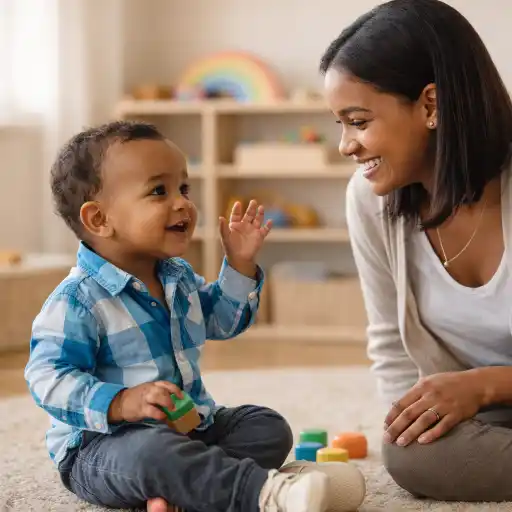
What should providers expect from preschoolers’ speech and language?
During the preschool years, children generally develop longer sentences, broader vocabulary, more complex conversational skills, and increasing ability to explain experiences. They may tell short stories, answer questions, describe feelings, negotiate during play, and use language to plan or solve problems. Early literacy also becomes more visible through interest in books, rhymes, drawing, print, and storytelling.
- Use longer phrases and sentences to describe people, actions, locations, and ideas.
- Ask and answer increasingly complex questions, including “why” and “how” questions.
- Retell familiar events or stories with adult support.
- Participate in back-and-forth conversations with adults and peers.
- Notice rhymes, syllables, repeated sounds, letters, and meaningful print.
Speech clarity develops gradually. Young children may not produce every sound correctly, and unfamiliar listeners may understand less than familiar adults. Providers should model words naturally rather than correcting every sound. If speech remains consistently difficult for familiar listeners, if the child avoids communication, or if frustration is substantial, share objective observations with the family.
Interactive books, songs, fingerplays, puppets, and dramatic play provide authentic opportunities to practice vocabulary and narrative skills. The course Reading Aloud and Storytelling Buy Now $16.00 can help providers strengthen interactive reading, comprehension, vocabulary, and emerging literacy practices.
How can everyday routines strengthen children’s communication?
Language learning is most effective when it is meaningful, repeated, and connected to children’s interests. Providers do not need to turn the classroom into a series of speech drills. Instead, they can make ordinary routines more responsive and conversational.
- 😊 Narrate actions: “You are pouring water. The cup is getting full.”
- Use parallel talk to describe what the child is doing during play.
- Offer two meaningful choices, using objects or pictures when helpful.
- Pause five to ten seconds after speaking so children have processing time.
- Use comments as often as questions to reduce pressure.
- Expand children’s messages without requiring repetition.
- Pair spoken words with gestures, signs, photographs, objects, or visual schedules.
- Repeat important vocabulary across meals, play, books, art, and outdoor experiences.
Follow the child’s lead. If a child points toward a truck, respond with genuine interest: “You found the big blue truck. It is moving fast.” This approach teaches vocabulary and grammar while preserving the child’s meaning. Communication should also be accessible to children who use signs, pictures, drawing, or AAC. These systems are valid ways to participate and should not be withheld until a child speaks. For ideas on using baby sign language in a child care classroom, providers can explore how signs offer another way for young children to communicate as spoken language emerges.
Language-rich practice is especially important for children learning more than one language. Home-language use supports identity, family relationships, conceptual development, and belonging. Mixing languages or using different words across settings does not, by itself, indicate a delay. For additional support, Building Bridges for Dual Language Learners Buy Now $16.00 explores culturally responsive environments, language-building activities, and family collaboration.
How should providers document concerns and partner with families?
Providers should document communication objectively rather than assigning diagnoses or labels. Include the date, setting, communication partner, exact words or sounds, gestures, comprehension, who understood the child, and the support provided. For example: “During block play, Jordan pointed to the bridge, said ‘fall,’ and watched a peer for five seconds” is more useful than “Jordan has poor language.”
Observe across several contexts: free play, meals, group time, outdoor activities, books, transitions, and peer interactions. Ask families how the child communicates at home and in each language. A child may communicate differently with familiar adults, peers, or family members.
- Record strengths and new skills as well as concerns.
- Compare the child with developmental expectations, not with a specific peer.
- Track gestures, comprehension, social communication, speech clarity, and play.
- Protect confidentiality and share information only with appropriate consent.
- Use family input to interpret culturally and linguistically diverse communication.
Begin family conversations with strengths: “We appreciate how Maya engages during songs and communicates through pointing. We have also noticed that she uses very few words across several routines. What do you notice at home?” Encourage families to discuss concerns with the child’s health care provider and ask about developmental screening, hearing evaluation, early intervention, or consultation with a speech-language pathologist when appropriate.
Screening is not the same as diagnosis. The Head Start guidance on developmental screening describes screening as a process that helps families and programs decide whether further evaluation may be useful. State requirements vary - check your state licensing agency. If a child loses previously acquired skills, has significant hearing concerns, or shows persistent communication difficulties, act promptly rather than waiting indefinitely.
Conclusion: What should providers remember about speech and language milestones?
Speech and language milestones help child care providers notice broad developmental patterns, plan responsive experiences, and communicate effectively with families. Infants build foundations through vocalization, shared attention, and gestures; toddlers expand words, understanding, and combinations; preschoolers develop longer sentences, narratives, conversational skills, and early literacy. These milestones guide observation but do not diagnose children or define a single “correct” path.
The most effective support is warm, frequent, and embedded in daily life: talk during routines, read interactively, sing, play, pause, expand children’s messages, honor home languages, and accept all meaningful communication. When concerns persist, document specific examples, begin with strengths, involve families, and encourage appropriate professional follow-up. Your attentive relationships and small, repeated responses can make communication more accessible, joyful, and successful for every child.
- 45 Hour Child Growth and Development
- 24 Hour Texas Pre-Service
- CDA Bridge Bundle: Family Child Care without Portfolio Review
- CDA Bridge Bundle: Infant/Toddler without Portfolio Review
- CDA Bridge Bundle: Preschool without Portfolio Review
- Assessment of Language and Literacy Skills
- Texas Director Credential
- Bridging Cultures: Family Communication & Collaboration
- Supporting Families and Caregivers in Language and Literacy
- Identifying Developmental Milestones in Children
- Retraso del Habla en la Guardería: Cómo Pueden Ayudar los Proveedores
- How Can North Dakota Caregivers Help Toddlers with Speech Delays?
- How to Open a Daycare for Children with Speech Delays
- How Teachers Can Notice Early Signs of Language Delays
- What should Toddler Development Training teach child care providers?
- What should providers expect at different ages and when should they recommend further evaluation?
- How can we support early communication before children begin talking?
- How can I support speech and language development in toddlers?
- When Is Repetitive Speech Typical—and When Should Teachers Pay Closer Attention?
- How Can Child Care Providers Support Language Development in Young Children?
- How Can Child Care Providers Support Healthy Toddler Development?
- How Can Child Care Providers Support Preschool Development Across the Whole Child?
- How Can Child Care Providers Share Developmental Concerns with Sensitivity?
- What Are the Best Ways to Support a Child’s Speech Development?
- When Should Providers Be Concerned About Language Delays?
- How Can Child Care Providers Understand and Support Speech and Language Development?
- What Speech and Language Milestones Should Child Care Providers Know?
- When Should a Child Care Provider Be Concerned About Speech Development?
