


Sign in to download Create a free account
This resource is free. Sign in and you'll come straight back here to download it.
Description
Support Early Language and Literacy Through Play, Observation, and Name Practice!
Help young learners build foundational literacy skills with this 7-page Early Literacy Toolkit, combining engaging name recognition activities, a practical educator observation checklist, and a hands-on rhyming picture sort.
Designed for preschool teachers, kindergarten educators, child care providers, and early childhood professionals, this resource supports meaningful literacy experiences through everyday interactions, emerging writing, phonological awareness, and individualized observation.
With three complementary resources, educators can encourage early literacy participation while documenting children's communication and identifying opportunities for continued learning.
What's Included?
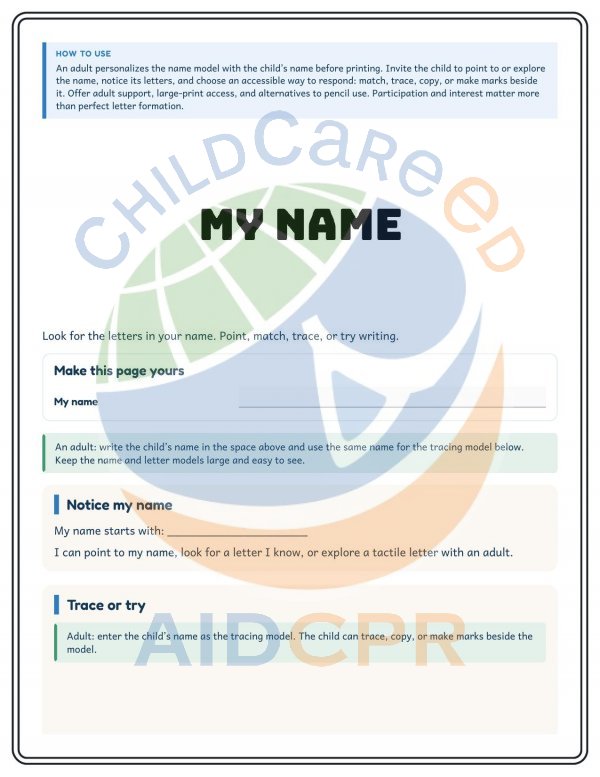
1. My Name: Letter Match and Trace — 2 Pages
A personalized early literacy activity that introduces children to the letters in their names and encourages emerging writing skills.
Includes:
Space for the child's name
A prompt to identify the first letter of their name
Opportunities to point to and recognize familiar letters
Space for tracing, copying, or making early writing marks
Three printed "My name is" sentence models, including tracing examples
Additional handwriting practice lines
Guidance for adapting participation to individual developmental and accessibility needs
How to Use: An adult adds the child's name and helps them recognize familiar letters, explore the printed words, or practice writing.
Children may participate by pointing, matching with separately provided letters, tracing, copying, or making marks.
The activity emphasizes exploration and participation rather than perfect handwriting.
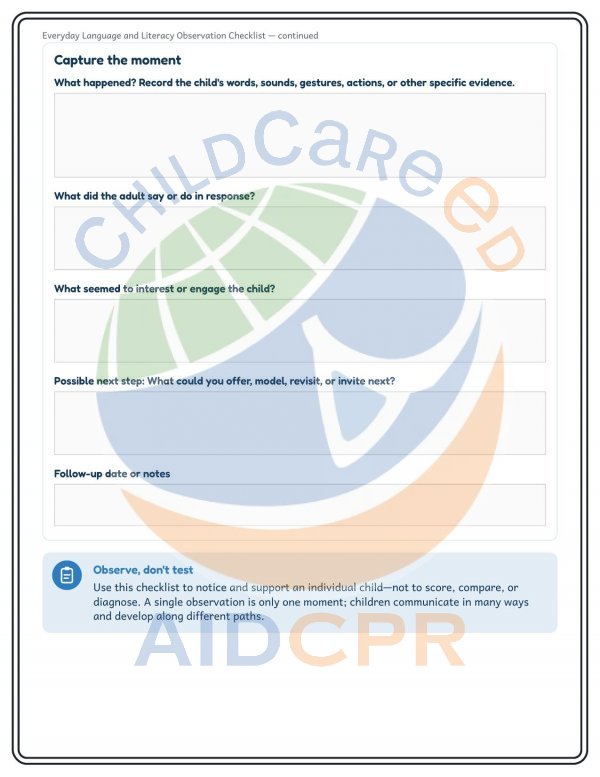
2. Everyday Language and Literacy Observation Checklist — 3 Pages
A reusable educator observation tool designed to document children's communication and early literacy behaviors during natural classroom experiences.
Includes 10 observable behaviors across three developmental learning areas:
Communication and Listening
Responding to familiar words, sounds, questions, or directions
Demonstrating attention or listening through different responses
Communicating needs, feelings, ideas, or choices
Participating in back-and-forth interactions
Words and Sound Play
Recognizing or using vocabulary
Exploring sounds, rhythm, repetition, rhymes, or songs
Sharing ideas, stories, or descriptions
Books, Print, and Early Writing
Noticing letters, signs, labels, or other print
Exploring books and demonstrating story understanding
Making scribbles, drawings, marks, or letter-like forms
The checklist also provides:
Child, date, setting, and participant information
Space to record specific observations
Notes about the adult's response
Space to identify the child's interests
Planning prompts for possible next steps
Follow-up notes or date
How to Use: Observe a child during play, reading, conversations, or everyday routines. Mark the behaviors noticed and record specific examples to help plan individualized learning experiences.
3. Listen, Rhyme, and Sort — 2 Pages
A hands-on phonological awareness activity that introduces children to rhyming sounds through picture matching and sorting.
Includes:
A two-column sorting mat featuring the target words cat and sun
8 illustrated picture cards: Hat, Dog, Bat, Map, Fun, Run, Bun, and Cup
Five rhyming matches and three nonmatching choices
Teacher instructions for modeling rhyming sounds
Guidance for adapting the activity to children's communication and language experiences
How to Use: The educator says each picture word aloud. Children listen, identify words that rhyme with the target words, and place or glue the matching pictures in the correct columns.
Children can also point to pictures or participate in oral matching without cutting and gluing.
Perfect For
Preschool and prekindergarten literacy activities
Kindergarten readiness
Name recognition and early writing practice
Language and literacy observation
Phonological awareness and rhyming lessons
Small-group literacy instruction
Early childhood learning centers
Individualized learning support
Literacy-themed classroom activities
Teacher observation and documentation
Parent-supported name recognition practice at home
Why Educators Will Love It
Combines learning and observation: Supports children's early literacy experiences while providing educators with a structured way to document developing skills.
Encourages personalized learning: The name activity makes literacy meaningful by connecting print to children's identities.
Builds phonological awareness: The rhyming sort encourages children to listen carefully to spoken words and identify similar ending sounds.
Recognizes different communication styles: The observation checklist considers speech, gestures, sounds, movements, and other forms of communication.
Supports differentiated instruction: Activities can be adapted with adult assistance, verbal modeling, pointing, tactile letters, or alternative ways to respond.
Encourages ongoing reflection: Educators can use observation notes to revisit learning experiences and identify appropriate next steps.
Easy to incorporate into daily routines: Works well during literacy centers, small groups, guided activities, and everyday classroom observations.
