Every child carries stories about the people, routines, places, and moments that make life feel like theirs. Use the All About Me: First Day of School Worksheet Buy Now $0.99 as an optional starting point, inviting children to draw, dictate, or talk about something they enjoy, then follow their lead as they connect it to family life. Let children choose what to share and which questions to skip. For practical ways to support children’s narratives and create richer literacy experiences, explore Reading Aloud and Storytelling  Buy Now $16.00. Read on for ways to welcome family stories while building language, belonging, and trust.
Why do children’s stories about family life matter?
When children describe who they live with, a favorite weekend routine, or the way a familiar meal is prepared, they are doing more than recalling events. They are organizing experience, exploring identity, and communicating what matters to them. Family stories can support a child’s sense of connection and help educators understand the child in the context of home, culture, language, and community. Research on family storytelling also points to possible benefits for oral language, literacy, emotional well-being, and family bonds.
These stories can strengthen classroom relationships, too. A child who hears an educator attend carefully to their words receives the message that their perspective counts. Stories can also help peers notice shared interests and differences with curiosity rather than judgment.
There is no single “right” family story. Children’s households and caregiving relationships vary, and a child’s account may be imaginative, incomplete, or changing. Follow the child’s lead and avoid assuming that every child wants to talk publicly about home. Respectful listening—not collecting personal details—is the foundation of meaningful storytelling.
How can educators invite children to tell stories in their own ways?
Start with an open invitation rather than a quiz. A gentle prompt such as “Would you like to tell me about something you did with someone you care about?” gives children room to choose the event and level of detail. Then allow time. Young children may need pauses to find words, gestures, or another way to communicate.
- Ask open-ended questions: “What happened next?” “Who was there?” or “What part do you remember best?”
- Accept many forms of storytelling: speaking, drawing, arranging photos, acting, using puppets, signing, or communicating with AAC.
- Let a child pass, change the subject, or tell a fictional story instead.
- Reflect the child’s meaning without correcting their memory or supplying details they did not offer.
For infants and toddlers, storytelling may begin with a familiar photograph, a repeated family phrase, or an adult narrating a shared daily moment. With preschoolers, props and pretend play can help turn ideas into characters and sequences. As NAEYC’s ideas for helping everyone become a storyteller suggest, everyday experiences can become stories when children choose to share them and adults listen responsively.
How can family partnership make storytelling more meaningful?
Families know their children’s interests, communication styles, routines, and comfort cues. Invite their perspectives as partners—not as performers expected to present a culture or provide materials. A brief, optional question can open the conversation: “Are there stories, songs, or everyday routines your child enjoys?” Families may respond in a conversation, note, drawing, or recording, or choose not to contribute.
Reciprocal communication matters. Share a short observation about what a child said or created, then invite the family’s interpretation: “Mina told us about helping make soup. Is there anything you’d like us to know about this story?” This respects family expertise and may reveal connections an educator would not infer alone. NAEYC describes respectful, reciprocal family relationships as an important part of understanding and supporting each child.
Be thoughtful about privacy. Ask permission before displaying or sharing a child’s family story, image, or recording, and follow program policy. Some stories may be personal or sensitive; families and children should have control over what is shared, with whom, and in what format. Strong family partnerships are built over time through trust, choice, and consistent two-way communication.
What classroom practices help children feel safe and represented?
A storytelling-friendly environment offers accessible materials and reflects children’s lives without making any child responsible for representing a whole group. Keep paper, drawing tools, puppets, story stones, and blank books available. Offer a quiet place for one-to-one telling as well as small-group opportunities. Include books and images that show varied family structures, cultures, languages, abilities, and everyday experiences.
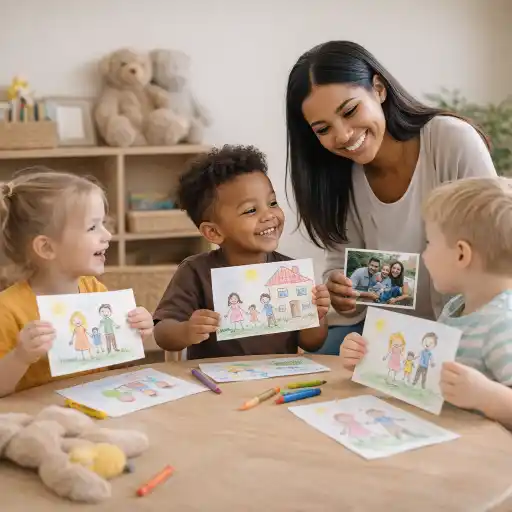
Children may tell stories in a home language, combine languages, use gestures, or communicate through play. Welcome those forms rather than treating English fluency or a polished beginning-middle-end structure as the measure of a good story. Head Start’s guidance on storytelling in many forms recommends using props, movement, home and Tribal languages, and communication supports so children can participate in ways that work for them.
- 📚 Rotate books and materials so children encounter familiar experiences alongside new perspectives.
- Use neutral, inclusive prompts such as “Tell me about someone important to you,” rather than assuming every child has the same household.
- Offer children choices about creating, keeping, or sharing their stories.
- Use photos, recordings, and personal details only with appropriate permission.
Representation is most powerful when it is part of everyday classroom life, not a one-time “culture day.” When children find their experiences respected alongside others’, the room can become a place where #families, #culture, and identity are treated with care.
How can providers document and extend children’s stories?
Documentation can show children that their words have been heard and give educators ideas for follow-up experiences. Write a child’s words as accurately as possible, label a drawing with the child’s explanation, or photograph a sequence of scenes the child created—always following permissions and program policies. Share the record back with the child: “You told me the garden was where your family looked for worms. Is that what you want this picture to say?” This check avoids assigning adult meaning to a child’s work.
Use documentation to notice interests and plan next steps, not to rank children. If a child tells a story about shopping with a grandparent, you might offer dramatic-play materials for a market, invite the child to draw a map, or provide books about intergenerational relationships. A child’s narrative may also offer insight into language, sequence, persistence, imagination, or topics they want to explore further.
Keep the child as the author. Educators can model richer language naturally—for example, “The dog ran home after the rain”—but should not rewrite a child’s account to make it sound more adult. Learning Stories and related narrative approaches emphasize observation, reflection, and family perspectives as ways to recognize children’s strengths and inform responsive teaching. A short note can be enough: what the child chose, how they communicated, and what invitation might extend the interest.
What common pitfalls should educators avoid?
Storytelling is an invitation, not an assignment to disclose personal information. Avoid pressuring a child to tell a family story in front of peers, asking a child to explain a whole culture, or expecting every family to contribute a photo, object, or recording. Such approaches can make a meaningful practice feel exposing or tokenizing.
Also resist turning a child’s narrative into an interview. Rapid-fire questions may interrupt the child’s thinking. Ask one question, pause, and follow the child’s response. Do not correct harmless differences in a child’s account or insist on a conventional plot. A story may be playful, fragmentary, or told through movement—and still be valuable communication.
When a child shares something concerning, respond calmly and follow your program’s established safeguarding and reporting procedures; do not promise secrecy. For ordinary storytelling, however, keep the focus on listening, choice, and connection. State requirements vary—check your state licensing agency for applicable rules about documentation, privacy, and training. Thoughtful practice can be supported with focused professional learning such as Supporting Families and Caregivers in Language and Literacy Buy Now $16.00, Building Bridges for Dual Language Learners Buy Now $25.00, and Family Voices Matter: Tools for Meaningful Collaboration Buy Now $55.00.
Conclusion: How can we help children tell their own stories?
Children tell their own stories when adults make time to listen, offer accessible ways to communicate, and respect a child’s choice about what to share. Family narratives can support language, identity, connection, and responsive teaching, but their value depends on trust—not on how much personal information a child reveals.
Start simply: offer an open prompt, give children time, make drawing and pretend play available, and invite family perspectives without pressure. Document children’s words carefully, protect privacy, and use their interests to shape future experiences. When providers honor children as authors of their own lives, each story—spoken, drawn, acted, signed, or imagined—can help build a classroom where every child’s voice belongs.
- 45 Hour Child Growth and Development
- Basic Life Support (BLS) In-Person Healthcare Providers
- A Better Space for All
- Basic Life Support (BLS) Blended Healthcare Providers
- Setting the Stage: Story Time
- Texas Director Credential
- Behind the Scenes: Baby Routines ONLINE
- Every Moment Matters: Schedules and Transitions
- Celebrate the Joy of Reading on National Book Lovers Day
- National Grouch Day: Turning Grouches into Giggles, Teaching Kids about Handling Negative Emotions
- CDA Certification en Español: Recursos y Consejos para Educadores Bilingües
- Proporciones de Cuidado Infantil y Tamaños de Grupo por Edad en Virginia (Guía Rápida para Centros y Hogares)
- Celebrando la amistad en el cuidado infantil durante el Día de los Mejores Amigos
- How Do You Choose 10 Books for Your CDA Bibliography? Examples by Topic
- How Can We Celebrate Every Family and Create a Classroom Where Everyone Is Represented?
- How Can Take-Home Books Strengthen the Home-School Reading Bond?
- How Can Families and Educators Connect Early Literacy With STEM, Art, Music, and Creativity at Home?
- How Can Preschool Teachers Introduce Inclusive, Culturally Responsive Books?
- How Can Providers Support Families Who Rely on Head Start?
- How Can Preschools Celebrate Hispanic Heritage Month Meaningfully?
- How Can Drawing and Dictation Help Children Respond to Juneteenth?
- How Can Child Care Providers Preserve a Child’s Exact Words During Story Dictation?
- How Can Educators Invite Children to Revise a Story They Told Earlier?
- How Can Child Care Providers Respond When a Classroom Theme Misrepresents a Family’s Culture?
- When an All-About-Me Question Leaves a Child Out, What Should Providers Do?
- How Can Providers Ask About Family Traditions Without Making One Child the Spokesperson?
- How Can Child Care Providers Help Children Tell Their Own Stories About Family Life?
