When preschoolers clap, stomp, or sort the beats in familiar words, they are building an important foundation for later literacy—without needing a worksheet or a formal reading lesson. Try the playful Ice Cream Syllable Sort Buy Now $1.49 as a hands-on classroom activity, and explore Lesson Planning for Preschoolers  Buy Now $24.00 to strengthen your ability to plan purposeful, developmentally appropriate learning experiences.
What are preschoolers noticing when they listen for syllables?
When children notice syllables, they are attending to the sound structure of spoken words. A syllable is a spoken beat or part of a word: sun has one, sunset has two, and watermelon is commonly spoken with four. Preschoolers do not need to read or spell these words to listen for their parts. At this stage, the target is oral language and sound awareness.
Syllable awareness is one part of phonological awareness—the broader ability to hear and work with sounds in spoken language. It is distinct from phonics, which connects sounds with letters. As NAEYC explains in its article on word play and phonological awareness, preschoolers can explore these skills through authentic routines, movement, songs, and conversation.
In a playful activity, children can practice several related actions:
- Listen to a familiar word and say it aloud.
- Separate the word into spoken beats by clapping, tapping, or moving.
- Count the beats and compare words with different numbers of parts.
- Blend the parts back together to say the whole word.
These are invitations to listen and experiment, not tests of perfect pronunciation. When a child notices that a long word has “more beats” than a short one, they are beginning to attend to how spoken language is organized.
Why does playful syllable practice matter?
Sound awareness develops through repeated, meaningful experiences. Syllables provide a manageable way for young children to begin noticing that words are made of smaller spoken parts. This kind of listening contributes to the broader language and literacy foundation children draw on as they encounter more advanced skills over time.
Play is especially useful because it gives children a reason to listen and respond. Clapping a name, tapping a rhythm stick for a food word, or sorting a picture into a one-, two-, or three-beat group makes an abstract idea physical and social. Children hear a model, try it themselves, and learn from peers—all while the activity remains enjoyable.
Brief, repeated moments also fit the realities of a busy preschool day. Instead of reserving syllables for a lengthy lesson, educators can weave a few words into arrival, snack, read-alouds, or cleanup. The goal is intentional practice that follows children’s interests, not a rigid schedule or a demand that every child master the skill at once. A carefully planned activity can support participation while leaving room for discovery and laughter.
How can you introduce the Ice Cream Syllable Sort?
The Ice Cream Syllable Sort Buy Now $1.49 invites children to cut out picture scoops, say each pictured word, clap its syllables, and glue the scoop under a cone marked for one, two, or three syllables. A bonus “Your Turn” page encourages children to think of and sort words of their own. The theme gives a familiar, inviting frame to a listening activity.
Before children sort independently, check that they recognize and can name the pictures. If a word is unfamiliar, introduce it with a picture, object, or short conversation; otherwise, vocabulary knowledge—not syllable awareness—may be the real challenge. Then use a consistent sequence:
- Show a picture and say its name naturally.
- Say it again clearly, inviting children to listen for its parts.
- Clap, tap, or move once for each spoken syllable.
- Count the movements together and choose the matching cone.
- Say the complete word again, then invite children to explain or demonstrate their choice.
Start with a few familiar pictures and model your thinking aloud. For example: “Ice cream. Let’s listen: ice-cream. I hear two beats, so I’ll place it with the two-syllable words.” Keep the emphasis on hearing the spoken word; cutting, gluing, and sorting are useful ways to extend participation, but they are not the sound-learning goal.
Which playful approaches help children hear the beats?
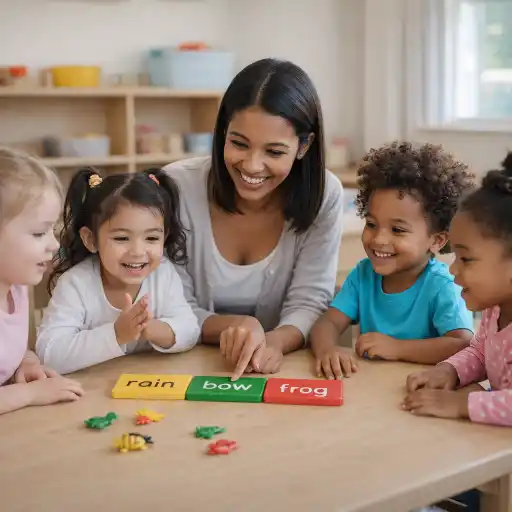
Clapping is familiar, but children can represent syllables in many ways. Offer different movements so the activity stays engaging and accessible: a child might tap knees, pat a drum, place one block per beat, or raise a finger for each part. The important link is one action for each spoken syllable—not movement for movement’s sake.
- Clap the syllables in children’s names during morning greeting.
- Tap rhythm sticks for words from a read-aloud or classroom theme.
- Move to a sorting station after hearing a word, with a seated pointing option available.
- Use a puppet that “speaks” a word slowly while children count its beats.
- Invite children to find familiar objects and decide how many beats they hear.
- 🎵 Make a short chant from children’s names or favorite foods, pausing so they can supply the beat count.
Keep the pace comfortable and the volume appropriate for the group. Some children may prefer quiet finger taps to loud clapping; others may benefit from smaller groups or watching a model first. Movement should make the sound pattern clearer, not become a distraction. Educators can take inspiration from NAEYC’s play-based examples of sound activities and adapt them to children’s interests and classroom routines.
How can providers include different learners and languages?
Children arrive with different vocabularies, home languages, speech patterns, sensory preferences, and motor abilities. These differences do not prevent participation; they remind educators to offer multiple ways into the activity. Pictures and real objects help children understand the word, while pointing, signing, tapping, speaking, or using a communication device can all be meaningful ways to respond.
For children learning English, invite families to share familiar words in the home language when appropriate. Sound and syllable patterns vary across languages, so educators should avoid assuming that an English pronunciation or word pattern is universal. A child’s home language is a resource for connection and learning. Offer a clear model without asking children to abandon the language they use with family.
- Use large, clear pictures or real objects, and introduce unfamiliar vocabulary first.
- Offer seated and standing movements, tactile materials, and adapted tools as needed.
- Begin with a small set of one-, two-, and three-syllable words children know.
- Provide time to observe or practice with a partner before responding to the group.
- Use encouraging language such as, “Let’s listen together,” rather than framing a first attempt as failure.
Observe patterns over time instead of drawing conclusions from one response. If concerns persist across listening or communication activities, follow your program’s procedures for partnering with families and seeking appropriate support. State requirements vary - check your state licensing agency when aligning professional development or classroom documentation with local expectations.
How can you plan, observe, and extend the learning?
A simple plan keeps the activity purposeful without making it feel overly formal. Identify the learning goal (for example, “children will represent syllables in familiar words with one movement per beat”), select pictures children can name, and decide how you will model the task. The Lesson Planning for Preschoolers Buy Now $24.00 course offers further support for identifying lesson components and planning developmentally appropriate instruction.
During play, observe what each child can do: name or identify the picture, repeat the word, mark each beat, count the beats, or sort the picture. A brief note can guide what to try next. If a child struggles, reduce the number of pictures, use a more familiar word, model again, or invite a response through movement or pointing. Avoid turning every attempt into a correction; warm repetition helps children stay engaged.
Common pitfalls are easy to avoid with a few adjustments:
- Too many cards at once: Begin with a small group of familiar words, then add more as interest and confidence grow.
- Unfamiliar vocabulary: Teach the word or show the object before asking children to analyze its parts.
- Worksheet-first instruction: Make listening and movement the core; use the printable as one hands-on option.
- Overcorrecting: Model the word again and invite another try without treating a response as a high-stakes answer.
Extend the experience by finding syllables in names, snack foods, story characters, or toys. The bonus “Your Turn” page can prompt children to contribute words from their own lives. When educators plan with clear goals, familiar language, flexibility, and playful repetition, children can notice more than the number of beats: they can experience language as something to explore together.
Conclusion: What should preschoolers notice about syllables?
Preschoolers should begin to notice that spoken words have parts or beats that can be heard, represented with movement, counted, and blended back into a whole word. They do not need to read the words or perform perfectly. The learning goal is purposeful listening through developmentally appropriate play.
Use familiar vocabulary, model one movement per beat, give children multiple ways to participate, and revisit the skill in short, joyful moments across the day. The Ice Cream Syllable Sort offers one engaging way to make the listening and sorting visible; thoughtful planning helps you adapt it to the children in your care. With curiosity, responsive teaching, and repetition, syllable play can become a lively part of your preschool literacy routine.
Five ChildCareEd courses for continued learning
- Understanding Print Knowledge in Preschool
- CDA Preschool Credential with Portfolio Review
- 45 Hour Preschool Methods and Materials
- Birth to Five CDA Credential with Portfolio Review
- CDA Bridge Bundle: Preschool
- Pediatric RSV First Aid & CPR/AED
- CDA Bridge Bundle: Preschool without Portfolio Review
- Play, Learn, Grow
- Creating Environments that Nurture Growth and Community
- CDA Certification en Español: Recursos y Consejos para Educadores Bilingües
- 😫🧸 ¿Qué hacer cuando un bebé no quiere dormir la siesta en el aula?
- ¿Cómo puedo usar escenarios de juego de roles de primeros auxilios en mi aula?
- ¿Cómo puedo enseñar habilidades de primeros auxilios con escenarios de juego de roles?
- Actividades de Motricidad Gruesa que Desarrollan el Equilibrio, la Coordinación y la Fuerza
- Actividades de Otoño Fáciles para Preescolares esta Temporada
- What are fun language-learning games preschool teachers can use?
- Celebrando la amistad en el cuidado infantil durante el Día de los Mejores Amigos
- How can preschool programs build early literacy every day?
- First Week of Preschool Lesson Plans: 5 Days of Easy Activities and Routines
- How Can Sound Bingo Sharpen Listening Skills in Preschoolers?
- Why Do Predictable Books Help Preschoolers Feel Like Readers?
- How Can Teachers Build Early Literacy Without Screens or Worksheets?
- How Can Printable Books Help Preschoolers Fall in Love With Reading?
- What Should a 3-Year-Old Be Learning at Preschool?
- What Speech and Language Milestones Should Child Care Providers Know?
- How Can Shape Vocabulary Strengthen Early Reading Practice?
- How Can Transportation Interests Motivate Beginning Readers?
- Teaching Syllables Through Play: What Should Preschoolers Notice?
- Teaching Syllables Through Play: What Should Preschoolers Notice?
