Recognizing a letter is an important beginning, but children also need opportunities to hear how spoken words start and connect those sounds to meaningful print. The Understanding Print Knowledge in Preschool  Buy Now $16.00 course can help you strengthen these connections through intentional routines, observation, and classroom strategies. For a broader framework that includes phonological awareness, alphabet knowledge, vocabulary, and emergent writing, explore Science of Reading Foundations in the Pre-K Classroom Buy Now $16.00.
Moving from letter recognition to beginning-sound awareness is not a race toward formal reading. It is a carefully scaffolded shift from noticing symbols to listening closely, comparing spoken words, and understanding that letters represent sounds. When instruction is playful, brief, and connected to children’s names, interests, and everyday experiences, providers can support developing #literacy while preserving curiosity and confidence.
Why should educators move beyond letter recognition?
Letter recognition involves identifying a printed symbol and often naming it. Beginning-sound awareness involves listening to spoken language and noticing the first sound in a word. These abilities are related, but they are not interchangeable. A child may identify uppercase A yet not hear that apple begins with /a/. Another child may notice that sun and sock begin alike before confidently naming or locating S.
This distinction matters because early reading depends on coordinating oral language, phonological awareness, alphabet knowledge, and print knowledge. The ChildCareEd resource Importance of Print Knowledge describes print knowledge as including letter names, letter sounds, and concepts of print. Providers therefore have an opportunity to help children build a flexible network of knowledge rather than treating letter naming as the final goal.
Beginning-sound work also strengthens auditory attention, vocabulary, memory, and sound discrimination. Children learn to compare words, listen to the entire word, and focus on a specific part without losing meaning. This foundation supports later phonics and emergent writing, but preschool instruction should remain developmentally appropriate.
- Letter recognition answers: “Which symbol is this?”
- Beginning-sound awareness asks: “What sound do you hear first?”
- Phonics connects the spoken sound to the printed letter.
- Vocabulary ensures children understand the words they are analyzing.
How can providers assess readiness without turning learning into a test?
Begin with observation. During play, read-alouds, name routines, and picture activities, notice whether children recognize familiar letters, name common objects, attend to the beginning of a word, or compare two words that start alike. Brief, natural observations are often more informative than a single formal prompt.
Use a progression that separates skills while allowing them to interact:
- Can the child name or recognize a familiar picture?
- Can the child repeat the whole word?
- Can the child hear whether two words begin alike?
- Can the child identify the first sound with choices or modeling?
- Can the child connect that sound to a letter?
- Can the child use the letter or sound during writing and play?
If a child struggles, consider vocabulary, hearing, attention, speech production, language background, or sensory conditions before concluding that the child is not ready. Children learning English may need visual supports, gestures, real objects, and home-language connections. A pronunciation difference is not automatically an error; model classroom English respectfully while honoring each child’s linguistic identity.
Record what the child did, the support provided, and a possible next step. For example: “Maya identified A and named apple but needed two choices to hear /a/.” The Assessment of Language and Literacy Skills Buy Now $24.00 course can help providers make observations more objective and use them to plan individualized instruction.
What instructional sequence helps children hear beginning sounds?
Begin with oral language before requiring print. Choose one clearly articulated sound and familiar words. For /m/, you might use mama, moon, and milk. Say each word naturally, invite children to repeat it, and draw attention to the beginning: “Moon begins with /m/. Listen: /m/—moon.” Avoid exaggerating the sound so much that the word becomes distorted.
Once children have heard and compared the sound, introduce the corresponding letter. This sequence respects the difference between phonological awareness and phonics while building a meaningful bridge between them.
- 🗣️ Say the word and invite children to repeat it.
- 👂 Ask what sound they hear first.
- 🖼️ Use a familiar object, photograph, or picture as support.
- 🔤 Show the letter after children have listened.
- ✍️ Invite children to trace, build, or write the letter.
- 🔁 Revisit the sound later during play, transitions, or reading.
Keep the target narrow. Introducing several sounds at once can overload working memory, particularly for children who are still developing vocabulary or English proficiency. Use short sessions of approximately five to ten minutes, then embed additional practice in authentic routines.
The ChildCareEd article How Can Child Care Providers Teach Beginning Sounds with Tracing, Pictures, and Repetition? emphasizes that children benefit when they can hear, see, touch, and repeatedly practice a target in meaningful contexts.
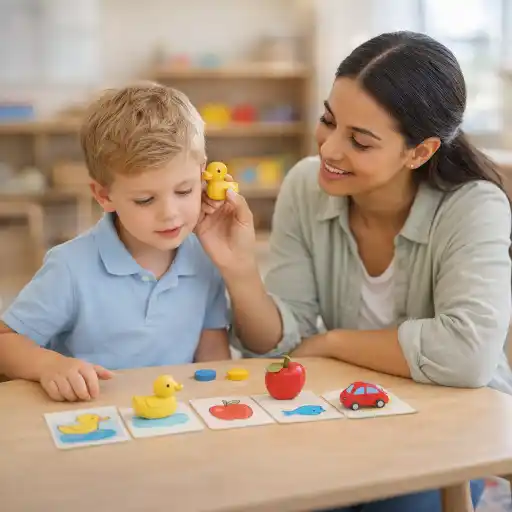
How can the Letter A activity connect tracing, pictures, and sounds?
The Letter A: Trace, Color & Find Activity Buy Now $0.49 is most effective when used as one part of a broader lesson rather than as isolated paper practice. The printable invites children to trace and color a large uppercase A while recognizing familiar A-themed pictures. That combination can support letter recognition, visual attention, fine-motor development, and an emerging connection between the symbol and its beginning sound.
Use a gradual sequence:
- Preview the pictures and confirm what each image represents.
- Say each word together: “This is an apple.”
- Ask children to listen for the first sound in apple.
- Model: “Apple begins with /a/.”
- Show uppercase A and name it.
- Invite children to trace A while saying its name or sound.
- Encourage children to color or find matching A pictures.
- Extend learning by searching the room for another A word.
Be attentive to picture vocabulary. If a child does not know the pictured word, difficulty with the sound may reflect vocabulary rather than phonological awareness. Add real objects, gestures, photographs, or family-language labels when useful. Children with developing fine-motor skills can trace with a finger first, form A with playdough, air-write it, or use a thick crayon.
Do not require perfect letter formation. The goal is a meaningful connection among the sound, the picture, and the symbol. Celebrate attempts and provide additional opportunities without pressure.
How can programs build repetition into the whole day?
Repetition is most powerful when the learning target stays consistent while the activity changes. A weekly focus on /a/ might begin with the Letter A activity, continue through an alphabet book, and reappear in dramatic play, name work, songs, and classroom exploration.
- During arrival, invite children to find A in name cards or labels.
- During a read-aloud, briefly notice A in a meaningful word.
- At transition time, play “I Spy something that starts with /a/.”
- In sensory play, hide large A letters and matching picture cards.
- In dramatic play, add an “animal hospital” or “apple market” sign.
- During outdoor play, search for objects or names beginning with /a/.
Revisit the same words, but vary the social and sensory format. Whole-group songs may build confidence; small-group sorting allows closer scaffolding; independent tracing supports fine-motor practice; movement games help children who learn best through action.
Use feedback that guides thinking rather than simply marking answers right or wrong. If a child places a ball with A, say, “Let’s say ball together. What do we hear first? /b/. Let’s compare it with apple.” Give wait time, reduce the number of choices, and model when necessary.
Directors can support consistency by providing shared picture cards, printable resources, common prompts, and planning time. The Classroom Tools for Emergent Literacy Buy Now $16.00 course offers additional approaches involving interactive read-alouds, labeling, reading buddies, and literacy-rich materials.
What common mistakes should educators avoid?
Moving children toward beginning-sound awareness is most successful when providers avoid rushing, overcorrecting, or relying on worksheets alone. A printable can be valuable, but it should be connected to conversation, objects, movement, and authentic print.
- Teaching too many sounds: Focus on one sound or a small, clearly contrasting set.
- Confusing letter names with sounds: Ask children what they hear before asking which letter represents it.
- Using unfamiliar pictures: Preview vocabulary and use real objects whenever possible.
- Overcorrecting pronunciation: Model the target respectfully and consider home-language differences.
- Expecting identical progress: Adjust choices, materials, wait time, and response modes.
- Making competition central: Use cooperative games and celebrate listening, effort, and explanation.
- Measuring only worksheet accuracy: Observe sound awareness during play, conversation, and routines.
Families can extend learning through simple activities such as finding household objects that begin alike, looking for A in a child’s name, or singing a sound-based song in the home language. State requirements vary - check your state licensing agency when selecting professional development, documenting progress, or determining whether a course meets local training expectations.
Conclusion: How can children successfully move from letters to beginning sounds?
Children move successfully from letter recognition to beginning-sound awareness when providers treat the transition as a connected developmental process. Start with meaningful words and pictures, invite children to listen and compare, introduce the letter after the sound is familiar, and offer tracing or writing as a purposeful extension.
The Letter A: Trace, Color & Find Activity can provide a focused hands-on opportunity, especially when paired with oral sound play, vocabulary support, environmental print, and repeated practice. The central goal is not worksheet completion; it is helping children understand that spoken words begin with sounds and that letters are meaningful symbols connected to those sounds.
For continued professional learning, consider these relevant ChildCareEd options:
- Understanding Print Knowledge in Preschool Buy Now $16.00
- Science of Reading Foundations in the Pre-K Classroom Buy Now $16.00
- Classroom Tools for Emergent Literacy Buy Now $16.00
- Language and Literacy Foundations in Pre-K Buy Now $16.00
- Assessment of Language and Literacy Skills Buy Now $24.00
When instruction is intentional, inclusive, and joyful, letter knowledge becomes a gateway—not a stopping point—to sound awareness, emergent writing, and confident future reading.
- Understanding Print Knowledge in Preschool
- Moving About the Classroom: Effective Transitions for Everyday
- Science of Reading Foundations in the Pre-K Classroom
- CDA Home Visitor Subject Area 3 Part 3 Birth to 5
- CDA Home Visitor Subject Area 2 Part 3 Birth to 5
- Safe and Sound: Creating Healthy Environments for Every Child
- Birth to Five CDA Credential with Portfolio Review
- CDA Bridge Bundle: Family Child Care without Portfolio Review
- Texas Director Credential
- Phonological Awareness
- Cómo Abrir Una guardería Para Niños Con Necesidades Especiales?
- 10 Ejemplos de Cómo la Cultura Influye en el Desarrollo Infantil
- Capacitación en Salud y Seguridad Preventiva en Línea para Proveedores de Cuidado Infantil
- Regulaciones de Licenciamiento de Cuidado Infantil en California para Centros y Hogares de Cuidado Infantil Familiar
- Proporciones de Cuidado Infantil y Tamaños de Grupo por Edad en Maryland (Guía Rápida para Centros y Hogares)
- Proporciones de Cuidado Infantil y Tamaños de Grupo por Edad en Nueva Jersey (Guía Rápida para Centros y Hogares)
- Proporciones de Cuidado Infantil y Tamaños de Grupo por Edad en Virginia (Guía Rápida para Centros y Hogares)
- Canciones, juegos y preguntas de círculo para niños
- Why Is Beginning-Sound Bingo a Smart Step Toward Reading?
- How Can Child Care Providers Help Children Recognize Letters Through Play?
- How Can Play Help Children Distinguish Uppercase and Lowercase Letters?
- How Can Child Care Providers Teach Beginning Sounds with Tracing, Pictures, and Repetition?
- How Can Child Care Providers Move Children from Letter Recognition to Beginning-Sound Awareness?
- How Can Child Care Providers Teach Less-Frequent Letters Without Relying on Worksheets Alone?
- How Can Seasonal Picture Sorting Build Phonemic Awareness in Early Childhood?
- What Should Effective Beginning-Sound Practice Include?
- How Can Familiar Household Words Help Children Complete CVC Words?
- How Can Picture Task Cards Help You Assess Beginning Sounds?
- What Can a Wrong Beginning-Sound Answer Tell a Preschool Teacher?
