A holiday activity pack can do more than fill a festive morning—it can turn children’s excitement about stars, flags, and summer celebrations into meaningful practice with words, numbers, and patterns. Explore how to use the Math Foundations in Early Childhood  Buy Now $16.00 course to strengthen your play-based math instruction, and consider Letter & Number Planning in Child Care Buy Now $24.00 for practical ways to plan literacy and numeracy together. These courses can help you build stronger classroom practices while you adapt the ideas below for your children.
Why combine literacy and math in a holiday activity pack?
Children do not experience learning in isolated subject areas. As they name colors, listen for rhymes, recognize letters, count objects, and compare quantities, they use language to express mathematical thinking and math experiences to give words concrete meaning. A thoughtfully used Fourth of July activity pack can bring these strands together through playful, hands-on experiences rather than extended seatwork.
For example, counting stars invites children to coordinate number words with objects. Matching an uppercase letter to a lowercase letter supports alphabet knowledge and visual discrimination. Sorting red, white, and blue pieces encourages children to describe attributes, explain choices, and use comparison words. These experiences build vocabulary and reasoning at the same time.
The goal is not to turn a celebration into a test or require every child to complete every page. Instead, use the pack as a flexible set of invitations. Children can explore materials at their own pace, while educators listen, model useful language, and offer the next small challenge. Research and professional guidance emphasize that developmentally appropriate math is connected to children’s active problem-solving and meaningful classroom experiences; see the NIEER overview of developmentally appropriate math and NAEYC’s math resources.
Which literacy and math skills can the activities support?
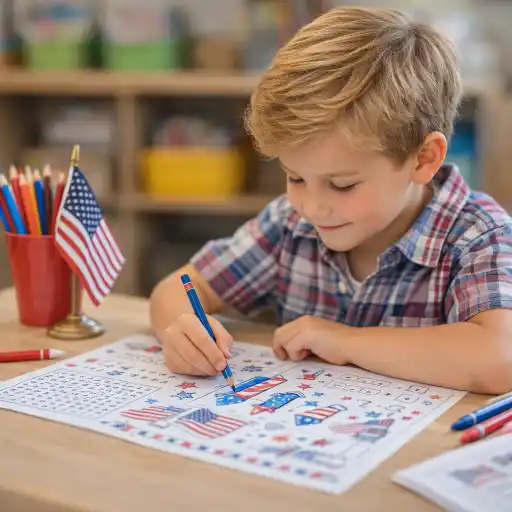
A well-chosen pack can provide multiple entry points for children with different interests and emerging skills. The described Fourth of July preschool activity pack includes examples such as rhyming stars, letter matching, counting cards, number puzzles, color sorting, shape matching, and seek-and-find tasks. Each can be adapted with educator prompts and accessible materials.
- Literacy: Match letters, notice beginning sounds, identify color words, listen for rhymes, follow picture cues, and mark items on a checklist.
- Math: Count objects with one-to-one correspondence, recognize numerals, order numbers, classify by color or size, identify shapes, and compare groups.
- Integrated thinking: Ask children to explain how they know two pieces match, describe what comes next in a sequence, or tell a short story about a picture.
Use precise but child-friendly language. Rather than asking only “What number is that?”, try “How many stars did you count, and how did you keep track?” When a child sorts picture cards, invite them to name the category and explain their choice. These open prompts make children’s thinking visible and support rich #language alongside early #math.
How can educators organize the pack as engaging learning centers?
Keep the setup focused: choose two or three activities that match your learning goals, rather than placing the entire pack out at once. A small-group rotation helps children handle materials comfortably and gives educators time to observe. Prepare materials in trays or labeled baskets, and use a picture cue or brief demonstration to make each station easy to enter.
- Read, rhyme, and match: Use a short holiday-themed story or picture discussion, then invite children to match rhyming images or identify familiar letters. Model a few words and let children contribute their own observations.
- Count and clip: Children count stars or other pictured objects, then match the total to a numeral. For children who need support, start with a smaller set and move objects as they count.
- Sort and describe: Offer large, safe counters or cards to sort by color, shape, or size. Encourage children to explain their rule and try another way to group the same materials.
- 🎉 Move and learn: Place large number or letter cards around the room. Invite children to move to a called-out card, say its name, and complete a simple action such as clapping four times.
Keep sessions brief and responsive. Younger children may benefit from large materials and fewer steps; preschoolers ready for more challenge might make a repeating pattern or compare two sets. Adapt any printables for children’s motor, language, sensory, and access needs. Avoid small loose pieces with children who may mouth objects, and supervise all materials according to program policy. For broader holiday planning context, review ChildCareEd’s age-appropriate Fourth of July activities for daycares.
How can you scaffold learning and notice children’s progress?
Scaffolding means offering just enough support for a child to participate and extend current understanding. Begin by observing what a child already does: Can they identify a few letters, count objects accurately, sort by one feature, or describe a picture? Use that information to choose the next prompt—not to compare children or rush them through a fixed sequence.
During an activity, model a strategy aloud: “I’ll touch each star once as I count, so I don’t count one twice.” Then pause and give the child time to try. If a task feels difficult, reduce the number of items, provide a visual model, or count together. If the child is ready, invite a more complex response: “Can you make a group with one more star?” or “What word rhymes with this picture?”
Capture learning with a short observation rather than a lengthy form. A note such as “Matched four letters independently; counted six stars, skipping one object” gives a useful next step for planning. A photo of a child-created pattern or a brief quotation can also document thinking, consistent with program policies and family permissions.
- Offer choices in materials and response: pointing, speaking, placing objects, or drawing.
- Use familiar home languages and invite children to share words or traditions, without asking any child to represent a whole culture.
- Celebrate strategies, persistence, and curiosity—not only correct answers.
What common pitfalls should providers avoid?
Holiday materials can be exciting, but too many choices or overly academic expectations may undermine the playful learning you intend. A pack is a resource, not a script: select activities based on the children in your group, their interests, and the time and staffing available. Keep the experience calm, inclusive, and flexible.
- Trying to cover every page: Choose a few activities with clear goals; rotate the rest on another day.
- Focusing on worksheets over interaction: Use printables as prompts for conversation, movement, matching, or hands-on counting.
- Correcting too quickly: Ask children to show how they reached an answer, and offer clues before supplying it.
- Assuming every family celebrates the same way: Use welcoming, optional language and focus on colors, summer, community, or children’s own experiences.
- Overlooking safety and accessibility: Check age suitability, material size, allergies where relevant, and individual accommodations; state requirements vary - check your state licensing agency.
Also watch for accidental skill overload. A child asked to identify letters, count to ten, follow several directions, and cut a shape at once may be managing too many demands. Separate steps, demonstrate one at a time, and let children participate in ways that fit their developmental level. ChildCareEd’s Fourth of July craft ideas offer additional reminders about simple setups, supervision, and age-appropriate materials.
How can you extend the learning beyond the activity pack?
Connect a center activity to the rest of the day so children revisit the ideas in natural contexts. After counting stars, count children at the table or steps on the way outside. After matching letters, look for those letters in children’s names, room labels, or a read-aloud. Repetition in new situations helps children use skills flexibly and gives educators more opportunities to hear their reasoning. For another seasonal example of using counting and patterns to build early STEM skills, explore candy cane-themed STEM activities for early learners.
Families can be invited into the learning with a low-pressure note: share a conversation prompt such as “What colors or patterns do you notice together?” or suggest counting objects during a routine at home. Avoid assigning families a required holiday activity; family traditions and schedules differ. A short explanation of the classroom learning goal helps caregivers understand that play supports both literacy and numeracy.
For staff, a brief planning reflection can make the next holiday pack easier to use. Identify one literacy objective and one math objective, choose a small number of activities, and decide what evidence of learning you will look for. The Early Mathematics Through Play Buy Now $24.00 course offers further strategies for weaving math into exploration, routines, and hands-on experiences. For a literacy-focused next step, explore Reading Aloud and Storytelling Buy Now $16.00 or Classroom Tools for Emergent Literacy Buy Now $25.00.
Conclusion: How can a holiday activity pack become meaningful learning?
A Fourth of July activity pack can blend literacy and math when educators use it as a flexible starting point for conversation, play, and observation. Rhyming, letter matching, counting, sorting, and number ordering each provide opportunities to connect print, vocabulary, quantity, and reasoning. Keep the choices manageable, adapt tasks to children’s developmental needs, and use open-ended prompts that let children explain their thinking.
Most of all, remember that a successful holiday activity is not measured by how many pages children finish. It is measured by the curiosity, language, problem-solving, and confidence they practice along the way. Plan one or two intentional connections, notice small gains, and build from there. For deeper support in planning playful, integrated math experiences, explore Math Foundations in Early Childhood Buy Now $16.00.
- Moving About the Classroom: Effective Transitions for Everyday
- Early Mathematics Through Play
- The ABCs of Behavior: Turning Challenges into Learning Opportunities
- Setting the Stage: Story Time
- Pediatric RSV First Aid & CPR/AED
- Math Foundations in Early Childhood
- Texas Director Credential
- Letter & Number Planning in Child Care
- Montessori Cultural Activities: Exploring the World Through Play and Learning
- Supporting Families and Caregivers in Language and Literacy
- CDA Certification en Español: Recursos y Consejos para Educadores Bilingües
- 🍑 ¿Qué capacitación requiere DECAL cada año para el personal de cuidado infantil en Georgia?
- Recursos en Español sobre el Sueño Seguro del Bebé
- Cómo ser director de cuidado infantil en Maryland
- ¿Cuáles son las mejores actividades de primeros auxilios para adultos?
- ¿Cómo pueden los equipos de cuidado infantil practicar habilidades rápidas de primeros auxilios en situaciones reales?
- ¿Cómo puedo enseñar habilidades de primeros auxilios con escenarios de juego de roles?
- 10 Ejemplos de Cómo la Cultura Influye en el Desarrollo Infantil
- Proporciones de Cuidado Infantil y Tamaños de Grupo por Edad en Maryland (Guía Rápida para Centros y Hogares)
- Proporciones de Cuidado Infantil y Tamaños de Grupo por Edad en Nueva Jersey (Guía Rápida para Centros y Hogares)
- Proporciones de Cuidado Infantil y Tamaños de Grupo por Edad en Virginia (Guía Rápida para Centros y Hogares)
- Lista para Guardería en Casa en Illinois: Cómo Iniciar una Guardería en el Hogar
- Cómo Trabajar en el Cuidado Infantil en Carolina del Norte: Requisitos y Pasos
- Capacitación Previa al Servicio para Proveedores de Cuidado Infantil en Nevada
- Celebrando la amistad en el cuidado infantil durante el Día de los Mejores Amigos
- Canciones, juegos y preguntas de círculo para niños
- Cómo simplificar la capacitación para sus empleados de daycare
- How Can Child Care Providers Integrate Counting into Seasonal Art Activities?
- How Can a Fourth of July Activity Pack Blend Literacy and Math?
- ¿Cómo puede la retroalimentación visual apoyar la fluidez en la multiplicación?
