December’s excitement can make it hard to hold preschoolers’ attention, but familiar seasonal stories, sounds, and symbols offer inviting ways to practice early literacy. Try the activities below to connect playful moments with real skills—and explore ChildCareEd’s Science of Reading Foundations in the Pre-K Classroom Buy Now $16.00 and Reading Aloud and Storytelling  Buy Now $16.00 courses for practical strategies on phonological awareness, vocabulary, comprehension, and interactive read-alouds.
Why use holiday play to build early reading skills?
Preschoolers are not expected to read conventionally. They are building the knowledge that supports later reading: listening closely to words, noticing sounds and letters, understanding that print carries meaning, learning vocabulary, and talking about stories. Festive activities can make these ideas concrete through movement, songs, picture cards, pretend play, and shared books.
The value lies in intentional interaction—not in making every activity elaborate or turning play into a test. A quick rhyme during circle time, a child noticing the first letter of “tree,” or a conversation about a story illustration can become a meaningful literacy opportunity. NAEYC describes phonological awareness as noticing and working with the sound structure of spoken language; Reading Rockets recommends weaving this learning into daily activities while connecting sounds with letter knowledge.
As you choose activities, follow children’s curiosity and offer multiple ways to participate. Some children will want to name letters; others may prefer listening, moving, pointing, or telling a story. These flexible experiences support #literacy, #phonologicalawareness, and a positive relationship with books—without expecting preschoolers to master skills before they are ready.
How can rhyme and sound games strengthen listening?
Rhyme and sound games help children attend to how words sound. Keep the focus playful: the goal is to hear, compare, and experiment with sounds, not to produce perfect answers. Introduce a few familiar words at a time, model your thinking, and welcome invented rhymes as part of exploration.
- 1. Rhyming gift bags: Place a familiar object or picture in each bag. A child draws one, names it, and suggests a word that rhymes. If the object is a block, try “clock” or a playful nonsense rhyme such as “flock.” Offer a sound-matching version for children who are beginning to notice first sounds.
- 2. Paper snowball rhyme toss: Write pairs of words on paper, crumple them into “snowballs,” and take turns opening one. Say the words aloud and invite children to decide whether they sound alike at the end. Make tossing gentle and use a clear, open space.
- 3. Christmas rhyme corners: Put picture cards in different classroom areas—for example, tree, sleigh, and stocking. Say a word such as “bee” and invite children to move toward the matching rhyme. Let children answer by pointing or saying the word if they prefer not to move.
- 4. Carol pause-and-rhyme: Sing a familiar seasonal song, pause at a word, and invite children to think of another word with a similar ending sound. Choose songs that are familiar to the group and offer non-holiday rhymes as an alternative.
Give children time to listen before answering. Repeat words clearly and explain the sound match—“Tree and bee rhyme because their endings sound alike.” Activities like these support the foundations of #reading while keeping language joyful and social.
How can letter and beginning-sound activities make print meaningful?
Children learn about letters through repeated, purposeful encounters—not by racing through the alphabet. Use a few letters at a time, starting with children’s names or letters they already notice. Pair the letter symbol with a spoken sound and a picture or object, while avoiding pressure to pronounce sounds in exactly the same way as an adult.
- 5. Santa’s sound sack: Put a few safe, familiar objects in a cloth bag. A child selects one, names it, and listens for its beginning sound. Ask, “What sound do you hear first in bell?” If helpful, offer two possible sounds or model the answer.
- 6. Christmas-tree letter match: Make simple tree cards with large letters and small picture “ornaments.” Children match a picture to a letter with the same beginning sound. Start with a small set, such as /b/ for bell and /t/ for tree, then add more as children show interest.
- 7. Reindeer letter hunt: Place a few large letter cards around the room. Call out a letter or sound and invite children to find it, point to it, or carry its matching picture to a reindeer poster. Keep walking paths clear and manage turns so movement stays safe.
- 8. Stocking name search: Place the letters of children’s names in labeled stockings or envelopes. Invite each child to find, order, or match the letters in their name. Children can use a name card as a visual guide rather than relying on memory.
Connect each activity to meaningful language: name the object, describe its features, and say the sound naturally. Beginning sounds are only one part of phonological awareness; children also benefit from stories, conversation, and a print-rich environment. These playful #letters experiences give children repeated chances to notice how spoken words and print relate.
How can books, storytelling, and vocabulary turn activities into literacy?
A shared story gives children a common experience to revisit through talk, play, and creative work. Choose a book with clear illustrations and an engaging plot, and preview it for suitability to your group. Christmas books are one option; winter, family, and other seasonal stories can also provide a welcoming choice for children with different backgrounds and traditions.
- 9. Read, pause, and wonder: During a read-aloud, invite children to notice a picture, predict what may happen, or connect an event to something they know. Use open questions such as “What do you notice?” and “What might the character try next?” Pause long enough for children to respond in words, gestures, or pointing.
- 10. Make a class story or message: Invite children to dictate a short story about a winter adventure, a helpful character, or a classroom celebration. Write their words where they can see them, reread the text together, and let children add drawings, labels, or marks. A simple greeting card or pretend letter can provide a genuine reason to communicate through print.
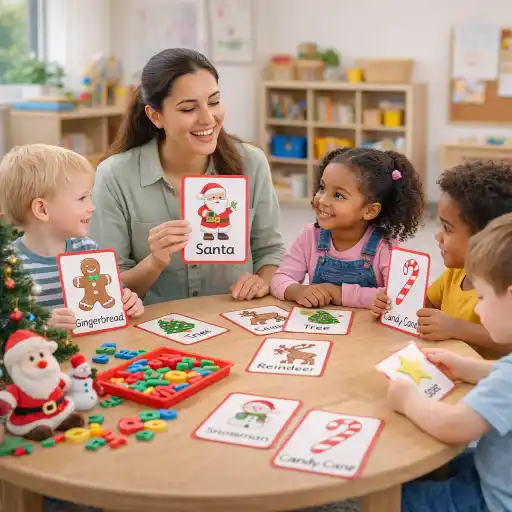
Revisit new words in conversation and play—for example, “ornament,” “glow,” “journey,” or “generous.” Ask children to explain an idea in their own way rather than requiring a memorized definition. Interactive reading and dialogic reading approaches encourage children to talk about pictures and events, gradually moving from naming objects toward describing what is happening and connecting it to experience. ChildCareEd’s Christmas Minibook: Preschool Literacy Buy Now $0.00 is one optional printable resource to pair with a shared literacy experience.
How can providers adapt activities for different learners and families?
Children bring different language backgrounds, motor abilities, interests, and experiences to the classroom. Adapt the activity so each child can engage meaningfully: use large, high-contrast cards; offer tactile letters; reduce the number of choices; provide extra wait time; or allow children to answer by pointing, gesturing, using a communication device, or speaking in a home language.
Keep activities brief, flexible, and open to choice. A child who watches the rhyme game may be learning by listening. Another child may know a letter’s name but not its sound yet. Respond with encouragement and a clear model rather than correction that interrupts the play. For multilingual children, accept words from home languages and explore similarities or differences in sounds with care; rhyme patterns are language-specific, so a rhyme in English may not rhyme when translated.
Christmas-specific content should not be treated as universal. Explain that some families celebrate Christmas and others may mark the season differently or not celebrate holidays. Offer a parallel winter story, open-ended art invitation, or other appealing literacy choice. Families should not be asked to disclose beliefs or provide materials in order for their child to belong. State requirements vary - check your state licensing agency, and follow program policies for supervision, materials, and accessibility.
How can educators make these activities practical and purposeful?
During a busy season, small routines are often more sustainable than a full themed overhaul. Choose two or three activities that match children’s current interests and repeat them across the week. Repetition lets children anticipate the routine and try a skill again with greater confidence. Keep materials organized in baskets or simple centers, and use everyday objects where possible.
Notice children’s responses as you play. Are they beginning to hear rhymes, recognize a few letters, use new words, or retell a story event? These observations can help you adjust the next invitation, but the activity should not become a formal test. If a task feels frustrating, reduce the choices, model the first turn, or shift to a song or book.
- Start with the learning purpose: rhyme, letter noticing, sound awareness, vocabulary, or story comprehension.
- Show how to play, then let children take the lead and repeat as they wish.
- Offer choices to participate, observe, or choose a related alternative.
- 🎄 Keep movement games spacious, supervised, and simple enough for children to manage safely.
- Share a brief activity idea with families, inviting—not requiring—continued play at home.
For deeper professional learning, ChildCareEd offers Language and Literacy Foundations in Pre-K Buy Now $16.00 and Classroom Tools for Emergent Literacy Buy Now $25.00. These courses provide additional strategies for building language-rich experiences and supporting emerging literacy in everyday classroom practice.
Conclusion: What makes Christmas literacy activities effective?
Effective Christmas-themed literacy activities are playful, purposeful, and responsive to the children in your care. Rhyming games help children listen for sound patterns; letter and beginning-sound games connect symbols to spoken words; and shared books, storytelling, and dictation support vocabulary, comprehension, and the idea that print communicates meaning.
Keep expectations developmentally appropriate: preschoolers are building foundations for reading, not being asked to perform as independent readers. Offer repeated practice, clear models, flexible ways to participate, and inclusive alternatives for children and families. Whether you try one rhyme bag or create a small read-aloud routine, the most important goal is to make language and books part of warm, engaging relationships. How can ten Christmas-themed activities support early reading? By giving children joyful, repeated opportunities to hear, see, talk about, and play with language.
- What Makes Me Special: An Overview of Autism and ADHD
- From Tantrums to Triumphs: Equipping Preschoolers with Self-Regulation Skills
- From Tantrums to Triumphs: Equipping Preschoolers with Self-Regulation Skills
- CDA Bridge Bundle: Family Child Care without Portfolio Review
- CDA Bridge Bundle: Infant/Toddler without Portfolio Review
- CDA Bridge Bundle: Preschool without Portfolio Review
- Language and Literacy Foundations in Pre-K
- Montessori Cultural Activities: Exploring the World Through Play and Learning
- Supporting Families and Caregivers in Language and Literacy
- Read Across America Day
- Cultivating Literacy, Language, and Cultural Awareness: The Hanukkah Minibook in Early Childhood Education
- CDA Certification en Español: Recursos y Consejos para Educadores Bilingües
- 🍑 ¿Qué capacitación requiere DECAL cada año para el personal de cuidado infantil en Georgia?
- Recursos en Español sobre el Sueño Seguro del Bebé
- Actividades de Motricidad Gruesa que Desarrollan el Equilibrio, la Coordinación y la Fuerza
- Proporciones de Cuidado Infantil y Tamaños de Grupo por Edad en Maryland (Guía Rápida para Centros y Hogares)
- Cómo Trabajar en el Cuidado Infantil en Carolina del Norte: Requisitos y Pasos
- Calabazas, hojas y manzanas: actividades de otoño para preescolares
- Celebrando la amistad en el cuidado infantil durante el Día de los Mejores Amigos
- Canciones, juegos y preguntas de círculo para niños
- Superhero Activities for Preschoolers: Play, Create, and Learn
- How Can I Use Fun Math Activities for Preschoolers Every Day?
- What simple early literacy activities really work for preschoolers?
- How can preschool programs build early literacy every day?
- How Can Themed Vocabulary Strengthen Beginning-Sound Awareness in Preschool?
- How Can Holiday Word Games Strengthen Visual Scanning and Spelling?
- How Can Low-Prep Christmas Activities Build Preschoolers’ Visual Planning?
- How Can 10 Christmas-Themed Literacy Activities Help Preschoolers Develop Early Reading Skills?
- How Can Holiday Writing Activities Work for Children at Different Skill Levels?
