Young children’s first writing attempts become more powerful when the words connect to ideas, relationships, and histories that matter. Use Juneteenth vocabulary to build language, fine-motor practice, and thoughtful classroom conversations—and explore ChildCareEd’s Cultures in the Classroom  Buy Now $24.00 course to strengthen your approach to celebrating culture and diversity. For targeted strategies in early writing and literacy, the Classroom Tools for Emergent Literacy Buy Now $16.00 course offers another useful next step as you plan meaningful experiences.
Why connect Juneteenth vocabulary with early writing?
Juneteenth commemorates June 19, 1865, when enslaved people in Texas learned they were free—more than two years after the Emancipation Proclamation was issued. For young children, the learning goal is not to cover every historical detail. Educators can introduce accurate, age-appropriate language about freedom, fairness, family, kindness, and community, while acknowledging that Juneteenth remembers an important moment in Black history and the continuing value of freedom.
Writing gives children a way to notice, revisit, and communicate these ideas. The National Association for the Education of Young Children describes emergent writing as children’s early attempts to represent thoughts through drawings, marks, letters, and words. Meaningful words provide a reason to write: a child might draw a family gathering, make marks to represent a message, or try to copy a word that resonates.
Vocabulary learning is not simply memorizing definitions. Children develop understanding through repeated encounters in conversation, stories, play, and writing. A brief, respectful Juneteenth experience can support #literacy, fine-motor development, and belonging when it is connected to children’s questions and classroom relationships.
Which words are meaningful and developmentally appropriate?
Choose a small group of words that children can connect to everyday experiences as well as the holiday’s significance. The Juneteenth Word Tracing resource features words such as “freedom,” “kindness,” “family,” “love,” and “community.” These words can anchor conversation and writing, but tracing should accompany—not replace—explanation, stories, and child-led expression.
- Freedom: Explain simply that freedom means being able to make important choices and live without being controlled unfairly. Link it carefully to Juneteenth’s history.
- Fairness: Invite children to notice what fair treatment looks and feels like in classroom routines.
- Family: Recognize that families can look and celebrate in many different ways.
- Kindness and love: Connect these words to care, friendship, and how people support one another.
- Community: Talk about people who help a group learn, celebrate, and care for one another.
Offer child-friendly explanations without flattening history into a generic message. One possible introduction is: “Juneteenth is a day when many people remember that enslaved Black people in Texas learned they were free. We talk about freedom and fairness, and we celebrate Black history and community.” If children ask questions, listen, answer honestly in brief language, and follow their lead. The ChildCareEd guidance on introducing Juneteenth in developmentally appropriate ways offers further ideas for thoughtful conversations.
How can tracing support emergent writing rather than rote practice?
Tracing can introduce the shape and direction of letters and invite children to coordinate vision and hand movements. Yet children’s writing development is broader than forming neat letters. They learn that print carries meaning, gain experience handling writing tools, and begin to use marks and words to express ideas. NAEYC’s discussion of emergent writing emphasizes the value of connecting writing mechanics to communication and providing opportunities suited to each child’s current abilities.
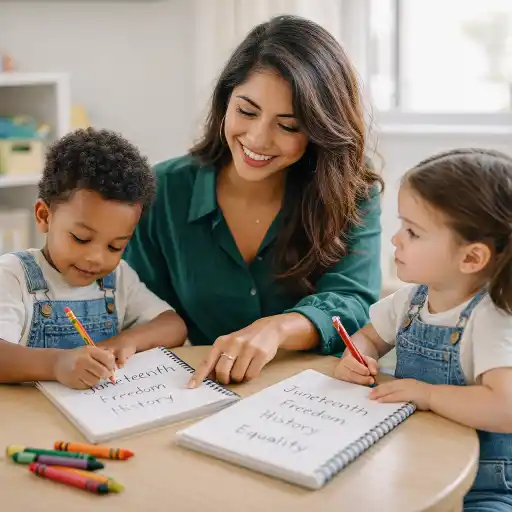
Make the activity purposeful by treating each traced word as a starting point for language. Before children begin, say the word together, discuss what it could mean, and invite them to connect it to an image, story, or experience. As they trace, describe the action without judging precision: “You are following the letters in community.” Afterward, ask what they would like to add to the page.
The Juneteenth Word Tracing resource Buy Now $0.99 offers children meaningful words to trace and pictures to color. Use it as one option in a broader literacy plan, not as a stand-alone lesson or test of fine-motor readiness.
- Model one word by saying it aloud and tracing slowly with your finger.
- Let children choose whether to trace, copy, dictate, draw, or make their own marks.
- Write a child’s dictated caption beside their drawing, preserving their intended meaning.
- Notice effort, curiosity, and communication—not whether a child stays precisely inside a line.
Offer larger paper, chunky crayons, adapted grips, extra time, or non-writing ways to participate. Children’s attempts count as real writing when they are used to communicate.
How can providers build a vocabulary-to-writing experience?
A short sequence helps children encounter a word in several connected ways. For example, select “community” and introduce it with a picture book or a simple discussion about people who care for one another. Ask children what they notice in the illustrations, then invite them to draw a community moment—a shared game, a family gathering, or classmates helping clean up. Children can trace the word, dictate a caption, or make marks that they explain in their own words.
Support oral language with open-ended prompts: “What do you notice?” “Who is helping?” and “What makes this group feel connected?” Avoid telling children what every image or symbol must mean. Their responses help educators see what vocabulary they understand and what concepts may need more conversation.
- 📚 Connect: Read a short book or offer a clear, brief explanation of Juneteenth.
- Explore: Introduce one or two target words with pictures, conversation, or objects.
- Create: Invite children to trace, draw, write, dictate, or use alternative tools.
- Share: Ask children whether they want to describe their work; participation can be verbal, gestural, or private.
- Extend: Add children’s captions to a class book or display, with permission and care.
Revisit the words during play and routines. A child might use “kindness” in a message for a friend or “family” while discussing a story. For multilingual learners, welcome home-language contributions and provide visuals or bilingual labels when possible. These approaches honor the fact that children can express knowledge in more than one language or mode.
How can educators make the lesson culturally responsive and inclusive?
Juneteenth is a meaningful opportunity to teach, not a costume or craft theme detached from history. Center Black voices and experiences through carefully selected children’s books and materials, and include Black joy, creativity, community, and resilience rather than focusing only on hardship. Keep historical explanations honest and age-conscious. Avoid suggesting that Juneteenth is merely a celebration of kindness or that every Black family observes the holiday in the same way.
Family partnership can make planning more responsive. Invite caregivers to share a book, song, word, or tradition if they wish, while making clear that participation is optional. Do not ask a child or family to speak for an entire community or take responsibility for teaching the class. Reflect on whether materials represent children and families with respect throughout the year, not only during a holiday.
Common pitfalls are often easy to avoid with intentional planning:
- Do not overload preschoolers with lengthy explanations; select a few clear ideas and return to them through play.
- Do not reduce the activity to tracing or coloring; connect words to conversation, stories, and children’s meaning-making.
- Do not correct children’s marks as though conventional spelling and handwriting are the only valid forms of writing.
- Do not assume one symbol or color has a single meaning for every child; invite observation and questions.
- Make participation accessible, and respect children who prefer to observe or express themselves in another way.
When planning events, food, or visitors, follow program policies; state requirements vary - check your state licensing agency. Staff reflection and shared planning help ensure the experience is respectful, accurate, and developmentally appropriate.
How can programs extend learning and strengthen staff practice?
Use children’s words and work to plan what comes next. If children are curious about fairness, revisit the idea through classroom problem-solving, stories, or a group discussion about taking turns. If a child returns to the word “family,” add books and dramatic-play materials that reflect different family structures. Brief observations—what a child said, drew, traced, or attempted—can help educators plan a responsive follow-up without turning the activity into a formal test.
Share a simple, optional take-home prompt with families, such as “Ask your child which Juneteenth word they remember and invite them to draw what it means to them.” Provide the prompt in accessible language and, when feasible, in families’ home languages. Do not require families to celebrate or complete an assignment.
Professional learning can help staff connect cultural responsiveness with daily teaching decisions. The online Cultures in the Classroom course Buy Now $24.00 focuses on celebrating culture and diversity and fostering acceptance among young children. For complementary literacy practice, consider Classroom Tools for Emergent Literacy Buy Now $25.00 or Building Vocabulary Buy Now $16.00. These English-language courses offer additional professional learning; confirm any training-hour needs with your registry, employer, or licensing agency, since acceptance and requirements may vary.
Conclusion: How can meaningful Juneteenth words nurture early writers?
Meaningful Juneteenth vocabulary can give early writers something real to communicate. Select a few words—such as freedom, fairness, family, kindness, and community—explain them accurately in developmentally appropriate language, and connect them to stories, conversation, drawing, and children’s own writing attempts. Tracing can help children explore letter forms, but it works best as one part of a language-rich experience where ideas matter more than perfect lines.
Above all, center history with care, respect children’s different ways of participating, and work in partnership with families without asking any child or caregiver to represent a whole community. With thoughtful planning, a simple word-tracing activity can become an inviting doorway to literacy, reflection, and belonging.
- CDA Home Visitor Subject Area 3 Part 3 Birth to 5
- Reading Aloud and Storytelling
- Language and Literacy Foundations in Pre-K
- From Play to Planning: Building Culturally Competent, Child-Centered Curriculum
- Connections That Count: Building Relationships in Child Care
- Texas Director Credential
- Building Vocabulary
- Classroom Tools for Emergent Literacy
- Supporting Families and Caregivers in Language and Literacy
- CDA Certification en Español: Recursos y Consejos para Educadores Bilingües
- 🔍 ¿Qué ves cuando observas a un niño aprender?
- 💛🧩 ¿Cómo puedo hacer que mi enseñanza sea inclusiva para los niños con autismo?
- 👶 ¿Cuáles son las proporciones y grupos requeridos en Dakota del Norte? 🏫
- Curso Gratis De Cuidado Infantil Con Certificado
- Recursos en Español sobre el Sueño Seguro del Bebé
- 10 Ejemplos de Cómo la Cultura Influye en el Desarrollo Infantil
- Proporciones de Cuidado Infantil y Tamaños de Grupo por Edad en Virginia (Guía Rápida para Centros y Hogares)
- Cómo Ayudar a Niños con Retraso del Habla en el Cuidado Infantil
- Cómo Trabajar en el Cuidado Infantil en Carolina del Norte: Requisitos y Pasos
- Celebrando la amistad en el cuidado infantil durante el Día de los Mejores Amigos
- Canciones, juegos y preguntas de círculo para niños
- Cómo simplificar la capacitación para sus empleados de daycare
- How Can Teachers Build Early Literacy Without Screens or Worksheets?
- How Can Child Care Programs Celebrate Juneteenth Through Respectful, Child-Centered Art?
- How Can Coloring Pages Spark Meaningful Historical Conversations About Juneteenth?
- How Can Juneteenth Symbols Build Visual Memory in Young Children?
- How Can Meaningful Juneteenth Vocabulary Support Early Writers?
- How Can Drawing and Dictation Help Children Respond to Juneteenth?
- ¿Todos los niños deben participar en el tiempo de círculo?
