Letter learning becomes more meaningful when children can touch, move, discover, and use print for real purposes. Explore Science of Reading Foundations in the Pre-K Classroom Buy Now $16.00 to deepen your knowledge of alphabet knowledge, phonological awareness, and emergent writing, and consider Classroom Tools for Emergent Literacy Buy Now $25.00 for practical classroom strategies and materials. These courses can help you strengthen daily literacy practices and support professional learning goals; state requirements vary, so check your state licensing agency.
Why does playful letter recognition matter?
Recognizing letters is more than memorizing an alphabet chart. Children gradually learn to notice a symbol, name it, distinguish it from other symbols, and connect it with spoken language. These abilities contribute to alphabet knowledge, print awareness, phonological awareness, and later reading and writing.
Play gives children a reason to look closely at letters. A child may search for the first letter of their name, build a pretend sign for a grocery store, or “rescue” a magnetic letter from a sensory bin. Because the activity has meaning, children often repeat the skill willingly. This aligns with the principle that play can support early reading and writing through language, print, and social interaction.
Purposeful play also allows providers to observe development without turning learning into a test. Notice which letters children recognize spontaneously, which forms they confuse, and what kinds of movement or materials help them persist. Keep expectations responsive: toddlers may benefit from exposure and naming, while older preschoolers may be ready to match cases, identify beginning sounds, or construct familiar words.
- 🔤 Play connects letter shapes with names, sounds, and meaning.
- Children receive repeated practice without worksheet fatigue.
- Hands-on materials support visual, tactile, auditory, and motor learning.
- Providers can differentiate activities while preserving children’s choice.
Which letters should we introduce first?
Begin with letters that are personally meaningful and visually accessible. A child’s name is an especially powerful starting point because it represents identity and belonging. Display each child’s name at cubbies, sign-in areas, job charts, and artwork. Invite children to notice the first letter, compare names, and find the same symbol elsewhere.
Uppercase letters are often easier for young children to distinguish because their forms are generally more consistent in height. However, lowercase letters appear frequently in books and environmental print. Rather than postponing lowercase letters indefinitely, introduce uppercase and lowercase forms gradually and connect them explicitly: “This is uppercase M, and this is lowercase m. They are two ways to write the same letter.” Guidance on uppercase- and lowercase sorting emphasizes comparison, classification, and repeated retrieval.
Choose a small set of target letters rather than presenting all 26 at once. Four to six familiar letters may be enough for a beginning activity. Select letters with clear visual differences, then gradually include forms that are more alike. Avoid implying that children must master letters in a prescribed order; developmental readiness, language background, and personal interests matter.
- Start with letters in children’s names and meaningful classroom words.
- Use clear, high-contrast forms before introducing unusual fonts.
- Pair letter names with sounds when children are ready.
- Revisit familiar letters across books, centers, routines, and outdoor play.
What hands-on games make letter recognition engaging?
Effective games are brief, repeatable, and easy to adapt. The goal is not speed; it is thoughtful attention to symbols and language. Model the activity first, then invite children to participate with increasing independence.
- Letter treasure hunt: Hide large letter cards around the room or playground. Children find a card, name it if they can, and place it beside a matching name card or alphabet mat.
- Sensory letter search: Add sturdy plastic or foam letters to a bin of rice, sand, water, or large safe materials. Ask children to find a target letter, describe its lines or curves, and match it to a card.
- Play-dough construction: Children roll “snakes” and form letters, press letters into dough, or build the letters in their names. The activity strengthens fine-motor control while reinforcing shape memory.
- Letter hop: Place letters on the floor and call one out. Children hop, tiptoe, or drive a toy vehicle to the correct symbol. Add a sound prompt only when developmentally appropriate.
- Environmental print walk: Look for letters on labels, signs, books, menus, and packaging. Ask, “Where do you see a letter from your name?”
- Mystery letter bag: Place a few large letters in a bag. Children feel one, describe its shape, make a guess, and then check visually.
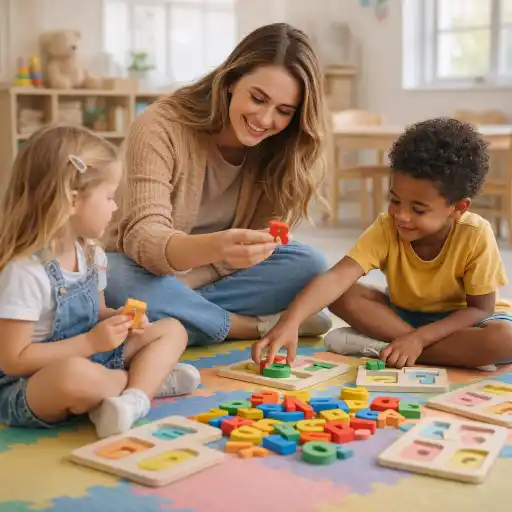
Movement-based activities are especially useful for children who find seated practice difficult. Music, gestures, and gross-motor games can make repetition feel fresh.
How can providers connect letters with sounds and meaningful print?
Letter recognition and sound awareness are related but distinct. Children can know a letter’s name without consistently producing its sound, and they may hear a beginning sound before they can identify the corresponding symbol. Build connections gradually rather than requiring every activity to address every skill.
Use familiar objects and children’s names to make sound work concrete. During an “I Spy” game, say, “I spy something that starts with /b/.” When a child finds a ball or book, show the letter B and repeat the connection naturally. In a dramatic-play center, add menus, tickets, labels, order forms, and name tags. Children then encounter letters as tools for communication rather than isolated symbols.
Read alphabet books, rhyming books, and predictable stories interactively. Point to selected letters, invite children to locate the first letter of a character’s name, and repeat interesting words. Avoid interrupting every page with questions; one or two intentional prompts are usually enough. The ChildCareEd resource Understanding Print Knowledge in Preschool highlights the value of print referencing, book handling, environmental print, and name-writing opportunities.
- Use pictures and objects to clarify beginning sounds.
- Include children’s home languages, names, songs, and family print whenever possible.
- Offer writing tools in dramatic play so children can imitate meaningful adult writing.
- Connect found letters to words, but do not pressure children to decode before they are ready.
How should classrooms and routines support playful letter learning?
A well-organized environment makes letter practice available throughout the day. Create a welcoming book area with accessible shelves, alphabet books, name books, puppets, and writing materials. Label bins and centers with both pictures and words so children can connect objects to print.
Place magnetic letters, alphabet puzzles, stamps, chalk, clipboards, markers, and play-dough tools where children can use them independently. Rotate only some materials at a time; familiar resources support confidence, while a few new items renew curiosity. Include culturally relevant books, names, signs, and languages so the print-rich environment reflects the children and families in the program.
Build predictable literacy moments into existing routines rather than adding a demanding lesson. For example:
- At arrival, children locate their name card and make a sign-in attempt.
- During transitions, children sing a letter song or move like the shape of a target letter.
- During read-alouds, the provider briefly points out a meaningful letter or word.
- During centers, children use print in stores, restaurants, post offices, construction sites, and art studios.
- Before dismissal, children share one letter they noticed or used.
Safety remains essential. Supervise sensory activities, inspect materials, and follow age-appropriate small-parts practices. State requirements vary - check your state licensing agency. For additional ideas about intentional literacy environments, see building early literacy skills through play.
How can we differentiate, document progress, and avoid common mistakes?
Children develop letter knowledge at different rates. A responsive provider adjusts the number of choices, the size of materials, the amount of prompting, and the sensory demands. A child beginning to notice print might match two identical letters. A child with more experience might sort uppercase and lowercase forms, locate letters in words, or identify a beginning sound.
- Beginning: explore large letters, match identical forms, and recognize letters in the child’s name.
- Developing: name familiar uppercase and lowercase letters and find them in books or labels.
- Extending: connect selected letters to sounds, sort by features, and build names or simple words.
- Access supports: use larger pieces, strong contrast, verbal choices, visual models, and pointing instead of requiring precise grasping.
Document learning through short anecdotal notes, photographs, child-created work, and occasional checklists. Record what the child did independently, what prompt helped, and what might be offered next. Assessment of Language and Literacy Skills is another ChildCareEd course that can help providers turn observations into meaningful goals: explore the course  Buy Now $24.00.
Common mistakes include overusing flashcards, introducing too many letters, correcting every attempt, and treating invented writing as failure. Instead, model accurately, invite another try, celebrate effort, and return to successful activities. Short, frequent practice is usually more productive than long sessions.
Summary: How can children recognize letters through play?
Children recognize letters most effectively when they encounter them repeatedly in meaningful, enjoyable, multisensory experiences. Start with names and familiar print, introduce a manageable number of letters, connect uppercase and lowercase forms, and gradually link symbols with sounds. Use sensory bins, movement games, play-dough, environmental print walks, dramatic play, interactive books, and purposeful writing.
Observe each child’s strengths and next steps, adapt materials without lowering expectations, and partner with families through simple home activities such as name hunts, shared reading, and finding letters on signs. Play does not replace intentional teaching; it gives intentional teaching a context children can understand and enjoy. With thoughtful invitations and steady repetition, providers can help children approach letters with curiosity, confidence, and a growing sense that print belongs in their world.
Additional ChildCareEd courses
- Science of Reading Foundations in the Pre-K Classroom
- CDA Home Visitor Subject Area 3 Part 3 Birth to 5
- Language and Literacy Foundations in Pre-K
- Play with Purpose: Supporting Children with Autism
- Creating Engaging and Meaningful Learning Experiences
- Creating Environments that Nurture Growth and Community
- Texas Director Credential
- Letter & Number Planning in Child Care
- Montessori Cultural Activities: Exploring the World Through Play and Learning
- Theories on How I Grow
- CDA Certification en Español: Recursos y Consejos para Educadores Bilingües
- 10 Ejemplos de Cómo la Cultura Influye en el Desarrollo Infantil
- Proporciones de Cuidado Infantil y Tamaños de Grupo por Edad en Maryland (Guía Rápida para Centros y Hogares)
- Proporciones de Cuidado Infantil y Tamaños de Grupo por Edad en Virginia (Guía Rápida para Centros y Hogares)
- Cómo Trabajar en el Cuidado Infantil en Carolina del Norte: Requisitos y Pasos
- Celebrando la amistad en el cuidado infantil durante el Día de los Mejores Amigos
- Canciones, juegos y preguntas de círculo para niños
- How can child care providers support name recognition and letter awareness effectively?
- Is My Preschooler Ready for Kindergarten? Milestones Beyond ABCs and 123s
- How Can Child Care Programs Build Meaningful Kindergarten Readiness?
- Why Is Upper- versus Lowercase Sorting Great for Letter Recognition?
- How Can Child Care Providers Help Children Recognize Letters Through Play?
- How Can Providers Show Families the Learning Behind Play?
- How Can Child Care Providers Move Children from Letter Recognition to Beginning-Sound Awareness?
- How Can Child Care Providers Teach Less-Frequent Letters Without Relying on Worksheets Alone?
- How Can Providers Connect Letter Formation, Sound, and Vocabulary in Phonics Instruction?
- How Can Child Care Providers Build Food Vocabulary and Word Recognition Together?
- How Do Color-Word Activities Support Reading Automaticity?
- How Can You Choose CVC Word Activities That Match a Beginning Reader’s Skill Level?
