As child care leaders and providers, you face choices each day about how to respond when children test limits. This article compares #guidance with #punishment and shows simple, practical steps your team can use to teach skills and keep your #children and classroom calm. Why it matters: When adults teach rather than punish, kids learn self-control, trust grows, and staff stress goes down. State requirements vary - check your state licensing agency.
For quick reading, this article uses numbered lists, short paragraphs, and links to trusted resources on ChildCareEd so yo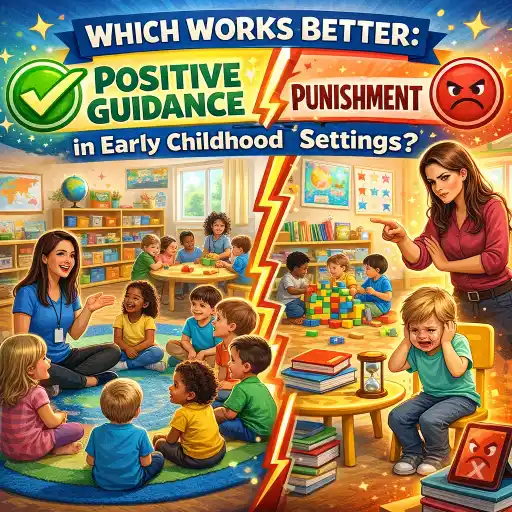
u can follow up fast. See a plain overview at Positive Discipline and top strategies at Positive Discipline Strategies for Child Care Providers.
What is positive guidance, and how is it different from punishment?
2. Punishment aims to stop behavior by making the child feel bad or scared (yelling, removal of unrelated items, or physical punishment). Research and practical guides warn that punishment often harms trust and does not teach new skills. See Alternatives to Physical Punishment for safe options.
3. Positive guidance focuses on: (a) connection, (b) short, clear rules, (c) logical consequences, and (d) teaching replacement skills. Read the concrete steps in " How Can Positive Guidance Improve Classroom Management?.
4. Why this difference matters for your program: positive guidance builds lasting behavior change and better #relationships between staff and children, while punishment can cause fear and repeated problems. For more on the big ideas, see Positive Discipline: Strategies That Actually Work.
How do natural and logical consequences teach differently than punishment?
2. Punishment is often unrelated, shaming, or harsh. It may stop a behavior for a moment but does not teach what to do next. Trusted sources recommend related, respectful, and predictable consequences instead (the CSEFEL briefs explain how logical consequences work and why they teach cause-and-effect: CSEFEL What Works Briefs).
3. Practical steps to use logical consequences:
- Tell the rule and choices ahead of time.
- Give a short warning when possible.
- If the child chooses not to follow the rule, apply a consequence that fits and is brief.
- After calm, teach or practice the replacement skill (sharing, asking, using words).
4. Use caution: never rely on natural consequences that risk safety. When natural results could harm a child (like being too cold), choose a safe logical consequence. For more safety notes, see ChildCareEd guidance.
What steps can my staff take every day to use positive guidance instead of punishment?
- 😊 Greet and connect: welcome each child by name at arrival to build trust. See ideas at Creating a Positive Learning Environment.
- 📋 Set 3–5 simple rules: post pictures and practice them (e.g., “Hands are for helping”).
- 🎯 Use prevention: arrange the room into clear zones and balance active/quiet times. The Pyramid Model explains prevention routines well (Pyramid Model).
- 🔁 Redirect early: offer safe choices so children can switch to a better option.
- 🧘 Offer Time-Ins not time-outs: stay near a child while they calm and teach calming tools (see Positive Discipline Strategies).
- 🛠️ Teach replacement skills: role-play asking for a turn, using words, breathing.
- 🤝 Be consistent: all staff use the same phrases and responses. Consider staff training like Viewing Guidance in a Positive Light
 Buy Now $24.00.
These steps reduce power struggles and build #classroom routines that children can follow. If behaviors persist, collect notes and consult specialists (CSEFEL and ChildCareEd materials have team planning tips).
How can we involve families and avoid common mistakes?
1. Partner with families: share one strength, one short observation, and one easy plan to try at home. Use the structure: Strength + Fact + Small Plan. ChildCareEd offers family-collaboration resources and courses for this work (How Can Positive Guidance Improve Classroom Management?).
2. Document patterns: note time, place, trigger, and adult response. This helps when you need to ask for extra support or a specialist consult (see the PBS and Pyramid Model resources at CSEFEL).
3. Common mistakes and how to avoid them:
- 😵 Expecting quick fixes — track small wins and be patient.
- 😶 Being inconsistent — make a short team script so all adults use the same words.
- ⚠️ Using unrelated punishments or shaming — choose consequences that teach and are respectful.
- 🔍 Ignoring data — if behavior repeats, collect notes and seek help early.
4. FAQ (quick answers):
- Q: How many rules? A: 3–5 simple rules with pictures.
- Q: Time-In or Time-Out? A: For young children Time-Ins that keep connection usually work better.
- Q: When to ask a specialist? A: When behavior is intense, long-lasting, or harms learning or safety.
- Q: Where to learn more? A: ChildCareEd courses like Mysteries of Challenging Behavior Solved Buy Now
$24.00$18.00.
Conclusion: What can my team try this week?
- Pick 3 classroom rules and add pictures.
- Teach one replacement skill and practice it in circle time.
- Use a 2-minute warning at transitions for a week.
- Share one short Strength + Fact + Plan with a family.
Using positive guidance takes practice but pays off with calmer days and children who learn real skills. For step-by-step staff training and printable tools, start with ChildCareEd resources such as Positive Discipline: Strategies That Actually Work and Creating a Positive Learning Environment Checklist Buy Now $0.00. You are doing important work—small, consistent steps help children grow and your staff thrive.
1. Natural consequences let children experience the direct result of a choice when it is safe (e.g., a wet trike that was left out cannot be ridden). Logical consequences are set by adults and relate directly to the behavior (e.g., if a child throws sand, the sand table is closed until it is cleaned). See examples at What’s the Difference Between Natural Consequences and Punishment?.Use a short daily plan your whole team follows. Below are easy steps your staff can use tomorrow:1. Positive guidance is a teaching approach. It helps children learn social skills and self-control by using connection, clear rules, and practice. It is not the same as being permissive. For a child who hits, positive guidance asks: What is the child trying to say, and how can we teach a better way?- 45 Hour Child Growth and Development
- CDA Home Visitor Subject Area 3 Part 3 Birth to 5
- 45 Hour Preschool Methods and Materials
- Power of Art: Bldg Self-Esteem & Positive Behavior for ALL Abilities
- Bienvenido! Welcoming All Families
- Pediatric RSV First Aid & CPR/AED
- CDA Bridge Bundle: Family Child Care
- Texas Director Credential
- Prevention and Solutions To Challenging Behaviors
- CDA Certification en Español: Recursos y Consejos para Educadores Bilingües
- ¿Cuál es la Diferencia Entre la Crianza Respetuosa y la Crianza Permisiva?
- Ejemplos de Crianza Respetuosa vs. Crianza Permisiva
- How Can Positive Guidance Turn Chaos into Calm in Texas Early Childhood Classrooms?
- How Can Positive Guidance Build Respectful Classroom Routines in Texas Child Care Programs?
- How can positive guidance make indoor transitions calm in California early childhood classrooms?
- How Can Child Care Programs Support Children’s Mental Health?
- What Positive Guidance Techniques Help Preschoolers Learn and Stay Safe?
- What Positive Behavior Guidance Techniques Work in Child Care?
- How can preschool teachers use positive guidance to shape behavior?
- Child Care Discipline Philosophy: Supporting Positive Behavior
- How can we guide behavior without punishment?
- Can Redirection Replace Punishment in Early Childhood Settings?
- Why Do Classroom Management Strategies Fail With 3-Year-Olds—and What Works Instead?
- How Can Child Care Providers Help Children with Attention and Impulse-Control Challenges?
- How Can Positive Guidance Transform Early Childhood Classrooms?
- How Can Child Care Providers Support Children With ADHD in the Classroom?
- What Is the Difference Between Positive Discipline and Punishment in Early Childhood Education?
- What Should Teachers Do When a Child Throws Toys?
