Children sometimes refuse to join an activity. It can feel hard and upsetting for staff and other children. This article helps childcare directors and providers in North Dakota know what to do right away and how to fix the problem for good. You'll get simple, repeatable steps, short scripts you can use, and ideas for working with families and your team. Remember: state requirements vary - check your state licensing agency.
Why might a child refuse to join and why does it matter?
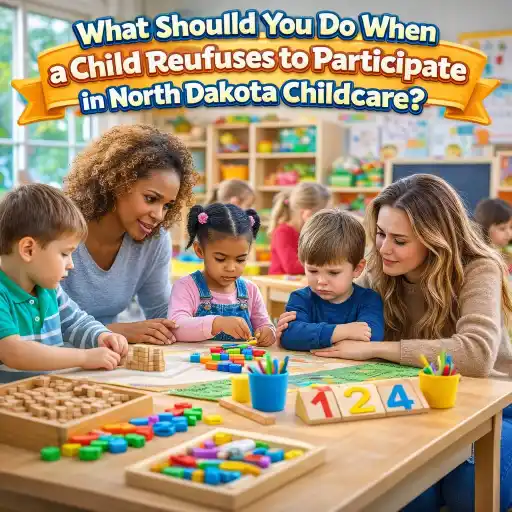
1) A child’s refusal is usually a message. They may be tired, hungry, nervous, overwhelmed, or unsure what you want. Research and practice call behavior “communication” — it tells us something about the child’s needs (see What Can You Do Instead of Time-Out in Preschool?).
2) Why it matters:
- When we respond with empathy and teaching, the child learns skills instead of feeling punished. See ideas from Positive Discipline.
- Quick, calm responses keep the room safe and help the rest of the group stay engaged. For short in-the-moment scripts, the post What Can I Do When a Preschooler Won’t Listen? has repeatable lines.
- Refusal patterns can point to learning or health needs. Use observation and share with families; see CDC guidance on talking with parents at How to Talk With Parents About Development.
When a child refuses, your calm matters. Keep your voice steady and your actions simple so the child can hear you. Small steps help your whole #classroom and support #children to join in later.
What can I do right now when a child refuses to participate?
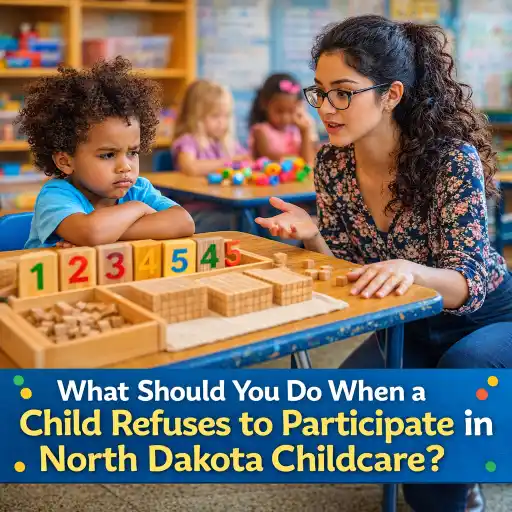
Use a short, 3-step script every time. Make sure all staff use the same words so children learn the routine.
- 🧑🤝🧑 Connect — get down to the child’s level and show you are with them. Say: "I’m here." (One sentence.)
- 😮💨 Calm — offer a quick co-regulation tool: breathe together or offer a quiet seat or a sensory object. Try a 3-count breath: "Breathe in 1-2-3, out 1-2-3." (See Using Reflective Listening and Emotion Coaching.)
- 💬 Coach — give one small choice to join: "You can sit here with me or play with the blue bin." Keep choices to two options only.
Examples you can say now:
- 😊 "You look upset. Breathe with me or hold this ball. Which would you like?"
- 😊 "You can join Circle or build at the table for two more minutes. Which do you pick?"
Follow-up: once the child is calmer, teach the skill in a short 1–2 minute practice. These in-the-moment steps are from positive guidance practices on ChildCareEd and redirection ideas in ChildCareEd. Staying calm helps #teachers and keeps the room #calm for others.
How do we teach skills so refusals happen less?
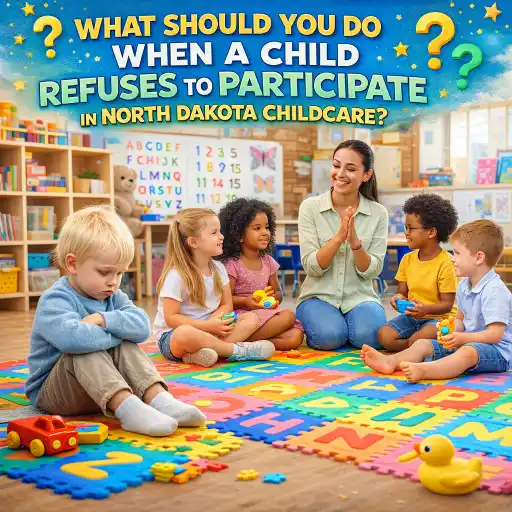
Teaching is the long game. Use short, repeated lessons so children learn words and steps. Try this simple 4-step teaching loop drawn from CSEFEL and ChildCareEd resources:
- 📌 Pick one target skill this week (e.g., "use words," "wait two minutes").
- 🎭 Model the skill with puppets or role-play during calm times. Use scripts from How Can We Teach Sharing.
- 🔁 Practice often for 1–2 minutes (circle time drills, games like Red Light/Green Light). See emotion tools at Emotion Coaching.
- 🏆 Reinforce with specific praise: "You asked for a turn—thank you!" (This matches Positive Discipline ideas in ChildCareEd.)
Use visuals and self-management charts from CSEFEL (CSEFEL What Works Brief) to help kids track small steps. For older preschoolers, self-checklists can encourage independence. Celebrate tiny wins and share them with families. Over time, consistent practice reduces refusals and builds #participation.
How do we involve families, staff, and know when to get extra help?
1) Share short, kind notes with families. Use the formula strength + fact + plan: e.g., "Ava loves drawing. Today she did not join circle. We will try a 1-minute transition warning and a cozy spot. What works at home?" See family communication tips at CDC.
2) Team steps (numbered):
- 🤝 Make one short staff script and practice it in daily huddles so substitutes know it too (Positive Discipline).
- 📋 Track patterns for 3–5 days (time, place, triggers). Use a simple ABC note (Antecedent, Behavior, Consequence).
- 🧠 Behavior observation and guidance: To build staff confidence in identifying triggers and responding consistently to refusal and challenging behavior, ChildCareEd's The ABCs of Behavior: Turning Challenges into Learning Opportunities
 Buy Now $55.00 is a 6-hour online course that teaches the Antecedent-Behavior-Consequence framework in a practical, classroom-focused way — giving your whole team a shared language for the pattern-tracking and scripted response steps outlined in this guide.
 - 👥 If you see frequent refusal, involve families, the director, and consider a mental health consultant or early intervention. For inclusion rights and supports, see ADA and inclusion guidance at ChildCareEd on ADA and CSEFEL inclusion brief.
When to get extra help (red flags):
- 🛑 The child hurts self or others often.
- 🛑 Meltdowns happen many times a day and do not improve with coaching.
- 🛑 Usual calm tools fail after weeks of consistent practice.
Be trauma-aware. Trauma can change how a child responds. Use trauma-informed practices from Trauma-Informed Care and prevent harm by building steady routines (also relevant to ACEs prevention at CDC ACEs).
💛 Trauma-informed and resilience practices: For staff working with children who have experienced adversity, ChildCareEd's ACEs and Resilience in Child Care Buy Now $24.00 is a 3-hour online course covering how adverse childhood experiences affect behavior and how providers can build trauma-aware routines that help children feel safe and ready to participate — directly supporting the trauma-informed care section of this article.
For additional strategies and training focused specifically on fostering resilience in young children, see the Building Childhood Resilience resource.
State note: For North Dakota specifics, follow your local licensing rules and supports—state requirements vary; check your state licensing agency.
Common mistakes and how to avoid pitfalls
- ❌ Long lectures during meltdowns — Fix: Give one short sentence now; teach later when calm (CDC on good directions).
- ❌ Different adults use different scripts — Fix: Pick one short script and practice it together (Positive Discipline).
- ❌ Using punishment that removes learning — Fix: Use teaching, choices, and logical consequences (see alternatives to time-out).
Conclusion
1) In the moment: Connect → Calm → Coach. 2) Teach one small skill each week and practice it often. 3) Work with families and your team. 4) Track patterns and ask for help when red flags appear. Using these steps protects the child's dignity and helps your whole #classroom. You are doing important work—small, consistent actions lead to big changes for #children and #teachers.
FAQ (short)
- Q: How long should a calm spot visit be? A: 2–5 minutes to reset; staff stays nearby.
- Q: What if a child refuses all choices? A: Stay calm, offer one simple choice, try again later, and practice the skill in a calm moment.
- Q: When should I contact early intervention? A: If refusal links to delays or if you see red flags above; use CSEFEL and local contacts.
Selected resources: ChildCareEd - Alternatives to Time-Out, ChildCareEd - Redirection, CSEFEL - Self-Management, CDC - Good Directions, ChildCareEd - Trauma-Informed Care.
Remember to support one another, keep scripts short, and celebrate small wins. Your calm and consistency help children learn to take part and feel safe.
- UNITED STATES OF AMERICA - North Dakota
- 📋🧸 What Do You Need to Work in Childcare in North Dakota?
- What Training Is Required to Be a Childcare Director in North Dakota?
- Growing Futures North Dakota
- Child Growth and Development Training North Dakota
- North Dakota Child Care Rule Updates: How to Participate and How to Prepare Your Program
- North Dakota Child Care Training Hours: What You Need Each Year
- Flexible 120 Hour CDA Training Online for North Dakota Child Care Professionals
- Free ECE Units Online in North Dakota: Start Here!
- How to Become a Preschool Teacher in North Dakota
- Cómo Ser Maestra de Preescolar en Dakota del Norte
- Preservice Training Requirements for Child Care Providers in North Dakota
- Capacitación Previa al Servicio para Proveedores de Cuidado Infantil en Dakota del Norte
- What Should You Do When a Child Refuses to Participate in North Dakota Childcare?
- What Does North Dakota Require for Medication Administration Training?
- How Can North Dakota Providers Encourage Independence in Young Children?
- How Can Simple Cooking Activities Teach Skills in North Dakota Child Care Programs?
- How should North Dakota child care programs handle transportation safety and car seats?
