Working with young children who have special needs takes heart and clear tools. This article gives practical steps you can use today in your #Georgia program. You will learn how simple pictures, steady #routines, and kind words help children 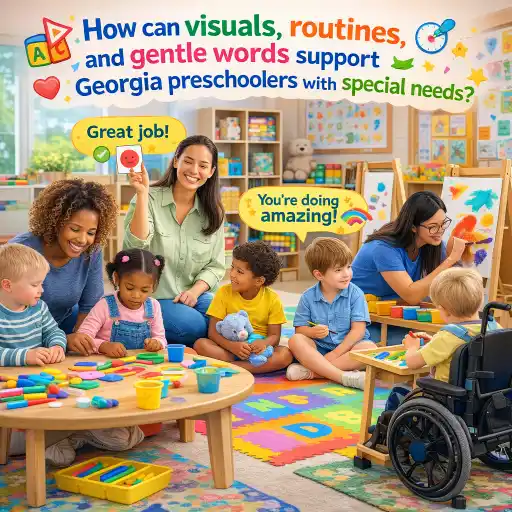 feel safe, join activities, and try new skills. State requirements vary - check your state licensing agency.
Why this matters: 1) Children who know the plan feel calmer and learn more. 2) Small changes help many children, not just one. 3) Families notice and trust programs that use clear supports. These ideas come from classroom-tested tips like visual schedules and calm spaces at ChildCareEd: Visual Schedules and routines guidance at ChildCareEd: Transitions & Routines. Read on for hands-on steps you can try with staff and families.
How can visuals help Georgia preschoolers feel safe and know what comes next?
Visuals make the day concrete for children who learn by seeing. Use pictures, photos, or simple symbols that match your real room. Start with 1) a daily picture schedule, 2) a first/then card, and 3) a visual timer. Child care teams often use these tools to cut worry and give children control — see how to set up a visual schedule at ChildCareEd: Visual Schedules and printable visuals at ChildCareEd: Visuals PDF Buy Now $0.00.
- 😊 Make a simple morning-to-pickup picture strip. Keep 6–8 items only (arrival, snack, centers, outside, circle, rest).
- 🕒 Use a visual timer for short waits (clean-up, turn-taking). Visual timers help children see time pass — experts at Indiana University also recommend them (Indiana Visual Support Tips).
- 🔁 Create a personal mini-schedule for children who need extra support (laminate a 3-card strip they can carry).
Tips for success:
- Introduce visuals during calm times and practice each morning.
- Use real photos from your space (not clip art) so children recognize items.
- Keep visuals at child eye level and point to them often.
Why visuals work: they reduce surprises, build #independence, and cut down on repeated verbal prompts. For children with autism or communication needs, visuals are an evidence-backed support — see practical ideas in guides like the DRDP ASD guide and social narratives tips at Indiana: Social Narratives. Use visuals with kind words and gentle coaching to help children stay calm and join in.
What simple routines and transition tricks make the classroom calm and predictable?
Routines are the backbone of a calm day. A few steady steps turn chaos into calm. For big wins, pick one transition (circle time, clean-up, or line-up) and practice the same routine each day. See many quick ideas at ChildCareEd: Transitions & Routines and calming room setup at ChildCareEd: Calm Classroom. State requirements vary - check your state licensing agency.
- 🔔 Choose one clear attention signal (bell, clap, call-and-response). Teach it and practice 2–3 times a day.
- 🎵 Use the same clean-up song and 2-minute warning before every clean-up.
- 🪧 Post a short visual step chart for the transition (1–3 steps only).
Try this 4-step plan for any transition:
- ⏱️ Warning (2 minutes),
- 🔔 Signal (bell or song),
- ✅ One clear action (sit, put toys away, line up),
- 👏 Quick praise for children who follow the steps.
Use timers and jobs to keep waiting short. Break big groups into smaller ones when lining up or moving to the playground. For times when children need motion to settle, plan a short active break before circle time. ChildCareEd recommends pairing movement with calm activities to raise on-task time (ChildCareEd: Sensory Breaks).
Why this matters: steady routines build trust and self-control. They also help staff work as a team because everyone uses the same words and signals. Share routines with families at pickup so children get the same messages at home.
How can gentle words and positive guidance help with sharing and behavior?
Children learn social skills from calm coaching. Use short phrases, role-play, and specific praise. For scripts and short coaching ideas, see ChildCareEd: Positive Guidance for Sharing and behavior supports from CSEFEL (CSEFEL: Building Relationships).
- 😊 Teach one short script to use daily: “Can I have a turn?” or “Your turn next.” Model it and let children practice with puppets.
- 🧾 Use a simple first/then or timer for turns: “First truck for 3 minutes, then your turn.”
- 🏷️ Give specific praise: “You waited and handed the truck—thank you.”
- 🔁 Role-play repair: teach quick lines like, “I’m sorry. Are you okay?” so children can fix mistakes.
Behavior is often a message. Look for triggers (loud noise, long wait, hard task). Use calm tools like a cozy corner, sensory breaks, or a short heavy-work task (carrying books) to help kids reset. The Pyramid Model and other positive behavior frameworks offer step-by-step supports for children who need extra help — see the Pyramid resources at the National Center for Pyramid Model Innovations (Pyramid Model Resources).
Work with families: share one small tip to try at home each week and ask what works for the child there. If concerns continue, collect simple notes about when the behavior happens and ask for coaching or early intervention referrals. For Georgia programs, local resources like Babies Can’t Wait and DECAL supports can help families find services — see Georgia supports listed in local resources (Georgia Special Needs Resources).
What easy classroom changes make inclusion real in Georgia — and how do we avoid common mistakes?
Inclusion means changing the room or the task so every child can join. You do not need big money—start with small, smart changes. ChildCareEd has a helpful guide on simple classroom supports and Georgia resources at ChildCareEd: Inclusion in Child Care (Georgia).
- 🟢 Make the room predictable:
- Post a picture schedule and keep it the same each day.
- Label shelves with photos so children find materials easily.
- 🔵 Offer a calm corner: soft light, a small rug, a feelings chart, and 3 calm tools (sensory bottle, book, fidget).
- 🟣 Adapt materials: thicker crayons, adapted scissors, or visual choice cards so more children can do the same activity.
- 🔸 Use short individual supports: a 3-step picture strip for a child who needs extra help to join circle time.
Common mistakes and how to avoid them:
- 🚫 Mistake: Forcing sharing or using the calm corner as punishment. ✅ Fix: Teach choices, swaps, and use the cozy corner as a safe option, not a timeout.
- 🚫 Mistake: Too many visuals at once. ✅ Fix: Use 1–2 clear pictures per routine and remove extras.
- 🚫 Mistake: Inconsistent staff language. ✅ Fix: Pick 3 short phrases and practice them in staff meetings.
Quick referral tips for Georgia:
- If a family asks about services, suggest Babies Can’t Wait for children under 3 and the local school district for ages 3–5 (see Georgia Resources).
- Use inclusion coaching from DECAL or state inclusion partners when you need classroom-level help (links in the ChildCareEd inclusion article above).
FAQ (short):
- Q: How long before I see change? A: Small wins in weeks; steady change in months with daily practice.
- Q: Should I remove a toy during fights? A: Only for safety. Teach alternatives first.
- Q: Who to call for help in Georgia? A: Babies Can’t Wait, DECAL Inclusion Specialists, or local early intervention teams.
Conclusion — Try one small change this week: 1) add a simple picture schedule, 2) teach one short script, or 3) create a tiny cozy corner. Share what works with your team and families. Small, steady steps help your #preschoolers join, learn, and belong.
- CDA Preschool Credential with Portfolio Review
- Birth to Five CDA Credential with Portfolio Review
- Equity in Action with Head Start
- CDA Bridge Bundle: Preschool
- Pediatric RSV First Aid & CPR/AED
- CDA Bridge Bundle: Family Child Care
- CDA Bridge Bundle: Family Child Care without Portfolio Review
- CDA Bridge Bundle: Infant/Toddler without Portfolio Review
- CDA Bridge Bundle: Preschool without Portfolio Review
- Texas Director Credential
- CDA Certification en Español: Recursos y Consejos para Educadores Bilingües
- 🔍 ¿Qué ves cuando observas a un niño aprender?
- 💛🧩 ¿Cómo puedo hacer que mi enseñanza sea inclusiva para los niños con autismo?
- ⏰ Cómo puedo facilitar las transiciones y las rutinas diarias en mi aula?
- Cómo Abrir Una guardería Para Niños Con Necesidades Especiales?
- ¿Cómo incluir a niños con necesidades especiales en cuidado infantil? Guía práctica y sencilla
- Apoyo en Español para Capacitaciones Grupales Presenciales y por Zoom en Cursos Selectos
- 45 horas para infantes y niños pequeños: cómo certificarse en línea
- Proporciones de Cuidado Infantil y Tamaños de Grupo por Edad en Maryland (Guía Rápida para Centros y Hogares)
- Proporciones de Cuidado Infantil y Tamaños de Grupo por Edad en Nueva Jersey (Guía Rápida para Centros y Hogares)
- Proporciones de Cuidado Infantil y Tamaños de Grupo por Edad en Virginia (Guía Rápida para Centros y Hogares)
- ¿Cuál es la Diferencia Entre la Crianza Respetuosa y la Crianza Permisiva?
- Lista para Abrir una Guardería en Casa en Georgia: Cómo Empezar
- Apoyo en Preescolar para Retrasos del Habla: Estrategias Simples que Ayudan
- How can Georgia preschool teachers use positive guidance to help preschoolers share during indoor play?
- How can rainy day indoor activities help preschoolers learn kindness and cooperation in Georgia?
- Which Georgia Parks and Nature Centers Are Best for Preschool Field Trip Adventures?
- How can visuals, routines, and gentle words support Georgia preschoolers with special needs?
- Celebrando la amistad en el cuidado infantil durante el Día de los Mejores Amigos
- Cómo simplificar la capacitación para sus empleados de daycare
