Every day in your program you balance busy minds, big feelings, and lots of activity. This article offers clear, easy steps to move from a noisy, stressful day to a gentle, learning-focused one. Our goal: a #calm, #guidance-focused, #classroom where #children in #Texas feel safe and ready to learn. Read on for practical ideas you can try this week, links to helpful ChildCareEd resources, and reminders about licensing: state requirements vary - check your state licensing agency.
What simple steps make a classroom calmer?
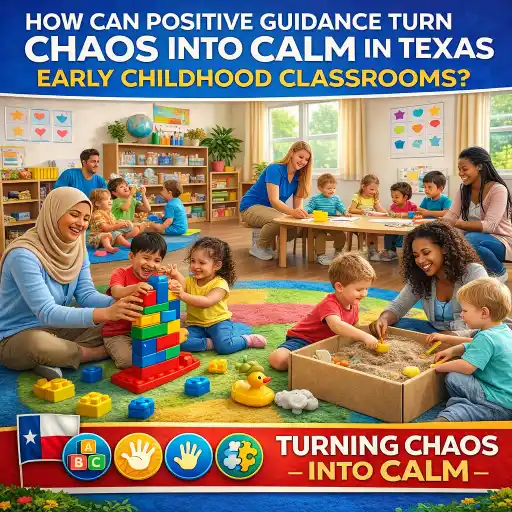
Start with small, consistent moves. When adults change, the room follows. Use this short plan you can do tomorrow:
- 😊 Greet and connect: Say each child’s name upon arrival. This builds trust and lowers worry. See ideas in Creating a Positive and Calm Classroom Environment.
- 📋 Post a picture schedule: Put the day at child's eye level and review it each morning. Visuals help children know what comes next — less surprise, less upset. ChildCareEd has printable ideas in From Chaos to Calm.
- 🎯 Teach 3 short rules: Keep rules positive and few (example: "Kind hands," "Walking feet," "Use words"). Practice with role-play and praise when you see them.
- 🧘 Create a calm corner: Add 2 simple choices (breathing or reading) and teach kids how to use it when calm, not as punishment. See calm corner ideas at ChildCareEd resources.
- 🔁 Use consistent transition cues: Give a 2-minute warning, a clean-up song, or a chime so transitions are predictable.
These quick actions reduce stress for staff and children. For more background on building calm from the start, explore Creating a Positive Learning Environment.
How do routines and room design prevent behavior problems?
Design and routine are prevention tools. When the environment fits children, many behaviors fade. Follow these steps to set up a space that supports learning and safety:
- 🧩 Create clear zones: Label areas (blocks, art, quiet reading) with photos so children know where to go and where things belong.
- ⏱️ Make a predictable day: Keep snack, circle, and rest times similar each day. Use visuals and timers to show the flow. The CSEFEL briefs on transitions explain why this works.
- 📏 Limit crowding: Fewer children per center lowers conflict. Rearrange shelves to create clear walkways and cozy corners.
- 🎵 Add soft signals: Music, a bell, or a song can cue behavior changes calmly.
- 🛠️ Provide easy access: Place materials at child height so children can make choices and clean up independently.
Plan for inclusion and trauma-aware practice: simple, consistent routines help children who have big feelings or different needs. ChildCareEd explains proactive structure in Proactive Behavior Guidance. Also remember training and rules for Texas programs — see Texas Child Care Training Requirements and be sure to check state rules: state requirements vary - check your state licensing agency.
What do I do in the moment when a child acts out?
When feelings are big, short and calm works best. Use this 4-step response every time to keep safety and teach skills:
- 🧘 Stay calm and get close: Lower your voice and sit or crouch at the child’s level. Your calm helps them calm.
- 📣 Name the feeling: Say one short phrase like "You are angry" or "You look sad." Naming feelings teaches words for emotions.
- ⛔ Set a clear limit: Use simple safety language: "Hands are for helping. We do not hit." Keep it firm but kind.
- 🔁 Teach the next step: Offer one replacement skill ("Take three breaths," "Ask for a turn," "Use the calm corner"). Then practice it together when calm.
After the child is calm, do a short repair: say a brief apology if needed, restate expectation, and practice the new skill. For difficult or repeated behavior use data: note time, place, and triggers. The PBS approach and Pyramid Model give useful guidance for building plans and supports — see the National Center for Pyramid Model Innovations. ChildCareEd offers step-by-step resources too, for example What Positive Behavior Guidance Strategies Actually Work?.
Common mistakes to avoid:
- ❌ Long lectures during a meltdown — use short phrases instead.
- ❌ Shaming language — label the behavior, not the child.
- ❌ Inconsistency across staff — pick scripts and practice together.
How can staff and families work together for consistent guidance?
Consistency across home and school helps children learn faster. Use this team plan that is quick and respectful:
- 🤝 Start with a strength: Share one thing the child does well at drop-off or in a quick note.
- 📊 Share one short fact: Give one observation (time, activity, behavior) — keep it factual, not judgmental.
- 🧾 Offer a small plan: Suggest one simple strategy to try at home and school (2-minute warning, calm corner, or choice options).
- 🔍 Track progress: Use quick notes for a week and meet to tweak the plan. If behavior is persistent, consult a specialist.
Directors can support staff by providing shared scripts, short coaching, and by offering training like Viewing Guidance in a Positive Light  Buy Now $24.00. Texas programs should note the training rules found at Texas Child Care Training Requirements. Also remember: state requirements vary - check your state licensing agency.
FAQ (quick):
- Q: How many rules should we teach? A: 3 or fewer simple rules with pictures.
- Q: When to refer for extra help? A: If behavior is intense, frequent, or keeps a child from learning, ask for support.
- Q: Does praise work? A: Yes—specific praise for what the child did helps them repeat it.
Conclusion
Start small. Pick one routine, one calm phrase, and one visual this week. Use the 4-step calm response when feelings run high, and build staff-family partnerships for steady support. ChildCareEd has many resources to guide you, including From Chaos to Calm and practical checklists. Small, consistent changes help your program move from #chaos to a steady, respectful, and learning-focused #classroom. You are not alone — steady practice, teamwork, and kindness make big differences for children and staff. Remember: state requirements vary - check your state licensing agency.
- 45 Hour Child Growth and Development
- Building Equity: Inclusionary Practices in Preschool
- Bienvenido! Welcoming All Families
- 45 Hour Infant and Toddler Methods and Materials
- Pediatric RSV First Aid & CPR/AED
- Art from the Heart for Preschoolers: Open Ended Art Projects that Build Self-Esteem
- Texas Director Credential Renewal
- Texas Director Credential
- Mindful Supervision: Balancing Safety & Independence in Montessori
- What Makes Me Special: An Overview of Autism and ADHD
- Crayons, Chaos, and Coffee: A Day in the Life of a Childcare Educator (As Told by a Five-Year-Old)
- CDA Certification en Español: Recursos y Consejos para Educadores Bilingües
- 😤💬 ¿Qué Le Digo a un Niño que Acaba de Morder a Otro?
- 👶 ¿Cuáles son las proporciones y grupos requeridos en Dakota del Norte? 🏫
- Recursos en Español sobre el Sueño Seguro del Bebé
- 10 Ejemplos de Cómo la Cultura Influye en el Desarrollo Infantil
- ¿Cuál es la Diferencia Entre la Crianza Respetuosa y la Crianza Permisiva?
- Ejemplos de Crianza Respetuosa vs. Crianza Permisiva
- Retraso del Habla en la Guardería: Cómo Pueden Ayudar los Proveedores
- Cómo Trabajar en el Cuidado Infantil en Carolina del Norte: Requisitos y Pasos
- How Can Positive Guidance Turn Chaos into Calm in Texas Early Childhood Classrooms?
- How Can Positive Guidance Build Respectful Classroom Routines in Texas Child Care Programs?
- How can Texas early childhood educators support preschool behavior in simple ways?
- After the Texas Rising Star Early Educator Conference: What Does Quality Improvement Look Like in Real Classrooms?
- Celebrando la amistad en el cuidado infantil durante el Día de los Mejores Amigos
- Canciones, juegos y preguntas de círculo para niños
- Cómo simplificar la capacitación para sus empleados de daycare
- How Can Visual Daily Schedule Cards Turn Classroom Chaos into Calm?
- How Can Printable Routines Turn Morning Chaos into Classroom Calm?
