Positive guidance helps staff teach children how to behave with respect and kindness. This article gives quick, practical tips directors and child care providers in Texas can use right away. You will learn simple steps to set routines, design rooms, respond during big feelings, and work with families and Texas rules. These ideas come from classroom-tested resources like How Can Positive Guidance Turn Chaos into Calm in Texas Early Childhood Classrooms? and Creating a Positive Learning Environment. Keep in mind state requirements vary - check your state licensing agency. In your text you will see five key words linked to quick ideas: #guidance #routines #childre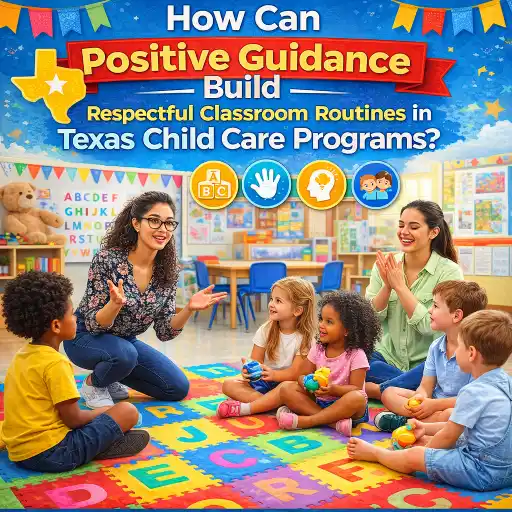
What simple steps create respectful classroom routines?
- 😊 Greet each child by name at arrival. This builds trust and lowers anxiety. See routine ideas at Creating a Positive and Calm Classroom Environment.
- 📋 Post a picture schedule at child eye level and review it each morning. Visuals help kids know what comes next — fewer surprises and fewer meltdowns (see daily schedule tips).
- 🎯 Teach 3 short rules (example: "Kind hands," "Walking feet," "Use words"). Practice with games and puppet role-play so rules feel friendly and clear.
- 🧘 Create a calm corner with 2 choices (breathe or read). Teach children how to use it when they are calm, not as a punishment. ChildCareEd has calm-corner ideas in several guides like Positive Guidance That Works.
- 🔁 Use consistent transition cues: a 2-minute warning, a clean-up song, or a chime. Predictable cues help children move from one activity to the next with less upset (CSEFEL transition brief).
Why it matters: Small, steady routines give children safety and more time to learn. When adults use the same words and signals, children learn faster, and staff stress goes down.
How can room design and schedules prevent behavior problems?
- 🧩 Create clear zones: reading, blocks, art, and quiet. Label shelves with photos so children know where to go and where things belong. This reduces crowding and confusion (see design tips).
- ⏱️ Make a predictable day: keep snack, circle, and rest times similar each day. Use visuals and timers so children can see the flow (scheduling guide).
- 📏 Limit crowding: fewer children per center lowers conflict. Move shelves to create clear walkways and cozy corners.
- 🎵 Add soft signals: music, a bell, or a simple song can gently cue changes and calm the room. CSEFEL briefs show how short cues support smooth transitions (CSEFEL).
- 🛠️ Offer child-accessible materials: place toys and art where children can reach them. When kids can choose and clean up, they feel capable, and their behavior improves.
Practical check: do a quick walk-through with staff and pick one spot to change this week (move a shelf, add a label, or post a picture schedule). Small room changes prevent many behavior problems before they start. For step-by-step checklists and classroom tools, look at ChildCareEd resources.
What should we do in the moment — and how do we avoid common mistakes?
- 🧘 Stay calm and get close. Lower your voice and crouch to the child’s level so you don’t tower over them.
- 📣 Name the feeling with one short phrase: "You are mad" or "You seem sad." Naming feelings teaches words for emotions (Positive Guidance That Looks Like).
- ⛔ Set a clear limit: "Hands are for helping. We do not hit." Keep it firm, simple, and kind.
- 🔁 Teach the next step: offer one replacement skill ("Take three breaths," "Ask for a turn," "Use the calm corner"). Practice it together later when calm.
Common mistakes and how to avoid them:
- ⚠️ Long lectures during a meltdown — use short phrases and reteach later.
- ⚠️ Shaming language — label the behavior, not the child (say "Hitting is not safe" not "You are bad").
- ⚠️ Inconsistency across staff — pick shared scripts and practice them in brief coaching sessions.
If behavior repeats or is intense, collect simple notes (time, place, triggers) and use a team plan. Positive Behavior Support and the Pyramid Model give steps for longer-term plans — see Proactive Behavior Guidance and CSEFEL resources (CSEFEL).
How can staff, families, and Texas rules work together to keep routines respectful?
Consistency between home and school helps children learn fast. Directors can set simple systems so staff and families use the same words and steps:
- 🤝 Start with a strength at drop-off: share one good thing you noticed about the child that day.
- 📊 Share one short fact if there is a concern: keep it factual (time, activity, behavior) and avoid judgment.
- 🧾 Offer a one-step plan: try one strategy at home and school (2-minute warnings, calm corner, or visual choices) and check back in a week.
- 🔍 Track progress briefly: use short notes for a week to spot patterns and meet with families if needed.
- 👩🏫 Provide staff training and coaching: use short role-plays and shared scripts. ChildCareEd courses like Viewing Guidance in a Positive Light
 Buy Now $24.00 help teams learn the same language.
Know the rules: Texas programs must follow state licensing standards. See the Texas guide at Texas Minimum Standards for Child Care and remember state requirements vary - check your state licensing agency. When behavior is persistent or risks safety, bring in mental health or special education consultants early and document steps taken (CSEFEL on PBS).
Conclusion: What can we change this week?
Quick checklist to try right away:
- ✅ Pick 3 rules with pictures and post them.
- ✅ Teach staff one short script for the 4-step calm response and practice it once.
- ✅ Add or refresh a picture schedule in one room.
- ✅ Share one small tip with families at pick-up (one strength and one step to try).
For ready tools and printable checklists, visit ChildCareEd resources like Creating a Positive Learning Environment and courses like Viewing Guidance in a Positive Light Buy Now $24.00. Small, steady steps help your program grow into a respectful, calm, and learning-focused place. You and your team can do this — one routine at a time.
FAQ (quick)
- Q: How many rules should we teach? — A: 3 or fewer, with pictures.
- Q: When to ask for extra help? — A: If behavior is intense, frequent, or stops learning, get support and document patterns.
- Q: Does praise really help? — A: Yes. Specific praise (“You waited your turn”) helps children repeat the action.
- Q: Who sets licensing rules? — A: Texas HHSC sets standards; see Texas Minimum Standards and remember state requirements vary - check your state licensing agency.
- Teach with Respect ONLINE
- Positive Attention: Interactions and Supervision of Infants and Toddlers: For Workforce Solutions
- Power of Art: Bldg Self-Esteem & Positive Behavior for ALL Abilities
- Teach with Respect!
- Texas Director Credential Renewal
- Connections That Count: Building Relationships in Child Care
- Texas Director Credential
- Shifting Gears to Respect
- Every Moment Matters: Schedules and Transitions
- CDA Certification en Español: Recursos y Consejos para Educadores Bilingües
- 👶 ¿Cuáles son las proporciones y grupos requeridos en Dakota del Norte? 🏫
- Recursos en Español sobre el Sueño Seguro del Bebé
- 10 Ejemplos de Cómo la Cultura Influye en el Desarrollo Infantil
- Cómo Solicitar una Licencia de Guardería en Texas
- Proporciones de Cuidado Infantil y Tamaños de Grupo por Edad en Maryland (Guía Rápida para Centros y Hogares)
- Proporciones de Cuidado Infantil y Tamaños de Grupo por Edad en Nueva Jersey (Guía Rápida para Centros y Hogares)
- Proporciones de Cuidado Infantil y Tamaños de Grupo por Edad en Virginia (Guía Rápida para Centros y Hogares)
- ¿Cuál es la Diferencia Entre la Crianza Respetuosa y la Crianza Permisiva?
- Lista para Guardería en Casa en Texas: Cómo Iniciar una Guardería en el Hogar
- Ejemplos de Crianza Respetuosa vs. Crianza Permisiva
- Capacitación Previa al Servicio para Proveedores de Cuidado Infantil en Nevada
- How Can Positive Guidance Turn Chaos into Calm in Texas Early Childhood Classrooms?
- How Can Positive Guidance Build Respectful Classroom Routines in Texas Child Care Programs?
- How can Texas early childhood educators build respectful parent partnerships?
- How can Texas early childhood educators support preschool behavior in simple ways?
- Cómo simplificar la capacitación para sus empleados de daycare
- How can Texas providers use after-school (OST) programs to improve attendance and behavior?
- What Must Texas Child Care Programs Put in Writing for Safe Sleep?
- How Often Should Preschool Teachers Change Classroom Activities?
