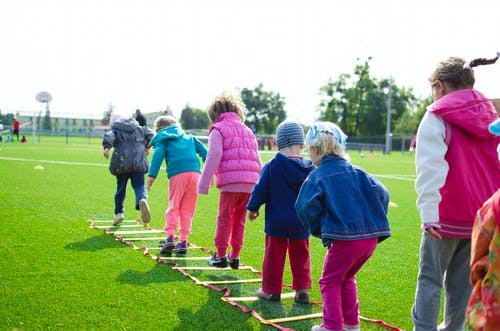
 Young children get stronger, steadier, and more coordinated when they move. This article gives child care providers simple, safe activities that build #balance #coordination #strength #grossmotor #play. Use these ideas in your classroom, on the playground, or in small groups.
What simple activities reliably build balance, coordination, and strength?
Here are easy activities you can use tomorrow. Each one targets big muscles plus balance and coordination. Use toys already in your room or make homemade props like socks-filled beanbags.
🟠 Obstacle course (indoors or out): crawl under a table, step over cones, walk a tape “beam.” This builds whole-body strength and planning. See examples at Gross Motor Spring Activities and 10 Gross Motor Games.
⚽ Ball games: toss, kick, or roll to targets to boost hand-eye and foot-eye coordination. Try bean bag toss for beginners (bean bag ideas at Bean Bag Games).
🟢 Balance beam line: use painter’s tape on the floor for heel-to-toe walks, one-leg balance, or carrying a light object on the head.
🐻 Animal walks: bear crawls, crab walks, frog jumps—fun moves that build core and leg strength (adapted from Gross Motor Activities for Preschoolers).
🎈 Balloon keep-up or parachute play: gentle vestibular input and timing practice. Parachute games are great for group cooperation (Parachute ideas).
Quick tips:
- Repeat short rounds (2–5 minutes) often.
- Always demo each move and show how to be safe.
- Celebrate effort—young children build confidence as much as skill.
How can I adapt these activities for different ages and abilities?
Every group has mixed skills. Adapting keeps all children included and successful. Use these numbered strategies to tune difficulty.
🎯 Change distance or height: move baskets closer for beginners; raise targets for older kids. (Ideas from Gross Motor Games for Preschoolers Buy Now $0.00.)
🧩 Offer two ways to play: “Hop OR step,” “Throw close OR throw far.” This gives choice and reduces frustration.
🪑 Seated options: for children with mobility limits, turn jumping into arm pumps or seated marches (many classroom moves can be modified—see Classroom Gross Motor Activities).
🤝 Pairing and peer help: buddy a confident child with a child who needs support. Let buddies cheer and guide each other.
📋 Visual supports & routines: use picture cards or tape lines to show steps. Children copy actions faster than they follow long instructions.
Safety and rules:
- Keep clear sight lines so you can supervise all children.
- Use soft surfaces or mats where falls could happen.
- Follow your center’s safety plan—state requirements vary - check your state licensing agency.
How often should we do these activities and where do they fit in the day?
Short, regular movement helps more than one long session. The CDC says younger children should be active throughout the day and school-age children need about 60 minutes daily (CDC Physical Activity Guidelines).
- 🕒 Daily mini-schedule (easy to follow):
- Morning: 5–10 minutes of tape-beam or animal walks to wake up muscles.
- Before circle time: 2–3 minute Freeze Dance to reset attention.
- Outdoor block: 15–20 minutes of free play with climbing or ball games.
- Afternoon: 5 minutes of balance or bean bag relay before rest.
- 🌦 Indoor vs outdoor: use outdoor time when weather and space allow (see outdoor benefits at Outdoor play benefits Buy Now $0.00). When inside, clear a movement zone and remove hard hazards.
- 👀 Supervision: place yourself where you can see each child. Teach one stop signal (clap, bell, or call) and practice it.
Note: Frequent short bursts of movement help children meet daily activity goals and improve focus in class. Use these moves as transitions and brain breaks.
What common mistakes should I avoid and how do I measure progress?
Avoiding pitfalls keeps children safe and learning. Use this list of common mistakes and fixes. Then use simple checks to track progress.
- ❌ Mistake: Activities are too hard. ✅ Fix: Start easy and add one challenge at a time. Break tasks into steps and give success options.
- ❌ Mistake: Long waits and lines. ✅ Fix: Use stations or small groups so kids stay active and engaged (relay or rotation format works well).
- ❌ Mistake: Not supervising movement closely. ✅ Fix: Position adults around play, explain rules, and demonstrate moves first.
- ❌ Mistake: Comparing children. ✅ Fix: Track each child’s effort and small wins—celebrate progress, not perfection.
How to measure progress (easy, practical):
- 1) Checklist: note skills like one-leg balance for 5 seconds, hopping 5 times, or catching a large beanbag.
- 2) Photos or short videos (with parent permission) to show change over weeks.
- 3) Observation notes: record when a child completes a task without help.
For deeper needs (movement concerns, delays), consider referral to professionals. ChildCareEd offers trainings on development and school-age milestones (Watch Me Grow Buy Now $35.00), and occupational therapy resources explain body awareness and bilateral coordination (see Body Awareness Activities and Bilateral Coordination).
Conclusion and FAQs
Quick takeaways:
- Do short, fun activities often.
- Adapt tasks so every child can succeed.
- Use simple checks to celebrate progress.
FAQ:
Q: How long are movement breaks? A: 2–10 minutes; repeat several times a day.
Q: What if I have limited space? A: Use tape lines, balloon games, or seated marches—many gross motor moves fit a small area (Indoor ideas).
Q: When should I refer for help? A: If a child is far behind peers in balance, walking, or catching, ask for an OT or PT evaluation and share observations (see milestone guidance at Identify stages and milestones).
Q: Are these activities safe? A: Yes with simple supervision rules, clear space, and age-appropriate challenges. Remember: state requirements vary - check your state licensing agency.
You’re doing important work. Little, regular movement builds big skills. Use these ideas, adapt them, and celebrate each child’s effort. For more classroom-ready games and printable activities, start with ChildCareEd’s resources on gross motor games and preschool activities (Gross Motor Games Buy Now $0.00 and Turkey Trek Trot Buy Now $0.00).
- CDA Home Visitor Subject Area 3 Part 3 Birth to 5
- CDA Home Visitor Subject Area 2 Part 3 Birth to 5
- Beyond the Classroom: Connecting Families to Essential Services
- CDA Infants/Toddlers: Lesson Planning Made Easy
- TEAM: Together Everyone Achieves More
- CDA: Special Needs: Understanding the Whole Child
- Emergent Learning & Development
- Access for All: Inclusion and the ADA
- Technology as a Classroom Tool
- Bye Bye Winter: The Role of Outdoor Play in Early Childhood Development
- Exploring the Cognitive Benefits of Movement in Early Childhood Classrooms
- How motor skills shape child development and creative ways educators can foster them.
- Actividades de Motricidad Gruesa que Desarrollan el Equilibrio, la Coordinación y la Fuerza
- Indoor and Outdoor Gross Motor Activities for Kids
- Gross Motor Games for Preschool and Kindergarten
- Gross Motor Skills Activities for Balance, Coordination, and Strength
- Indoor and Outdoor Activities for School-Age Children
- How can Michigan preschool programs build strong fine and gross motor skills?
- How can I build gross motor skills indoors and outdoors for the children in my program?
- How can I keep Children Active Indoors On Cold Days?
- What fun, practical activities help build fine and gross motor skills in early childhood classrooms?
- How Can Child Care Providers Support Gross Motor Development in Every Child?
- How Can Preschool Movement Build Stronger, More Inclusive Learning?
- Which Outdoor Play Activities Best Boost Gross Motor Development?
- What Gross Motor Skills Should Children Develop at Each Age?
