Art activities help young children learn how to think, solve problems, and use language. In North Dakota classrooms, simple art play can strengthen children’s memory, attention, and #cognition while it also brings joy. This article is for child care providers and directors who want clear, practical ideas to support preschool thinking with art. You'll find easy activities, planning tips, common mistakes to avoid, and links to helpful resources. Remember: state requirements vary - check your state licensing agency.
We use ideas from ChildCareEd resources like Play-Based Learning, Cognitive Growth, and Benefits of Art Exploration. This piece also draws on research about play and early development, such as the OECD review of early learning and articles on dramatic and artifact play, to show why art matters in preschool. The next sections answer practical questions you likely have.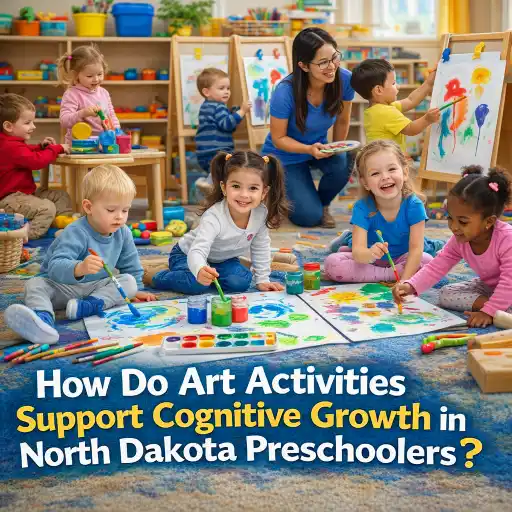
Core ideas to remember: art supports thinking through open play, sensory exploration, language, and fine motor practice. Put simply: art + play = stronger young brains. You'll see how to use activities like scratch art, finger painting, sensory bottles, and puppet making to build skills for your #preschoolers. Use training and local supports (like Head Start and UND early childhood programs) to grow your practice. Links to ChildCareEd courses in #NorthDakota are included for easy next steps.
How do art activities help preschoolers’ thinking?
- 🖍️ Attention and focus: When children paint or scratch a page, they concentrate on small tasks. This helps build attention spans needed for listening and group activities. ChildCareEd explains how play supports thinking in Play-Based Learning and Cognitive Growth.
- 🎨 Problem solving: Open-ended art asks children to make choices — which color, which shape, what to build. Making choices is a brain workout that strengthens planning and flexible thinking, as described in Benefits of Art Exploration.
- ✋ Fine motor and early writing: Using brushes, crayons, or toothpicks (for scratch art) builds small hand muscles. Strong hands help with future writing and self-help tasks. See ideas like DIY scratch art in Unlocking Creativity with DIY Scratch Art.
- 💬 Language and memory: Talking about art — naming colors, telling stories about a drawing, or describing steps — grows vocabulary and memory. Providers can ask simple questions during art to boost language, as recommended in play-based resources.
- 🔬 Early science and math thinking: Mixing paints, measuring glue, sorting shapes, and noticing cause-and-effect in art are early STEM moments. Research shows these hands-on experiences help young brains form lasting connections (see the OECD review on early learning).
Why this matters: Young children’s brains change fast. Art gives many small learning moments every day: choices, repetition, and sensory feedback. Those moments add up to stronger skills for school and life.
What art activities work best in North Dakota preschool rooms?
For providers working specifically with younger two-year-olds, consider adapting materials, expectations, and adult support; see practical, age-appropriate activities and caregiver-focused training for this age group in activities for two-year-olds and training strategies.
- 🎨 Finger painting and messy sensory tables — let children mix colors and textures. Messy play supports sensory learning and creativity, as shown in The Science Behind Messy Play. Tip: Cover tables and give ample clean-up tools.
- 🖤 Scratch art — children reveal colors by scratching a black-painted surface. This builds fine motor control and planning; see DIY Scratch, Art. Tip: Use toothpicks and supervise small groups.
- 🔎 Sensory bottles — quiet focus tools that help with noticing, sequencing, and calming. Find simple guides at Make Your Own Sensory Bottles Buy Now $0.00. Tip: Make a few varied bottles for small-group exploration.
- 🧸 Puppet making and dramatic play — build stories and role-play to strengthen narrative thinking and social perspective taking; research on dramatic play shows strong links to language and cognition (ECRP on Dramatic Play). Tip: allow time for the puppets to be created and then used in small shows.
- 🧩 Block-and-collage art — combine loose parts with drawing to encourage spatial thinking and planning (see artifact play research at Talking about Artifacts). Tip: rotate materials to spark new ideas.
- ✂️ Cutting, gluing, and sticker activities — quick tasks that support hand-eye coordination and sequencing. Tip: offer guided stations where children practice one new skill at a time.
- 📚 Story stones and art-linked storytelling — use painted stones as story prompts to build memory and expressive language. See ChildCareEd resources on story stones in their calm kits and activity pages.
- 🧪 Art + simple science experiments — mix baking soda and paint or make nature collages. These activities teach cause and effect and observation skills; link to STEM ideas on ChildCareEd’s activity pages.
Tip for ND providers: connect with local Head Start programs or UND early childhood graduates for volunteers or ideas—local programs often offer materials and partnerships that support creative learning in the classroom.
How can teachers plan art experiences that support cognition and follow rules?
- 🔁 Plan routines: 1) set-up, 2) work time, 3) clean-up, 4) reflection. Routines help children predict what comes next and build self-control. Use ChildCareEd planning tools from Play, Learn, Grow.
- 📋 Align goals with observations: Pick 1-2 learning goals (language, fine motor, counting). Use simple observation checklists such as DRDP preschool measures (DRDP (2015) Measures) to document progress.
- 🧯 Safety and materials: Choose non-toxic supplies, label materials, and have wipes/coverings ready. Keep scissors and small pieces supervised.
- 👥 Grouping and time: Offer small-group stations (4–6 children) so each child gets hands-on time. Rotate materials to sustain interest.
- 💬 Ask open-ended questions: "What are you making? What happens if you mix these colors?" This supports vocabulary and thinking. ChildCareEd’s play-based resources show how teacher talk boosts learning (Play-Based Learning and Cognitive Growth).
- 📚 Connect to curriculum: Use art to support literacy (story art), math (counting shapes), and science (texture experiments). ChildCareEd’s Art from the Heart materials offer open-ended project ideas tied to development.
- 🎓 Professional growth: Take local or online training. ChildCareEd lists courses for North Dakota providers (Childcare Courses in North Dakota), and UND offers early childhood degrees and field experiences to deepen skills.
-
🎓 Intentional learning design: To strengthen how staff plan and facilitate art experiences tied to cognitive goals, ChildCareEd's Creating Engaging and Meaningful Learning Experiences
 Buy Now $55.00 is a 6-hour online course that helps providers design purposeful activities connected to child development — a strong match for the planning routines and open-ended art goals described in this guide.
 - 🧩 Classroom environment and exploration: For staff who want to set up art and learning spaces that invite independence and curiosity, ChildCareEd's Environments That Inspire Independence and Exploration Buy Now $55.00 is a 6-hour online course covering how to design inclusive, stimulating environments where children can experiment, choose, and revisit materials — directly supporting the open-ended, child-led art approach outlined here.
Documentation tip: take quick photos (with parent permission) and jot one-line notes about what the child said or tried. Photos plus notes are powerful for family communication and licensing reviews.
What common mistakes do providers make, and how can we avoid them?
Avoiding a few common pitfalls makes art time stronger and more supportive of thinking. Here are mistakes and fixes you can use tomorrow.
- ❌ Mistake: Directing the art too much. When adults do every step, children lose the chance to plan and choose. ✅ Fix: Offer choices and say, "Show me what you want to try." Value process over product as advised in child development resources like PBS and ChildCareEd.
- ❌ Mistake: Rushing cleanup and skipping reflection. ✅ Fix: Build 5 minutes for children to show and talk about their work. Simple sharing improves language and memory.
- ❌ Mistake: Limited materials or one-use worksheets. ✅ Fix: Use open-ended, reusable materials (loose parts, collage items, paint) so children can experiment and revisit ideas. See examples in the Benefits of Art Exploration.
- ❌ Mistake: Ignoring sensory needs. Some children need calm-down options during messy play. ✅ Fix: offer quiet stations like sensory bottles (Make Your Own Sensory Bottles Buy Now $0.00) or visual breaks.
- ❌ Mistake: Not linking art to other learning. ✅ Fix: plan one simple tie-in each week (count the buttons you glue, tell a story about your painting). This makes art intentional for cognitive development.
- ❌ Mistake: Overlooking assessment. ✅ Fix: Use short notes, samples, or the DRDP measures to record growth in attention, language, and fine motor skills (DRDP).
Small changes—more choice, more talk, and clearer goals—make art a powerhouse for thinking. Providers who intentionally plan and reflect will see steady gains in children’s play and learning.
Conclusion
Art activities are simple, low-cost ways to grow preschool thinking in North Dakota. They build attention, language, fine motor skills, early STEM ideas, and social thinking. Start small: set goals, pick a few open-ended activities, and use simple observations to track growth. For more tools and training, explore ChildCareEd resources such as Art from the Heart, Play, Learn, Grow, and the list of Childcare Courses in North Dakota. Partner with local Head Start or university programs for support. Your creative, thoughtful art time helps every child build strong brains and big smiles.
Good planning makes art both powerful and safe. Below are clear steps to design art time that supports thinking and meets program standards. State requirements vary - check your state licensing agency. Choose activities that are open-ended, safe, and easy to repeat. Below are 8 practical activities that build thinking and skills. Each item includes a short tip for use in the classroom. Art is more than making pictures. It gives children chances to practice thinking skills that become the foundation for school learning. Here are key ways art helps cognition, using plain steps and short examples:
- CDA Subject Area 2
- CDA Home Visitor Subject Area 3 Part 3 Birth to 5
- Power of Art: Bldg Self-Esteem & Positive Behavior for ALL Abilities
- CDA Bridge Bundle: Family Child Care without Portfolio Review
- Art from the Heart for Preschoolers: Open Ended Art Projects that Build Self-Esteem
- CDA Bridge Bundle: Infant/Toddler without Portfolio Review
- CDA Bridge Bundle: Preschool without Portfolio Review
- Texas Director Credential
- Montessori Cultural Activities: Exploring the World Through Play and Learning
- Building Early Science Foundations
- Tiny Hands, Big Dreams: Fostering Creativity in Preschoolers
- 🚌❄️ Field Trip Ideas in North Dakota for Childcare Providers
- Child Growth and Development Training North Dakota
- Apoyo en Español para Capacitaciones Grupales Presenciales y por Zoom en Cursos Selectos
- Free ECE Units Online in North Dakota: Start Here!
- Lista para Abrir una Guardería en Casa en Dakota del Norte: Cómo Empezar
- Cómo Ser Maestra de Preescolar en Dakota del Norte
- Capacitación Previa al Servicio para Proveedores de Cuidado Infantil en Dakota del Norte
- Best Daycare Field Trip Ideas in North Dakota
- Las Mejores Ideas de Excursiones para Guarderías en Dakota del Norte
- How Do Art Activities Support Cognitive Growth in North Dakota Preschoolers?
- How can North Dakota early childhood programs teach children about nature and wildlife?
- Why is outdoor education essential for children growing up in North Dakota?
- How Do Art Activities Support Cognitive Growth in North Dakota Preschoolers?
- How can North Dakota providers celebrate America’s 250th in age-appropriate ways?
- How can North Dakota child care providers celebrate America’s 250th in simple, respectful ways?
- How can North Dakota fill the gap for school-age children before and after school?
- How can we turn playtime into learning time in North Dakota child care?
- How Can Simple Cooking Activities Teach Skills in North Dakota Child Care Programs?
- How can North Dakota child care providers build number sense in everyday routines?
