When a child holds an object that seems to belong in two places, that “problem” is a doorway to deeper mathematical reasoning. Explore the Early Mathematics Through Play course Buy Now $24.00 to build practical strategies for supporting classification, flexible thinking, and math-rich play; it can help you connect this small classroom moment to meaningful learning across the day.
Why is an object that fits two groups a valuable learning moment?
A sorting activity often begins with a simple question: “Which things go together?” But real objects have multiple attributes. A red, round button may fit with red objects, round objects, buttons, or things with two holes. When children notice more than one possible grouping, they are not confused by definition—they may be recognizing that classification depends on the rule being used.
This is a rich opportunity to help children explain their thinking rather than search for the one answer an adult expects. Classification asks children to identify a feature, apply a rule, compare examples, and consider whether an item belongs. Early math resources describe sorting and attributes as foundations for increasingly complex mathematical thinking; see Sorting and Attributes and the University of Nevada, Reno overview of classification and sorting.
When an object fits both groups, children can discover that categories may overlap without either category being mistaken. That insight supports #reasoning, curiosity, and confidence in sharing an idea. It also gives providers a practical way to make math visible through ordinary materials and conversation.
- Invite the child to name or demonstrate each group’s rule.
- Recognize that the same object can have several relevant attributes.
- Use the discussion to introduce words such as attribute, category, belongs, and both.
How can providers respond when a child places one object in both groups?
Start by asking about the child’s rule. A calm prompt—“Tell me why you put it here”—keeps the child in charge of the explanation. The child might say, “It’s red,” “It’s round,” or “It’s a button.” Each response gives you information about which attribute is meaningful to them and how they understand the task.
If the mat has two clearly defined groups, such as “red” and “round,” an object can meet both criteria. Rather than moving it immediately, make the overlap visible: “You noticed it is red and round. It fits both groups.” You can place it in an overlapping area, set it between the two labels, or use a duplicate picture if the material allows. Explain that the placement depends on the mat’s purpose and the rule being explored.
For a two-group activity that is intended to be exclusive—such as “living” and “nonliving”—a child may still see a connection that deserves discussion. Ask what they noticed, then clarify the agreed-upon category definitions with examples. The goal is not to treat every interpretation as technically correct; it is to use evidence and respectful conversation to refine the rule.
- Try: “What makes it fit this group?”
- Then ask: “Does it also have a feature that fits the other group?”
- Summarize: “Our rule is ____. This object has ____, so it can fit both / we need to decide which rule we’re using.”
What does “It Fits Both!” Overlapping Sorting Mats teach?
The ChildCareEd overview of sorting and early thinking skills explains that sorting involves noticing attributes, comparing items, and applying a rule. An overlapping mat makes that rule more visible by giving children a place to show that one object shares characteristics with two groups at once.
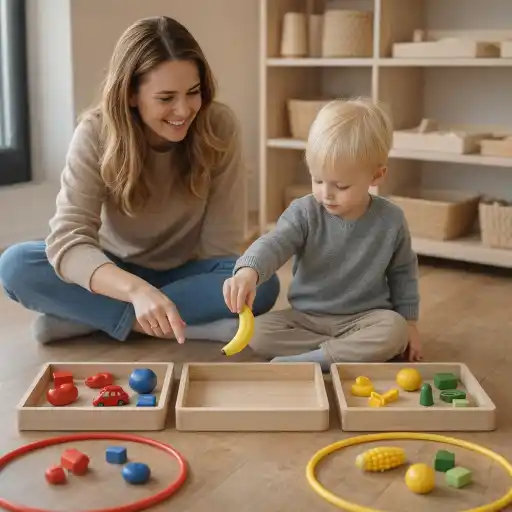
For example, a child might sort picture cards into “things that are red” and “things that are round.” A red ball belongs in the shared section; a red square belongs only in the first group, while a blue ball belongs only in the second. Children can see that categories depend on attributes and that one item may satisfy more than one condition. This is an early, concrete experience with overlapping sets and logical relationships.
The activity also naturally builds mathematical language and communication. Children can describe why an item fits, listen to a peer’s interpretation, and revise a placement after examining the evidence. A provider can extend the experience by asking children to count each section or compare how many objects are in one group versus the overlap.
- Choose two attributes children can recognize from the materials.
- Model one placement, explaining the features you notice.
- Invite children to place and explain the remaining objects.
- Ask what the overlap tells the group about the objects there.
How can you plan the activity so every child can participate?
Begin with a small collection of familiar, safe objects or picture cards that clearly vary in at least two attributes. The “It Fits Both!” Overlapping Sorting Mats resource can provide a ready-made structure; you can also draw two circles that overlap on paper or a reusable board. Choose categories that create genuine overlap, such as “has wheels” and “carries people,” or “is red” and “is round.”
Keep directions brief and the invitation playful: “Let’s see which objects fit each group. Some might fit both.” Demonstrate one example, then let children investigate. Avoid turning the mat into a speed test or insisting that every child use the same explanation. Children can point, gesture, place an object, use a communication device, draw, or explain in a home language.
Adapt the materials and setup to the children in your care. Use large pieces, sturdy cards, clear pictures, tactile markers, or nonslip surfaces when helpful. If color is a sorting attribute, include labels or symbols so the task does not rely on color perception alone. For additional guidance about making learning experiences accessible, explore child-directed sorting and choice.
- 👀 Observe first; offer a prompt only when it helps the child continue thinking.
- Offer fewer objects or highly contrasting attributes for a simpler entry point.
- For an extension, invite children to sort the same items using a new pair of rules.
How can you observe learning without turning the activity into a test?
Notice the child’s process, not only where the final card lands. Does the child identify an attribute, follow a sorting rule, recognize that an object has two features, explain a decision, or change a placement after new information? These observations help you plan a useful next step without labeling a child’s ability from one activity.
Brief notes can capture meaningful evidence: “Placed the red ball in the overlap and explained that it was red and round,” or “Sorted by animal type first, then proposed a new rule based on where animals live.” A photograph of the mat, paired with the child’s words, may preserve the reasoning behind the arrangement. Use documentation to notice progress over time and to plan opportunities for further exploration.
Common pitfalls include correcting a placement before hearing the child’s reasoning, introducing too many rules at once, and treating the overlap as a mistake. Instead, clarify the categories, invite an explanation, and discuss what the material shows. Connect the activity to other play: children can sort blocks by shape and color, compare classroom objects, or look for overlapping features in a nature collection. State requirements vary - check your state licensing agency when connecting documentation or training to local expectations.
Conclusion: Where does an object belong when it fits both groups?
When an object fits both sorting groups, its placement depends on the attributes and rule being explored. The overlap is not a problem to erase; it is a chance for children to notice that objects can share multiple features, explain their choices, and refine their understanding of categories.
Providers can make this learning practical with clear materials, accessible options, patient questions, and observation of children’s strategies. Ask what the child noticed, make the sorting rule explicit, and invite the group to consider how the object fits. To deepen your math teaching beyond one activity, explore the Early Mathematics Through Play course Buy Now $24.00, which covers mathematical reasoning and ways to incorporate hands-on math into play and routines.
Further professional learning
- Early Mathematics Through Play Buy Now $24.00 — strategies for mathematical reasoning, patterns, geometry, and hands-on learning.
- Math Foundations in Early Childhood
 Buy Now $16.00 — practical approaches for integrating early math through exploration and play.
- No Such Thing as Boring Math Buy Now $24.00 — ideas for connecting math concepts with child-centered play.
- Inclusive Lessons for Preschoolers Buy Now $16.00 — strategies for adapting materials and lesson experiences for diverse learners.
- Preschool Assessments & Observations Buy Now $24.00 — support for objective observation and using evidence to guide individualized learning.
- Early Mathematics Through Play
- Writing Training Goals & Objectives
- Bienvenido! Welcoming All Families
- Power of Art: Bldg Self-Esteem & Positive Behavior for ALL Abilities
- Birth to Five CDA Credential with Portfolio Review
- Pediatric RSV First Aid & CPR/AED
- CDA Bridge Bundle: Family Child Care
- Play, Learn, Grow
- No Such Thing as Boring Math
- Every Moment Matters: Schedules and Transitions
- CDA Certification en Español: Recursos y Consejos para Educadores Bilingües
- Cómo Abrir Una Quardería En Casa Sin Dinero?
- Proporciones de Cuidado Infantil y Tamaños de Grupo por Edad en Maryland (Guía Rápida para Centros y Hogares)
- Proporciones de Cuidado Infantil y Tamaños de Grupo por Edad en Wisconsin (Guía Rápida para Centros y Hogares)
- Proporciones de Cuidado Infantil y Tamaños de Grupo por Edad en Nueva Jersey (Guía Rápida para Centros y Hogares)
- Cómo Celebrar el Día Nacional del Kindergarten
- Consejos de Supervisión Activa para Salones de Preescolar y el Juego al Aire Libre
- Capacitación CDA gratuita en Illinois
- How Can Cut, Sort, and Glue Activities Strengthen Early Learners’ Development?
- Proporciones para guarderías en casa bajo el Título 22: Cómo la mezcla de edades cambia su capacidad en California
- Why Is Wild vs. Farm Animal Sorting a Favorite Preschool Activity?
- How Can Even vs. Odd Sorting Introduce Early Number Sense?
- How Can Hands-On Sorting Support Math and Language Together?
- How Can Seasonal Picture Sorting Build Phonemic Awareness in Early Childhood?
- How Do Color-Matching Activities Support Early Classification Skills?
- How Can Sorting Activities Build Preschool Vocabulary?
- How Can You Adapt a Sink-or-Float Investigation for a Mixed-Age Group?
- Beyond Color Matching: Letting Children Choose the Sorting Rule
- What Happens When Children Choose the Sorting Rule?
- Where Does an Object Belong When It Fits Both Sorting Groups?
