Everyday play can become a lively laboratory for children’s early math and reasoning: a basket of blocks, a handful of leaves, or a routine cleanup can invite children to notice what is alike and different. The Early Mathematics Through Play Buy Now $24.00 course offers practical ways to weave comparison, classification, and other math concepts into routines and hands-on exploration, helping you strengthen classroom practice while you explore the ideas below.
Why do comparing, sorting, and classifying matter?
When children ask, “Which things belong together?” they are doing the work of classification. They notice an attribute, compare examples, decide on a rule, and see whether each object fits. These actions support early mathematical reasoning and help children organize information about the world. As the National Association for the Education of Young Children explains in its sorting activities for preschoolers resource, children create sets when they group objects that share a property.
These experiences also connect with language and everyday problem-solving. Children use words such as same, different, larger, rough, group, and category while explaining their choices. They may collaborate, negotiate a rule, and revise a decision when they notice a new feature. Early math play should feel curious and low-pressure—not like a test with one adult-approved answer.
- Comparison helps children notice similarities and differences.
- Sorting provides practice applying a rule consistently.
- Re-sorting supports #flexibility: one collection can be organized in several reasonable ways.
- Explaining a grouping builds #language and #reasoning alongside early math concepts.
Children are not all ready for the same level of complexity at the same moment. Start from what they notice, offer a manageable invitation, and value the thinking they show—even when their category is unexpected.
How can you begin with simple, hands-on play?
Use materials children can safely handle and investigate: large blocks, toy animals, fabric pieces, picture cards, or leaves collected with adult guidance. Start with a small collection and one visible attribute, such as color, shape, size, or texture. Matching two similar objects can be an accessible entry point; children can then gather several objects that share a feature.
Try activities that fit naturally into your day:
- Invite children to compare blocks by shape, length, or whether they have straight or curved edges.
- Sort classroom vehicles by where they travel, how many wheels they have, or what they carry.
- After a nature walk, compare safe leaves by size, shape, or color; avoid unknown plants and supervise collection.
- Turn cleanup into classification by using accessible shelves with picture labels for books, blocks, and dramatic-play materials.
- Offer a “mystery sort”: make two groups and invite children to infer the rule, then let a child create a sort for peers to guess.
Concrete materials matter because children can move, inspect, and rearrange them. In NAEYC’s discussion of nurturing early math play, educators are encouraged to bring math concepts and vocabulary into playful exploration and daily routines. Hands-on play makes those ideas visible without requiring elaborate supplies.
What questions help children explain their thinking?
Thoughtful prompts make children’s reasoning audible without taking over the activity. Rather than asking only, “Is this right?” invite children to describe what they noticed. Give them time to look, touch, consider, and respond. A child who groups a stone with leaves may have a meaningful rule—perhaps both were found outdoors—even if that was not the category you expected.
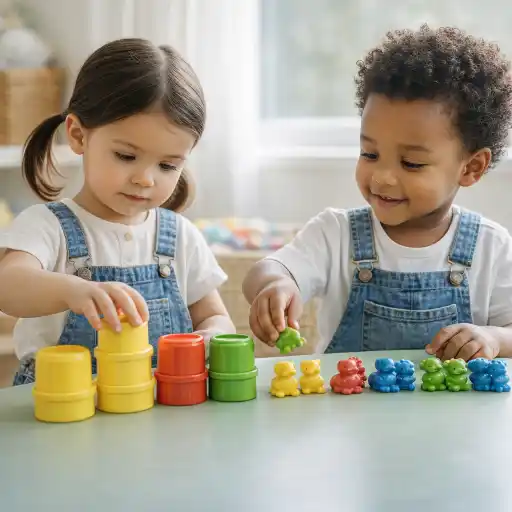
- “What do you notice about these objects?”
- “How are these groups alike? How are they different?”
- “What is your rule for this group?”
- “Could we organize the same objects another way?”
- “Which object was tricky to place? What made you decide?”
Model precise, accessible vocabulary in context: “You put the rough pieces together,” or “This set has the round blocks.” If a child’s grouping is unclear, ask for their idea before offering a comparison. When categories have specific definitions, such as living and nonliving, help children examine examples and clarify the rule together rather than dismissing a response abruptly.
Re-sorting is especially useful. A red, round button can belong to a group of red objects, round objects, buttons, or items with two holes. Children learn that a classification depends on the question being asked. This kind of exploration supports #curiosity, conversation, and flexible problem-solving.
How can you adapt play so every child can participate?
Inclusive practice preserves the central idea—observing and organizing—while adjusting materials, supports, or response options. Some children may benefit from fewer objects, highly contrasting examples, clear picture labels, or a brief demonstration. Others may be ready for two attributes or for inventing a category of their own. Adjust the challenge based on what you observe, rather than assuming every child will follow an identical sequence.
- Use large pieces, trays with raised edges, nonslip mats, or adapted tools when they support access and safe handling.
- Pair spoken directions with objects, photographs, gestures, symbols, or labels. If color is involved, include a non-color cue too.
- Welcome home-language words and accept pointing, signing, drawing, or communication-device responses as meaningful ways to share a rule.
- Offer photographs or carefully selected materials when textures or loose parts are uncomfortable or unsafe for a child.
- 🧺 Let children choose from a small selection of safe materials and decide how to begin.
Safety is part of thoughtful planning. Avoid small loose parts when they pose a choking risk, consider age and developmental needs, and supervise closely. For more support designing accessible experiences, explore Inclusive Lessons for Preschoolers  Buy Now $16.00, which focuses on adapting materials and lesson design so children with varied abilities can engage.
How can you observe learning without turning play into a test?
Look at the process, not simply whether an object lands in the category you expected. Notice whether a child identifies an attribute, follows a rule, compares items, changes a decision, explains an idea, or collaborates with a peer. A child’s rationale may show thoughtful classification even when it differs from an adult’s first interpretation.
Brief, objective notes can help you plan a next step:
- “Grouped blocks by shape, then made a second sort by size.”
- “Used ‘rough’ to describe the bark and placed it with other textured items.”
- “Pointed to the picture labels and independently returned materials to the matching shelves.”
Photographs, child quotations, and occasional work samples can document the thinking behind the arrangement. Use observations over time to guide new invitations, rather than labeling ability from one activity. Common pitfalls include introducing too many attributes at once, correcting a surprising choice before hearing the child’s rule, and relying only on worksheets. Keep the activity playful, concrete, and open to revision. State requirements vary - check your state licensing agency when connecting documentation or training to local expectations.
Conclusion: What simple strategies make classification part of play?
Children compare, sort, and classify most meaningfully when they can handle interesting materials, notice attributes, explain a rule, and try a new arrangement. Begin with a small collection and one visible feature; use open-ended prompts; and gradually offer fresh attributes, real-life routines, and opportunities for children to choose how they sort.
Keep access, safety, and children’s agency at the center. Observe their strategies and use those observations to shape what comes next. In short, simple play-based invitations help children organize their world while strengthening early math, communication, and flexible thinking. To deepen your planning, explore Math Foundations in Early Childhood Buy Now $16.00, No Such Thing as Boring Math Buy Now $24.00, and Building Vocabulary Buy Now $16.00.
- 45 Hour Child Growth and Development
- Early Mathematics Through Play
- CDA Home Visitor Subject Area 3 Part 3 Birth to 5
- Teacher-Child Interactions for Stronger CLASS® Outcomes
- Emergency and Disaster Preparedness
- Pediatric RSV First Aid & CPR/AED
- Role of Play in Learning
- Bienvenido! Welcoming All Families
- Injury Prevention: Their Safety Is In Your Hands
- Everyday Safety: Creating Healthy Environments
- ❄️ ¿Qué actividades al aire libre funcionan bien para los niños de Illinois en cada estación? 🌷🍂
- Consejos de Supervisión Activa para Salones de Preescolar y el Juego al Aire Libre
- How Can Cut, Sort, and Glue Activities Strengthen Early Learners’ Development?
- How Do Light vs. Heavy Activities Build Early Measurement Skills?
- How Can Living vs. Non-Living Sorting Spark Early Science Thinking?
- What Can Hot vs. Cold Sorting Teach Preschoolers About Safety?
- How Can Sorting Activities Strengthen Early Thinking Skills?
- How Can Hands-On Sorting Support Math and Language Together?
- How Do Animal Classification Activities Build Early Science Thinking?
- How Can Simple Sorting Activities Build Sustainable Habits in Early Childhood?
- How Does Word Sorting Build Phonics and Vocabulary Skills?
- How Can You Teach Young Children the Difference Between Living and Nonliving Things?
- How Can You Plan a Food-Learning Activity for Children with Different Dietary Needs?
- How Can You Choose Recycled Classroom Materials With a Real Purpose for Play?
- How Can Sorting Activities Build Preschool Vocabulary?
- How Can You Adapt a Sink-or-Float Investigation for a Mixed-Age Group?
- How Can Child Care Providers Check Children’s Understanding of Bus Safety Rules?
- How Do Children Decide Whether Something Is Living or Nonliving?
- How Can Classroom Recycling Questions Grow into a Meaningful Learning Project?
- What Are Simple Ways to Help Children Compare, Sort, and Classify During Play?
