A tub of water and a handful of everyday objects can invite toddlers, preschoolers, and older children into one shared investigation—if the experience has different ways to participate. Explore practical ways to adjust materials, questions, and expectations, and consider Montessori Essentials: Mixed-Age Mastery  Buy Now $16.00 for further guidance on inclusive, engaging instruction across ages. The course can help you strengthen your approach to mixed-age planning while you make this simple science experience work for every learner.
Why is a sink-or-float investigation a good fit for mixed ages?
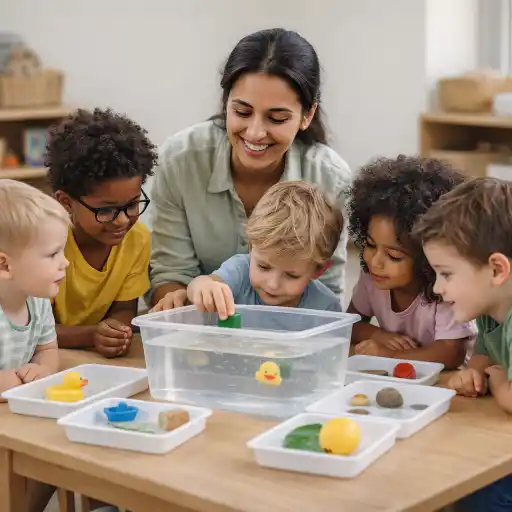
A sink-or-float activity gives children a shared question with room for varied levels of thinking. Every child can explore an object and notice what happens, while each can contribute according to their current language, motor, and reasoning skills. The youngest learners may watch an object settle or stay on top; older children may compare materials, explain a prediction, or record results.
This flexibility matters in mixed-age classrooms, where a single activity can either bring children together or leave some waiting for work that fits them. With clear roles and thoughtfully chosen objects, children can learn alongside one another rather than complete identical tasks. A mixed-age environment can offer valuable opportunities for peer observation and leadership, but older children should be invited—not assigned—to help.
Science is also naturally connected to other learning. Children practice #prediction and #observation, compare groups using early math, and build vocabulary as they talk about what they see. The investigation can become a hands-on expression of #inquiry and #collaboration, with the #sorting mat making ideas visible before and after testing. ChildCareEd’s Sorting Mat - Sink or Float Buy Now $1.49 includes picture cards for familiar objects and pairs well with a water-play test.
The goal is not for every child to master the same science explanation. The goal is for each child to have a meaningful way to notice, make a choice, share an idea, and encounter evidence.
How can you prepare materials and a setup that works for different ages?
Start with a shallow, stable container on a washable tray or surface, and keep the group small enough for close supervision. Choose a few contrasting, waterproof objects large enough not to pose a choking risk. A leaf, large cork, wooden block, plastic spoon, sponge, stone, or large metal spoon can offer children different properties to compare. Avoid sharp, breakable, toxic, or small loose items, and check materials for damage before and after use.
Prepare a simple work area with the water container, a towel, a basket of objects, and two clearly labeled places for results: “float” and “sink.” The sorting mat can offer a visual entry point. Children may point to a picture, place a card, or match a real object to its image before taking a turn at the water tub. Limit the first set to four or six objects; a smaller selection makes it easier to stay engaged and notice patterns.
- Place materials where children can reach them without crowding the water.
- Use picture labels alongside words to support emerging readers and multilingual learners.
- Offer large, easy-to-grasp objects or adaptive tools when handling is challenging.
- Plan turns, water disposal, handwashing, and cleanup before inviting children to begin.
- 🧺 Keep the container within an adult’s reach and maintain active supervision throughout the experience.
Water play requires continuous, attentive supervision even when the water is shallow. State requirements vary - check your state licensing agency for relevant expectations about supervision, water play, sanitation, and materials. Adjust participation to each child’s access needs: watching, pointing, using a home language, drawing, or working with a peer can all be authentic ways to take part.
How can you offer different levels of challenge within one investigation?
Use one shared question—“What might happen when this goes into the water?”—but vary the invitation and support. A younger child may choose between two picture cards, point to a prediction, or gently place a large object in the tub with help. A preschooler may name an object, say what they expect, and sort it after testing. An older or more experienced child might compare two objects made from different materials, tally outcomes, or suggest another test.
Offer flexible roles rather than fixed age-based assignments. Children might choose an object, make a prediction, place an item, watch closely, move a card, dry materials, or describe a result. Rotate roles so everyone has a chance to act and observe. Older children can model turn-taking or demonstrate how to use the mat, but should not become responsible for managing younger classmates.
- Beginning participation: “Point to the picture you want to test.”
- Developing language: “Do you think it will float or sink? Show me.”
- Comparing ideas: “What happened? Was that what you expected?”
- Extending inquiry: “What could we test next to compare these materials?”
Keep explanations developmentally appropriate. Young children can notice that objects behave differently without memorizing technical terms. Avoid relying on the shortcut “heavy things sink”: a large wooden block may float, while a small metal object may sink. Invite children to describe what they notice, and build scientific language gradually as their questions and experiences call for it.
How can you guide the inquiry without taking over?
Model the routine and safety expectations briefly, then leave space for children to investigate. For example, demonstrate placing one object gently in the water and say, “Let’s look carefully at what happens.” Then invite children to select the next object and predict. The adult’s role is to keep the experience safe, listen closely, and offer a prompt when it helps a child continue—not to supply every answer.
Open-ended prompts help children connect their first idea with what they observe. Try asking:
- “What do you think will happen?”
- “What do you notice now?”
- “Was the result the same as your prediction?”
- “What would you like to try next?”
Give children time to respond. Some will explain aloud; others may point, gesture, demonstrate, draw, or use a home language. Reflect their contributions neutrally: “You thought the sponge would sink, and now it is staying near the top.” An unexpected result is evidence to explore, not a mistake to correct or a reason to label a prediction wrong.
Use the mat to make thinking visible. Before testing, children can place a picture in a prediction area or indicate their idea. After the test, they can sort the card according to what they observed. If the mat has only two categories, a separate “Our prediction” space or a simple two-column chart can help distinguish a guess from a result. This distinction supports early scientific reasoning without adding unnecessary complexity.
How can you document learning and extend the activity?
Documentation can be brief and still useful. Record an object, a child’s prediction, what happened, and a short quote or gesture that shows the child’s thinking. A photograph of the mat or a simple chart can help the group revisit discoveries later. Focus on the process: a child’s willingness to predict, watch carefully, compare, or revise an idea is meaningful progress even when the child does not yet explain why an object floats or sinks.
Use what you notice to choose a next step that fits the group. Younger children may repeat the activity with familiar objects and practice sorting. Children ready for more can compare a wooden and plastic object, count how many items landed in each category, or test whether changing an object’s shape changes what happens. A foil-boat challenge can extend the experience into design: build, test, observe, and revise. Keep any extension manageable, safe, and under active supervision.
Consider these observation cues:
- Does the child choose or identify an object?
- Does the child make or communicate a prediction in any form?
- Does the child attend to the result and sort or classify accordingly?
- Does the child compare outcomes or respond to a peer’s idea?
- Does the child revisit or change an explanation after seeing evidence?
Share a short note or photograph with families to show how ordinary materials supported scientific thinking. For staff seeking broader professional learning, ChildCareEd also offers Basic Science in Early Childhood Buy Now $25.00, Building Early Science Foundations Buy Now $16.00, and Working With Mixed Age Groups Buy Now $24.00. Review each course page and confirm any training-hour needs with your program or licensing agency.
Conclusion: How can you adapt this investigation so every age can take part?
Adapt a sink-or-float investigation by keeping one shared question and offering varied ways to predict, test, observe, communicate, and sort. Prepare a safe, uncluttered water station; select a few contrasting objects; use picture supports such as the sorting mat; and adjust adult prompts and child roles to match individual readiness. Mixed-age learning works best when children can contribute meaningfully without being expected to perform at the same level.
Most importantly, protect children’s curiosity. Treat predictions as starting ideas, give children time to notice results, and use unexpected outcomes to spark another question. With thoughtful planning, the activity becomes more than a two-category sorting task: it becomes a shared experience in inquiry, communication, and learning together.
- 45 Hour Child Growth and Development
- CDA Home Visitor Subject Area 3 Part 3 Birth to 5
- 45 Hour Preschool Methods and Materials
- 45 Hour Infant and Toddler Methods and Materials
- Pediatric RSV First Aid & CPR/AED
- 45 Hour School Age Methods and Materials
- 45-Hour Infant and Toddler Curriculum
- Texas Director Credential
- CDA Certification en Español: Recursos y Consejos para Educadores Bilingües
- Proporciones de Cuidado Infantil y Tamaños de Grupo por Edad en Maryland (Guía Rápida para Centros y Hogares)
- Proporciones de Cuidado Infantil y Tamaños de Grupo por Edad en Nueva Jersey (Guía Rápida para Centros y Hogares)
- Proporciones de Cuidado Infantil y Tamaños de Grupo por Edad en Virginia (Guía Rápida para Centros y Hogares)
- Pumpkin, Leaves, and Apples: Fall Activities for Preschoolers
- Celebrando la amistad en el cuidado infantil durante el Día de los Mejores Amigos
- Child Care Lesson Plans by Age Group: Simple Ideas for Providers
- How Can Child Care Providers Encourage Preschoolers’ Growing Curiosity?
- How can child care providers teach hands-on STEAM with everyday materials?
- How can pumpkin science create meaningful, hands-on fall learning for preschool classrooms?
- How can I use simple STEM activities to spark curiosity in preschoolers?
- How Can I Use Everyday Materials for Meaningful STEM Exploration in My Preschool Classroom?
- How can simple science experiments transform my preschool classroom?
- How Can Childcare Programs Use Nature-Based Science Activities to Strengthen Learning?
- What’s Happening Outside? Fall Science Adventures for Preschoolers
- Fall Detectives: 10 Questions Pre-K Kids Can Investigate This Season
- What Can Float vs. Sink Sorting Teach Preschoolers About Science?
- How Can Sink-or-Float Water Play Become a Meaningful Science Investigation for Preschoolers?
- What Questions Keep a Preschool Science Conversation Going?
- How Can You Adapt a Sink-or-Float Investigation for a Mixed-Age Group?
