Everyday classroom objects can become powerful tools for children learning to notice, compare, and organize their world. Explore Early Mathematics Through Play Buy Now $24.00 to build practical strategies for bringing reasoning and math into routines, and consider Math Foundations in Early Childhood  Buy Now $16.00 for further professional learning; meanwhile, small changes to the materials you already have can make classification meaningful today.
Why does early classification matter?
When preschoolers decide which objects belong together, they are doing more than tidying. They notice attributes, compare examples, form a rule, and test whether each item fits. These experiences provide an important foundation for later mathematical ideas, including sets, patterns, number operations, and the organization of information. The Illinois Early Learning Project’s guidance on classification describes grouping by shared traits as a building block for mathematics.
Classification also connects to science, language, and social learning. Children might group leaves by shape, describe how two fabrics feel, or negotiate where a toy belongs. They practice listening, explaining, and revising their ideas. The goal is not to produce one adult-approved arrangement; it is to help children become thoughtful observers who can communicate how they reached a decision.
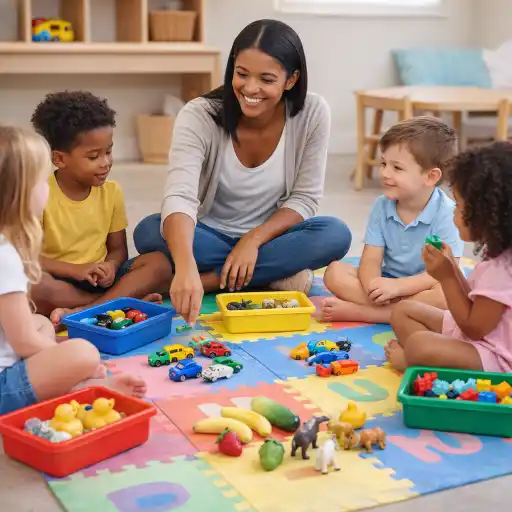
Everyday objects make this work accessible and relevant. A collection of blocks, large lids, fabric squares, or toy vehicles is enough to spark comparison. The same objects can be reorganized according to different questions, helping children see that categories depend on the rule being explored.
- Classification strengthens attention, comparison, and early logical reasoning.
- It builds vocabulary such as same, different, group, set, attribute, and category.
- It creates natural opportunities for cooperation and confidence-building.
Which everyday materials invite rich sorting?
Choose materials that are varied enough to invite observation but familiar and manageable for the children. Objects should differ in one or more visible attributes—color, size, shape, texture, material, or function. A small collection offers more opportunity for careful thinking than an overflowing bin.
Useful classroom materials include blocks, toy animals, vehicles, large buttons, fabric swatches, clean containers, leaves, and picture cards. A button collection, for example, can be grouped by color, size, shape, or number of holes. NAEYC’s button-box example for preschool sorting illustrates how magnifiers and sectioned trays can support close looking and repeated sorting. Because buttons and other small loose parts can pose choking hazards, use them only when appropriate for the children’s ages and with close supervision; choose larger substitutes where needed.
Try inviting children to sort:
- Nature finds by size, shape, or texture, after checking that items are safe.
- Vehicles by where they travel, number of wheels, or purpose.
- Classroom materials by what they are made of or how they are used.
- Picture cards by category, setting, or another child-proposed feature.
Materials need not be costly. Reusable trays, egg cartons, baskets, or paper circles can define spaces for groups. Keep the setup orderly, visible, and easy for children to access and return.
How can teachers guide thinking without taking over?
Start with an open invitation: “Put together things you think belong together.” Give children time to explore before naming a rule. Once a child creates a group, ask questions that make their reasoning visible: “What do these have in common?” “How did you decide?” or “Could you sort these another way?” These prompts extend thought without turning play into a quiz.
Development often moves from matching identical objects to sorting by one clear attribute, and later toward less obvious rules or multiple attributes. Children do not all progress at the same pace, and an activity should not be used to label a child’s ability. The University of Nevada, Reno Extension overview of classification and sorting places classification within broader preschool math experiences, while the Illinois guidance notes that sorting by two attributes can be challenging for young children.
Scaffold gradually:
- Offer two contrasting groups and model one example if children need a starting point.
- Invite a child to name, show, or gesture the sorting rule.
- After a first sort, mix the collection and encourage a new arrangement.
- For a challenge, ask how one object might fit more than one group.
🧺 Let children choose from a small selection of safe materials and decide how to organize them. Their unexpected rules are valuable evidence of what they notice.
How do sorting experiences support language and inclusion?
Classification gives children a meaningful reason to use descriptive language. Model precise words naturally: “This group has smooth objects,” or “These are all things we use outdoors.” Then pause so children can respond in their own way. Conversation, gestures, pointing, drawing, and arranging objects can all communicate a child’s idea.
Make participation accessible from the beginning. Use large pieces, nonslip trays, clear photographs, tactile cues, and uncluttered choices where helpful. If color is part of the activity, include shapes, symbols, or words as additional cues rather than relying on color alone. Children who use communication devices or are learning English can share their thinking through pointing, home-language labels, visuals, or supported peer interaction.
Sorting can also nurture social learning. In a small group, children take turns, listen to different interpretations, and work through disagreements. Rather than immediately moving an object, ask, “Tell us why you put it there.” A child may be using a rule you had not considered. When appropriate, explain that one object can have several attributes and may belong in different groups depending on the question.
Plan for safety and dignity: inspect materials, avoid items that are unsuitable for children’s ages, and supervise closely. State requirements vary - check your state licensing agency. For more focused professional learning, Inclusive Lessons for Preschoolers Buy Now $16.00 offers strategies for adapting materials and activities so children can participate meaningfully.
How can teachers observe progress and avoid common pitfalls?
Notice the child’s process, not only whether the objects land in the group you expected. Is the child attending to an attribute, maintaining a rule, explaining a choice, trying another arrangement, or responding to a peer’s idea? A surprising grouping may reveal thoughtful reasoning. Ask about the rule before correcting a placement.
Keep documentation brief and objective. A note such as “Grouped vehicles by where they travel, then reorganized them by wheels” captures strategy and flexibility more clearly than “did sorting.” Photographs or a child’s exact words can help you plan a next invitation. The Head Start Early Learning Outcomes Framework emphasizes observable skills and recognizes that development varies; it is not intended to function as a checklist for judging children.
Common pitfalls are easy to address:
- Introducing several attributes at once: begin with one clear feature.
- Correcting too quickly: invite the child to explain first.
- Relying only on worksheets: use movable objects so children can compare and revise.
- Assuming one activity tells the whole story: observe across materials and routines.
Cleanup is an especially useful recurring invitation. Photo labels on shelves can help children return materials while continuing to compare and categorize. Share an observation with families—such as a child’s self-created grouping—so they can notice classification in everyday routines at home.
Conclusion: How can everyday materials build early classification skills?
Preschool teachers can build classification skills by offering safe, familiar materials with varied attributes, inviting children to create and explain groups, and encouraging them to reorganize the same collection in a new way. These everyday experiences support mathematical reasoning, language, flexible thinking, and collaboration without requiring expensive supplies or formal worksheets.
Begin simply: choose a small collection, pose an open-ended question, listen closely, and note what children notice. Adapt the materials so every child has a meaningful way to participate, and treat unexpected groupings as opportunities to learn about children’s thinking. With patient guidance, classroom objects become tools for children to make sense of the world—one curious comparison at a time.
To strengthen your practice beyond these ideas, explore Early Mathematics Through Play Buy Now $24.00, Math Foundations in Early Childhood Buy Now $16.00, Inclusive Lessons for Preschoolers Buy Now $16.00, Preschool Assessments & Observations Buy Now $24.00, and Lesson Planning for Preschoolers Buy Now $24.00.
- Early Mathematics Through Play
- Teacher-Child Interactions for Stronger CLASS® Outcomes
- CDA Home Visitor Subject Area 2 Part 3 Birth to 5
- 45 Hour Preschool Methods and Materials
- Birth to Five CDA Credential with Portfolio Review
- Children at the Wheel: Emergent Curriculum
- Art from the Heart for Preschoolers: Open Ended Art Projects that Build Self-Esteem
- Building Equity: Inclusionary Practices in Preschool
- Creating Engaging and Meaningful Learning Experiences
- Montessori Cultural Activities: Exploring the World Through Play and Learning
- CDA Certification en Español: Recursos y Consejos para Educadores Bilingües
- 👶 ¿Cuáles son las proporciones y grupos requeridos en Dakota del Norte? 🏫
- ¿Qué es la Certificación de 90 Horas para Cuidado Infantil en Maryland?
- Cómo Trabajar en el Cuidado Infantil en Carolina del Norte: Requisitos y Pasos
- Cómo Ser Maestra de Preescolar en Maryland
- Celebrando la amistad en el cuidado infantil durante el Día de los Mejores Amigos
- Canciones, juegos y preguntas de círculo para niños
- How Can STEM Activities Turn Everyday Preschool Play Into Powerful Learning?
- How Do Light vs. Heavy Activities Build Early Measurement Skills?
- How Can Even vs. Odd Sorting Introduce Early Number Sense?
- How Can Child Care Providers Build Strong Early Math Skills Every Day?
- How Can Sorting Activities Strengthen Early Thinking Skills?
- How Can Hands-On Sorting Support Math and Language Together?
- How Can Simple Fall Activities Support Kindergarten Readiness Through Play?
- How Can Preschool Teachers Encourage Children to Notice Details During Observation Activities?
- What Are Simple Ways to Help Children Compare, Sort, and Classify During Play?
- How Can Child Care Providers Use Everyday Objects to Support Early Math Learning?
- How Can Preschool Teachers Build Early Classification Skills Through Everyday Materials?
