When children sort buttons, leaves, blocks, or picture cards, they are doing far more than organizing materials: they are observing, comparing, explaining, and revising ideas. To strengthen your math-rich classroom practice, explore Early Mathematics Through Play Buy Now $24.00, which offers practical strategies for embedding reasoning, patterns, measurement, and problem-solving into everyday play and routines.
Why Does Sorting Matter for Early Thinking?
Sorting answers a fundamental question: “Which things belong together?” To answer it, children identify attributes, compare objects, establish a rule, and decide whether each item fits. These actions are early forms of classification and logical reasoning. The University of Nevada, Reno and the Illinois Early Learning Project describe classification as a foundation for later mathematical concepts, while NAEYC connects sorting with children’s ability to notice similarities and differences across math, science, and literacy.
Sorting also helps children manage complexity. A classroom full of materials becomes more understandable when children organize objects into categories. This same mental habit later supports grouping numbers, classifying living things, recognizing text patterns, and interpreting information.
- 🧠 Sorting strengthens attention, comparison, memory, and decision-making.
- It supports vocabulary such as same, different, group, set, category, more, and fewer.
- It encourages children to explain and defend their ideas.
- It provides natural opportunities for collaboration and turn-taking.
For children, the experience should remain playful rather than test-like. There may be several reasonable ways to sort the same collection. Emphasizing curiosity and explanation protects children’s agency while building #reasoning and confidence.
How Do Sorting Activities Build Classification and Mathematical Thinking?
Classification develops gradually. Young children often begin by matching identical objects and then progress to sorting by one visible attribute, such as color or shape. Preschoolers may later sort by function, material, texture, habitat, or more than one attribute. The Illinois Early Learning Project notes that sorting by both color and size can be challenging, so providers should introduce complexity gradually.
Use language that makes the rule visible: “These objects are in the same set because they are round.” The concept of a set is particularly useful because it connects children’s concrete experiences with later mathematical ideas. After a child sorts by color, invite a second sort by shape. This demonstrates that a collection can be reorganized according to a new rule.
Effective prompts include:
- “What do these objects have in common?”
- “How are these groups alike and different?”
- “Could we sort them another way?”
- “Which object was difficult to place, and why?”
Re-sorting is especially valuable because it develops #flexibility. Children learn that categories are constructed according to purpose rather than fixed forever. A button can belong to a group of red objects, large objects, objects with two holes, or shiny objects. This insight supports flexible problem-solving across the curriculum.
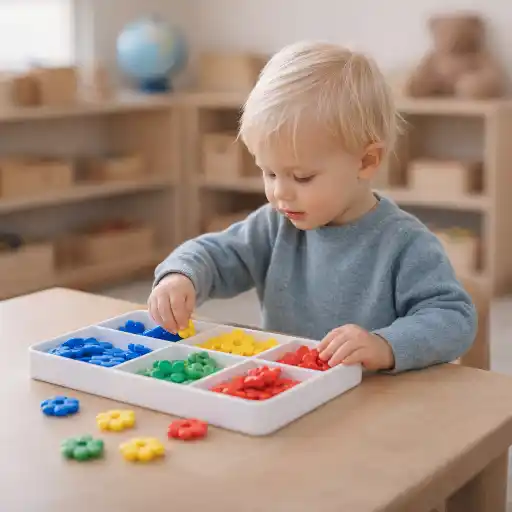
Which Hands-On Sorting Invitations Work Best?
Choose materials that are varied enough to invite comparison but manageable enough to prevent overload. Buttons, large beads, blocks, shells, leaves, fabric pieces, toy animals, utensils, and picture cards can all support classification. NAEYC’s button-box example illustrates how children can examine objects with magnifiers, describe attributes, sort them, and then sort them again using a different rule. Avoid small loose parts when they pose a choking risk, and supervise closely.
Try these classroom invitations:
- Nature sort: Collect safe leaves, sticks, and stones, then sort by size, color, shape, or texture.
- Cleanup categories: Label shelves with photographs and invite children to return materials to the correct group.
- Transportation sort: Group vehicles by land, water, air, number of wheels, or function.
- Texture sort: Classify fabric or classroom objects as smooth, rough, soft, or hard.
- Living-world sort: Compare plants, animals, rocks, toys, and photographs using a scientific rule.
- Mystery sort: Sort objects silently and invite children to infer the hidden rule.
Connect sorting to patterns by asking children to arrange groups in a repeated sequence. The ECE Resource Hub identifies sorting as an early step toward recognizing and creating patterns. Movement, sounds, and cleanup routines can also become patterning opportunities.
How Can Sorting Strengthen Executive Function and Language?
Sorting requires children to hold a rule in mind, ignore distractions, inhibit an impulsive placement, and shift strategies when the rule changes. These demands engage executive-function processes such as working memory, inhibitory control, and cognitive flexibility. Harvard’s Center on the Developing Child emphasizes that these abilities develop through interaction and practice; NAEYC likewise describes playful games as meaningful contexts for strengthening self-regulation and flexible thinking.
Adult language is central. Instead of correcting immediately, narrate and inquire: “You placed the stone with the leaves. Tell me about your idea.” This approach reveals the child’s reasoning and creates a reason to revise it. Add precise words—attribute, category, compare, observe, set, alike, and different—within authentic conversation.
Sorting can also support social-emotional learning. In a small group, children negotiate categories, listen to different interpretations, take turns, and tolerate disagreement. An activity involving emotion picture cards can help children classify feelings while building emotional vocabulary and empathy. The goal is not to imply that every facial expression has one universal meaning; invite children to consider context and individual experience.
For dual-language learners and children with communication differences, provide photographs, gestures, home-language labels, objects, and alternative ways to respond. Children may point, draw, sort silently, use a communication device, or explain their thinking in a familiar language before sharing in English.
How Can Providers Differentiate Sorting Without Lowering Expectations?
Differentiation changes access and challenge while preserving meaningful thinking. Begin with the child’s current experience and adjust the number of objects, attributes, category labels, and level of adult support.
- Beginning: Offer two highly contrasting categories with picture labels and model one example.
- Developing: Invite children to sort independently by one attribute and name the rule.
- Extending: Ask children to sort the same materials a second way.
- Advanced: Introduce two attributes, nested categories, or child-created rules.
Children with motor differences may benefit from large objects, nonslip trays, adapted tools, or a partner who handles materials while the child directs the classification. Children with sensory differences may prefer photographs or carefully selected textures. A child who is easily overwhelmed may begin with a small collection and a quiet workspace.
Use open-ended scaffolding rather than taking control. Observe first, offer one prompt, model briefly if needed, and then step back. The course Inclusive Lessons for Preschoolers  Buy Now $16.00 can help providers connect material selection, accessibility, and lesson design so every child can participate meaningfully.
How Can Directors and Teachers Assess Sorting Progress?
Authentic assessment focuses on process, not merely on whether objects were placed in an expected group. Observe whether a child notices attributes, maintains a rule, explains a decision, re-sorts materials, and responds to new information. A child’s explanation may demonstrate sophisticated thinking even when the final grouping differs from an adult’s expectation.
Brief documentation might include:
- “Sorted eight objects by color without assistance.”
- “Explained that the boat belongs with water vehicles.”
- “Created a second sort by size after the teacher’s prompt.”
- “Changed the category rule after noticing the buttons had different textures.”
Use photographs, work samples, child quotations, and checklists selectively. The course Preschool Assessments & Observations Buy Now $24.00 offers further support for objective observation, individualized planning, and family partnerships.
Share children’s thinking with families rather than sending home only a finished product: “Jordan sorted the animals by habitat and then made a group for animals that fly.” Families can extend learning by sorting socks, utensils, groceries, recycling, or books. State requirements vary - check your state licensing agency when connecting documentation and assessment practices to local expectations.
What Common Mistakes Should Providers Avoid?
One common mistake is treating sorting as a single-answer worksheet. Worksheets can have a place, but hands-on materials allow children to move, compare, test, and revise. Another mistake is introducing too many attributes at once. Most preschoolers benefit from beginning with one clear rule before moving toward multiple characteristics.
Adults can also unintentionally limit thinking by correcting too quickly. A child may sort by a feature the teacher did not anticipate. Ask for the rule before deciding that the grouping is incorrect. If the child’s rule is not yet clear, offer a comparison: “These two are together. What do they share?”
Finally, avoid assuming that familiarity with one material equals generalized skill. A child who sorts colored bears successfully may need additional support when sorting leaves, sounds, or pictures. Vary the materials and contexts while keeping the cognitive goal visible.
Conclusion: How Can Sorting Activities Strengthen Early Thinking Skills?
Sorting strengthens early thinking because it gives children repeated practice observing, comparing, classifying, communicating, and changing strategies. It lays the groundwork for early mathematics, science, language, executive function, and social learning without requiring formal worksheets or expensive equipment.
The most effective practice is intentional but joyful: offer accessible materials, begin with manageable rules, ask questions that reveal thinking, welcome multiple solutions, and document growth over time. When providers treat everyday cleanup, nature walks, snack routines, and play as opportunities for classification, children learn that organizing ideas is a powerful way to understand their world.
Additional professional-learning options: Math Foundations in Early Childhood Buy Now $16.00, The Best Promotion is Play Buy Now $24.00, and Building Vocabulary Buy Now $16.00.
Selected references: University of Nevada, Reno; Illinois Early Learning Project; NAEYC; Head Start ELOF; Harvard Center on the Developing Child.
- Teacher-Child Interactions for Stronger CLASS® Outcomes
- CDA Home Visitor Subject Area 2 Part 3 Birth to 5
- CDA Bridge Bundle: Preschool
- CDA Bridge Bundle: Family Child Care
- Art from the Heart for Preschoolers: Open Ended Art Projects that Build Self-Esteem
- CDA Bridge Bundle: Infant/Toddler
- Staff Supervision, Observation & Feedback
- Letter & Number Planning in Child Care
- Family Child Care: Building, Premises, and Outdoor Safety
- Preschool Arithmetic Activity
- Mathematical Skill Development
- Increasing Fine Motor Skills in the Early Childhood Education Classroom
- CDA Certification en Español: Recursos y Consejos para Educadores Bilingües
- 10 Ejemplos de Cómo la Cultura Influye en el Desarrollo Infantil
- How can we prepare preschoolers for kindergarten success?
- How Do Art Activities Support Cognitive Growth in North Dakota Preschoolers?
- Can Toddlers Do STEM in the Sandbox at Minnesota Daycares?
- Celebrando la amistad en el cuidado infantil durante el Día de los Mejores Amigos
- Open-Ended Preschool Activities for Creativity, Language, and Social Skills
- How can preschool classrooms effectively support early math skills?
- STEM for Preschoolers: Fun Activities That Encourage Curiosity
- How Can Cut, Sort, and Glue Activities Strengthen Early Learners’ Development?
- How Can STEM Activities Turn Everyday Preschool Play Into Powerful Learning?
- Why Is Wild vs. Farm Animal Sorting a Favorite Preschool Activity?
- How Can Living vs. Non-Living Sorting Spark Early Science Thinking?
- How Can Sorting Activities Strengthen Early Thinking Skills?
- How Do Animal Classification Activities Build Early Science Thinking?
- How Can Simple Sorting Activities Build Sustainable Habits in Early Childhood?
- How Does Word Sorting Build Phonics and Vocabulary Skills?
