When the laundry basket becomes a classroom mystery, children can practice far more than finding a matching pair: they compare, classify, count, and build independence through purposeful play. Explore the Sock Detective Teaching Guide Buy Now $1.75 for a ready-to-use activity framework, then deepen your math-teaching toolkit with Math Foundations in Early Childhood  Buy Now $16.00, a course focused on hands-on, play-based math strategies for young children.
For providers and directors, a cozy fall invitation like this can connect real classroom routines to early mathematical thinking without adding a complicated lesson to the day. Read on for ways to set up the investigation, adapt it for different learners, and notice what children are learning as they play.
Why does a missing-sock mystery matter for early learning?
A missing sock is a familiar, low-stakes puzzle with an appealing purpose: find the partner, sort the collection, and return the socks to their basket. For children ages 3–5, this practical task creates meaningful opportunities to compare visible features and explain decisions. They may notice color, pattern, length, size, or texture—and discover that one pair can match in more than one way.
The activity also makes early math tangible. Children encounter the idea of a pair as two related objects, compare groups, notice similarities and differences, and begin using words such as same, different, more, fewer, long, short, and matching. When they change the sorting rule, they practice flexible thinking: the same socks can be reorganized by color, owner, or pattern.
Practical-life routines add a valuable layer. Children can carry a basket, match socks, fold or roll them, and return materials to a designated place. Completing the sequence supports agency and gives children a chance to contribute to their classroom community. As with any hands-on activity, choose clean, age-appropriate materials, supervise closely, and follow program safety procedures. The ChildCareEd sorting and early-thinking discussion also highlights how classification can invite comparison, reasoning, and explanation.
How can you set up the sock investigation?
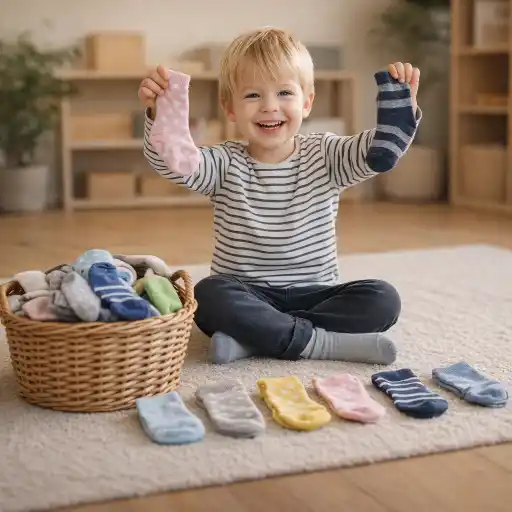
Keep the setup simple enough to invite exploration, but organized enough that children can focus. Gather a manageable collection of clean socks in a range of colors, patterns, and sizes, along with a basket or shallow tray. A doll or stuffed animal can provide a story hook: “The bear’s socks got mixed up. Can our detectives help?” The ChildCareEd Sock Detective Teaching Guide Buy Now $1.75 offers preparation notes, activity variations, and observation prompts for this kind of invitation.
Before children arrive, check each sock for loose threads, damaged elastic, or other concerns. Use larger socks or fabric sock cards if needed, and avoid small accessories that may present a choking risk. Arrange the materials within children’s reach and show them where completed pairs can go. You might place a small “finished” basket nearby so the activity has a clear beginning and end.
Introduce the investigation with curiosity rather than a demonstration of every answer. Invite children to inspect the socks, describe what they see, and choose a first strategy. If the group needs a starting point, begin with a small number of clearly contrasting pairs. Add more items as children become comfortable.
- Offer a basket of clean, varied socks and a clear space for sorting.
- Start with a few pairs; increase the collection when children are ready.
- Let children know how to return the materials when they are finished.
- 🧦 Invite children to be “sock detectives” and explain what clues helped them find a match.
What math and practical-life skills can children explore?
Matching socks supports visual discrimination: children look closely at features and decide which objects belong together. Sorting extends this work by asking them to group items according to an attribute. Start with one visible feature—such as color or pattern—then invite a second arrangement. A child might first make color groups and later sort the same collection into long and short socks.
Counting can emerge naturally. Children can count individual socks, count completed pairs, or compare how many socks remain unmatched. Keep the language conversational: “How many pairs did we find?” “Are there more striped socks or plain ones?” “What might we check next?” These prompts extend thinking without turning play into a quiz.
The practical-life sequence matters too. Children can select materials, complete a task, and put items away. That purposeful work supports independence and coordination while giving them an authentic reason to persist. The sock activity connects well with other everyday-object math opportunities described in ChildCareEd’s everyday objects and early math article.
- Matching: Find two socks that share a feature.
- Classification: Sort by color, pattern, size, texture, or another child-selected rule.
- Counting and comparison: Count individual socks or pairs; compare groups using more, fewer, or the same.
- Independence: Complete the task and return materials to the basket or shelf.
How can you guide play without taking over?
Your most useful role may be to observe, name what you notice, and ask a question that opens another line of thinking. Instead of telling a child where a sock belongs, try, “What clues are you looking at?” or “How did you decide these go together?” Give the child time to inspect and respond. A pause can be productive thinking time, not a sign that the activity has stalled.
Children may use a different matching rule than you expected. If two socks are paired because they are both soft or both belong to a pretend character, ask the child to describe the connection. This keeps the child’s reasoning visible and helps you distinguish a purposeful alternative from a match that needs more support.
Scaffold gradually. Model one match if a child is unsure, reduce the number of socks, or point out a feature without completing the task. For a child ready for more challenge, invite a second sort, ask them to create a pattern, or add a simple counting question. Providers can build a broader repertoire of playful math prompts and strategies through Early Mathematics Through Play Buy Now $24.00.
- “What do you notice about these two?”
- “Could you sort the socks another way?”
- “Which group has more? How can we check?”
- “What should our detectives do with the socks that have no match yet?”
How can you adapt the activity for different children?
Access matters more than everyone completing the same number of matches. Adjust the materials, directions, pace, and response options while preserving the central thinking: noticing, comparing, and making a decision. Some children may work best with two highly contrasting pairs; others may enjoy a larger collection and a child-created sorting rule.
For children who benefit from visual structure, use a small tray, a clear “start” and “finished” space, or simple picture cues. Children with motor differences may benefit from larger socks, a nonslip surface, or the option to direct a partner who moves the materials. If describing features aloud is difficult, accept pointing, gestures, signs, communication devices, or home-language explanations as meaningful ways to share thinking.
Consider sensory preferences as well. Some children may prefer fabric cards or a smaller selection rather than handling many textures. Avoid relying only on color as a clue; combine it with patterns, size, or picture symbols so children have different ways to participate. Observe what supports engagement and adjust without lowering expectations for curiosity or reasoning.
Keep safety part of planning: select clean, intact materials, follow supervision practices, and ensure that the objects are appropriate for the ages and developmental stages of the children in your care. If the activity connects to local training or licensing documentation, state requirements vary - check your state licensing agency.
How can you observe learning and avoid common pitfalls?
Use the activity as an opportunity for authentic observation, not a test of whether children can complete a prescribed number of pairs. Notice how each child approaches the puzzle: Do they scan all the socks first, compare two at a time, sort by one feature, or change strategies after a mismatch? A brief note about the process can inform your next invitation more effectively than a simple “completed” mark.
For example, you might record: “Matched three pairs by pattern; then sorted unmatched socks by size after a prompt.” A child’s explanation can also be useful evidence: “These are together because they both have stripes.” Use observations to plan a manageable next step—perhaps adding a few more socks, inviting a second sorting rule, or repeating the activity with different materials.
Common pitfalls include making the activity too large at the outset, correcting children before hearing their reasoning, or emphasizing speed and a single correct grouping. Keep the collection manageable, treat unexpected groupings as chances to ask questions, and let children revisit the materials. The ChildCareEd article on child-chosen sorting rules offers a related reminder: choice can turn routine matching into thoughtful classification.
- Observe strategies and language, not only the final arrangement.
- Use brief notes, child quotes, or a photo according to your program’s documentation and privacy practices.
- Let children choose or revise a sorting rule; avoid rushing to correct.
- Share a simple home connection with families, such as matching laundry or organizing mittens.
Conclusion: How can a sock mystery make fall math meaningful?
A missing-sock mystery turns an ordinary classroom object into a purposeful invitation to match, sort, count, compare, and practice independence. With a modest collection of clean socks, a welcoming story, and open-ended prompts, providers can make early math visible while honoring children’s curiosity and different ways of participating.
Start small: offer a few pairs, watch how children investigate, and use what you notice to shape the next challenge. Let them explain their clues, try a new sorting rule, and complete the practical-life routine of putting materials away. For a ready-to-use activity structure, explore the Sock Detective Teaching Guide Buy Now $1.75; for a more complete professional learning experience in early math, consider Math Foundations in Early Childhood Buy Now $16.00.
- Early Mathematics Through Play
- From Play to Planning: Building Culturally Competent, Child-Centered Curriculum
- The Best Promotion is Play
- Building Equity: Inclusionary Practices in Preschool
- Creating Engaging and Meaningful Learning Experiences
- Creating Environments that Nurture Growth and Community
- Connections That Count: Building Relationships in Child Care
- Texas Director Credential
- Environments That Inspire Independence and Exploration
- Mindful Supervision: Balancing Safety & Independence in Montessori
- CDA Certification en Español: Recursos y Consejos para Educadores Bilingües
- 🪁¿Cómo puede el juego apoyar de manera poderosa a los niños con autismo?🧩
- 💛🧩 ¿Cómo puedo hacer que mi enseñanza sea inclusiva para los niños con autismo?
- ¿Cómo puedo usar escenarios de juego de roles de primeros auxilios en mi aula?
- 10 Ejemplos de Cómo la Cultura Influye en el Desarrollo Infantil
- Capacitación en Salud y Seguridad Preventiva en Línea para Proveedores de Cuidado Infantil
- Proporciones de Cuidado Infantil y Tamaños de Grupo por Edad en Virginia (Guía Rápida para Centros y Hogares)
- Actividades de Otoño Fáciles para Preescolares esta Temporada
- Fall Circle Time Ideas for Preschool and Daycare
- Celebrando la amistad en el cuidado infantil durante el Día de los Mejores Amigos
- Canciones, juegos y preguntas de círculo para niños
- How Can I Make Circle Time Activities Work for Preschoolers?
- How can leaf-themed art and science activities deepen learning in my child care program?
- Cómo Planificar Actividades al Aire Libre Seguras Durante el Calor y la Mala Calidad del Aire
- Circle Time Topics Beyond Weather, Days of the Week, and the Calendar
- ¿Cómo puede la retroalimentación visual apoyar la fluidez en la multiplicación?
- How Can a Pumpkin Delivery Game Turn Fall Movement Into Real Problem-Solving?
- How Can a Missing Sock Mystery Turn Fall Play Into Practical-Life Math?
- What Disappeared from the Fall Tray? How Can Preschool Detective Games Build Memory?
