When a child sorts an autumn picture by a rule you did not expect, that moment can become a powerful math conversation—not a correction. Try the Math Foundations in Early Childhood  Buy Now $16.00 course to strengthen your approach to hands-on, play-based math and bring purposeful sorting experiences into everyday classroom practice. Then use the ideas below to help children explore fall pictures, explain their choices, and discover that one collection can be organized in several sensible ways.
Why does open-ended fall sorting matter?
Sorting looks simple: children place pictures into groups. But each decision involves noticing details, comparing features, and deciding which feature matters. When the materials include familiar autumn objects—leaves, pumpkins, apples, scarves, or boots—children can draw on what they already know while developing early mathematical reasoning.
A closed task has one adult-selected rule, such as “put all the red pictures together.” An open-ended invitation gives children room to choose: “What belongs together? You decide.” A child might group leaves by color, then regroup them by shape, what they do with them, or where they found them. More than one answer may be reasonable when the child can show or explain the rule.
This flexibility is central to classification, a foundation for later mathematical ideas. As the NAEYC discussion of preschool sorting explains, sorting helps children notice similarities and differences and form sets. It also creates authentic opportunities to use language such as attribute, category, alike, different, and belong.
- Children practice observation, comparison, decision-making, and flexible thinking.
- They experience their ideas as worth examining, which can support persistence and agency.
- Educators gain a window into children’s reasoning—not just whether a placement matches an expected answer.
For busy providers and directors, the value is practical: a simple seasonal center can support math talk, peer conversation, and purposeful observation without requiring a complicated lesson plan.
How can you introduce autumn picture mats without giving away the rule?
Begin with a small set of autumn picture cards Buy Now $2.50 or mats such as autumn leaf math activities Buy Now $0.00. Lay out the pictures so children can see and reach them, and give a short, open invitation: “Look closely. Put together the pictures you think belong together.” Avoid naming a category before children begin; doing so can turn child-led classification into a matching quiz.
Choose a manageable number of images at first. A small collection helps children focus on features and talk about their thinking rather than spending their attention managing too many pieces. If you use a resource such as Cut, Sort, and Match Autumn Pictures Buy Now $2.50, adapt the presentation: the printable offers a familiar matching structure, while an open-ended extension invites children to create their own groups.
Pause and observe before stepping in. Children may look, move one card, reconsider, and try again. That thoughtful hesitation is part of the work. Use neutral prompts that invite explanation:
- “What do you notice about these pictures?”
- “What made you put those together?”
- “Could this picture belong in another group too?”
- “How else could we sort the same pictures?”
If children are unsure, model how to inspect a picture without naming the answer: “I’m noticing the shape and the colors. I wonder what you see.” The goal is not to withhold support; it is to leave the important choice with the child.
What sorting rules can children discover in fall pictures?
Autumn imagery offers multiple visible and meaningful attributes. Leaves can be grouped by color, shape, size, or whether they appear whole or changing. Seasonal clothing might be grouped by what is worn outdoors, what keeps a person warm, or what has a particular pattern. Children may also form groups based on personal experience, such as things they see at a farm or things they like to eat.
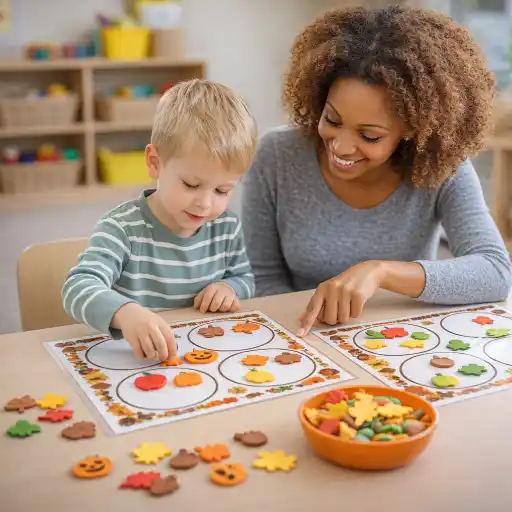
Use the featured My Sorting Rule Autumn Picture Mats as an invitation to compare, regroup, and explain—not as a demand to find one hidden answer. Picture mats can make boundaries visible and help children arrange cards independently. When practical, invite the child to choose a mat or create a group on a clear tabletop so the activity remains accessible to different learners.
- By appearance: colors, shapes, size, or patterns.
- By type: leaves, foods, clothing, animals, or outdoor objects.
- By use: things we wear, eat, collect, or use in cool weather.
- By setting or experience: things found outside, at home, or during a fall outing.
- By a child-created rule: pictures that feel cozy, remind the child of a story, or belong together for a reason the adult had not considered.
Some pictures may reasonably fit more than one group. Rather than treating overlap as a mistake, ask the child to name the rule being used. For example, a red apple could belong with red objects or with foods. This is a useful way to connect classification to language and reasoning. A child’s personal rule can be the beginning of a discussion, even if the adult wants to introduce a more conventional category afterward.
How can you extend the activity while keeping children in charge?
Once a child has made a first arrangement, invite a second sort. “You grouped these by color. What is another way you could organize them?” Re-sorting helps children recognize that the same collection can be viewed through different attributes. It also encourages cognitive flexibility: children practice shifting attention from one rule to another.
Keep the conversation warm and genuinely curious. Instead of announcing whether a group is right, describe what you see and ask for the child’s thinking: “You put the boots and scarf together. What do they have in common?” Children may explain a functional connection, a personal association, or an attribute that was not obvious to you. The explanation clarifies the rule and gives you a natural chance to add vocabulary.
Try a few playful extensions:
- Invite a partner to guess the sorter’s rule, then let the child confirm or clarify it.
- Ask children to find one picture that could fit in two different groups and explain why.
- Count the pictures in each group and compare which has more, fewer, or the same number.
- Photograph a child’s arrangement and revisit it later to see whether they would choose a new rule.
- Connect picture sorting to a safe, supervised nature walk by comparing cards with leaves children observe outdoors.
These extensions keep the activity playful while connecting classification to counting, comparison, observation, and oral language. In keeping with the University of Nevada, Reno Extension overview of preschool classification and patterning, sorting can be part of a broader early math experience rather than an isolated worksheet task.
How can providers adapt, observe, and avoid common pitfalls?
Children differ in language, motor skills, attention, sensory preferences, and familiarity with seasonal images. Adjust access while preserving the child’s role as decision-maker. Use fewer pictures, larger cards, nonslip surfaces, picture labels, gestures, or spoken prompts. Children can show their reasoning by speaking, pointing, signing, drawing, using a communication device, or directing a partner to move a card. Welcome home-language words and family knowledge as meaningful contributions.
Observe the thinking process rather than judging only the finished piles. Notice whether a child attends to a feature, applies a rule, changes a placement, explains a choice, or collaborates with a peer. A concise note can guide the next invitation: “Grouped leaves by color, then reorganized by shape with a verbal prompt.” Use observations to plan support and extensions, not to label a child’s ability based on one activity.
Common pitfalls are easy to prevent:
- Giving the rule too soon: start with an open invitation, then offer a focused challenge if needed.
- Correcting an unexpected group immediately: ask how the child decided before suggesting another category.
- Offering too many pictures: begin with a small collection and add more when children are ready.
- Relying only on color: include shape, type, use, or picture labels so participation does not depend on color perception alone.
- Making the task a test: value the child’s reasoning, communication, and willingness to reconsider.
Check that materials are age-appropriate and that supervision and use of scissors follow your program’s practices. State requirements vary - check your state licensing agency when considering local expectations for activities, materials, or documentation. Staff teams can support consistency by sharing open-ended prompts and briefly discussing what children’s sorting choices reveal.
Conclusion: What should providers remember about fall sorting?
Fall sorting mats can help children discover that more than one answer may be right when each arrangement follows a meaningful rule. The learning lies in noticing attributes, forming groups, explaining choices, and trying a new way—not in reproducing the adult’s preferred piles. With familiar autumn pictures, a manageable collection, and patient prompts, providers can make classification engaging and developmentally appropriate.
Offer children the chance to choose, listen carefully to their explanations, and adapt the materials so every child can participate. Extend the experience with re-sorting, counting, comparisons, or a conversation about the season. For a broader foundation in play-based early math, explore Math Foundations in Early Childhood Buy Now $16.00; the course can help you connect activities like sorting to purposeful math teaching throughout the day.
- 45 Hour Child Growth and Development
- 45 Hour Preschool Methods and Materials
- 45 Hour Infant and Toddler Methods and Materials
- 45 Hour School Age Methods and Materials
- CDA Bridge Bundle: Family Child Care
- Math Foundations in Early Childhood
- Texas Director Credential
- Every Moment Matters: Schedules and Transitions
- CDA Certification en Español: Recursos y Consejos para Educadores Bilingües
- 💛🧩 ¿Cómo puedo hacer que mi enseñanza sea inclusiva para los niños con autismo?
- 10 Ejemplos de Cómo la Cultura Influye en el Desarrollo Infantil
- Proporciones de Cuidado Infantil y Tamaños de Grupo por Edad en Nueva Jersey (Guía Rápida para Centros y Hogares)
- Proporciones de Cuidado Infantil y Tamaños de Grupo por Edad en Virginia (Guía Rápida para Centros y Hogares)
- Celebrando la amistad en el cuidado infantil durante el Día de los Mejores Amigos
- Canciones, juegos y preguntas de círculo para niños
- Cómo simplificar la capacitación para sus empleados de daycare
- How can leaf-themed art and science activities deepen learning in my child care program?
- STEM for Preschoolers: Fun Activities That Encourage Curiosity
- How Can Cut, Sort, and Glue Activities Strengthen Early Learners’ Development?
- How Can STEM Activities Turn Everyday Preschool Play Into Powerful Learning?
- Why Is Wild vs. Farm Animal Sorting a Favorite Preschool Activity?
- How Can Even vs. Odd Sorting Introduce Early Number Sense?
- How Do Fruits vs. Vegetables Sorting Mats Build Healthy Eating Habits?
- How Can Seasonal Picture Sorting Build Phonemic Awareness in Early Childhood?
- How Can You Adapt a Beginning-Sound Activity for Different Learning Needs?
- What Common Mistakes Do Teachers Make When Observing Children During Fall Activities?
- Why Does This Leaf Have Holes? How Can Preschool Questions Become Fall Investigations?
- How Can Fall Sorting Mats Show Children That More Than One Answer Can Be Right?
