Why do preschoolers return so eagerly to wild-versus-farm animal sorting? The activity combines familiar animals, hands-on decision-making, language, early science, mathematics, and fine-motor practice in one approachable invitation. To strengthen the way you plan playful, developmentally appropriate experiences, explore Sorting Mat - Wild Animal or Farm Animal Buy Now $1.49; it can help you connect classification and reasoning to meaningful classroom learning while earning focused professional training.
Why does this simple animal sort matter so much?
A child placing a cow beside a barn animal and a lion beside a wild animal may appear to be completing a basic worksheet. In reality, the child is answering a significant conceptual question: “Which things belong together?” That question requires observation, comparison, memory, language, and decision-making. Sorting is therefore more than matching identical pictures; children identify a shared attribute and construct a category.
Animal themes make this reasoning especially accessible because most #preschoolers already have some experience with animals through books, songs, toys, family conversations, or community visits. Familiar knowledge gives children a meaningful starting point, while the contrast between farm and wild settings creates a clear reason to compare.
- Classification introduces early mathematical and scientific thinking.
- Animal names and habitats expand #vocabulary and conversation.
- Cutting, placing, and gluing strengthen #fineMotor coordination.
- Group discussion supports confidence, listening, and social learning.
Use the categories as a starting point rather than an inflexible test. Some animals can live in more than one context, and children’s explanations may reveal thoughtful ideas even when their placement differs from the adult’s expectation. The conversation is often more educational than the final answer.
How does sorting build early mathematics and science understanding?
Classification is a foundation for mathematical reasoning because children organize objects into sets, compare groups, notice similarities, and recognize that one collection can be sorted in multiple ways. After children divide animals into farm and wild groups, invite them to count each group, compare which has more or fewer, or arrange the cards by size. These extensions connect sorting to number sense, data, and comparison.
The activity also introduces basic science concepts. Children begin to consider habitats, human care, food, shelter, movement, and animal needs. Rather than presenting habitat as a memorization exercise, ask questions that invite inquiry: “What might this animal need?” “Where could it find food?” and “Would this animal be safe in a barn?”
Begin with two clearly labeled categories and a small number of familiar cards. As children gain confidence, increase the cognitive demand:
- Sort animals by farm or wild habitat.
- Sort the same animals by number of legs or movement.
- Compare animals that are large, small, fast, or slow.
- Discuss animals that may fit more than one category.
- Graph the class’s favorite farm or wild animal.
Resources describing animal classification emphasize that children can also sort by environment, skin covering, feet, sounds, and how animals travel. These variations help children understand that a category depends on the chosen rule, a crucial idea in both #math and science.
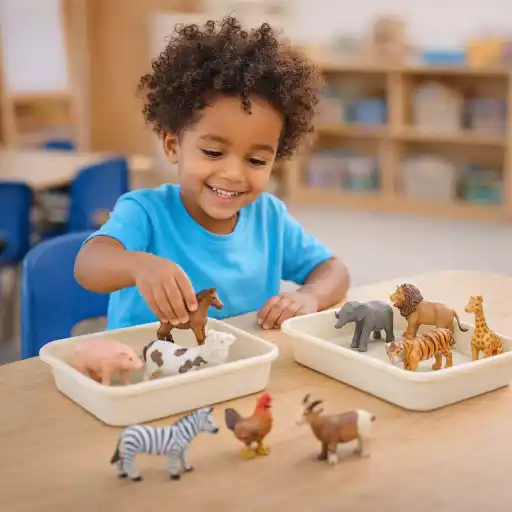
How can providers turn the activity into rich language learning?
Animal sorting naturally creates repeated opportunities to name, describe, compare, and explain. As children handle each card, model precise but accessible language: “The sheep is a farm animal. It has wool and four legs.” Then invite children to contribute through questions such as “What do you notice?” “Where does it belong?” and “How do you know?”
Extend children’s responses rather than correcting every sentence. If a child says, “Lion wild,” respond, “Yes, the lion is a wild animal that lives in a natural habitat.” This technique validates the child’s idea while providing a richer language model.
- Introduce habitat words such as barn, pasture, forest, jungle, and ocean.
- Use sentence frames: “A ___ lives on/in ___.”
- Invite animal sounds, movements, and dramatic-play scenarios.
- Compare attributes: “Both animals have four legs, but only one lives on a farm.”
- Offer picture labels and home-language translations for multilingual learners.
Pair the sort with an animal story, puppet conversation, or pretend farm and wildlife center. Children might become veterinarians, farmers, zoologists, or animal caregivers and use the new words during play. Animal-based role play has particular value because it gives children a reason to use vocabulary in meaningful social situations rather than repeating isolated labels.
For a ready-to-use option, the Wild Animal or Farm Animal sorting mat Buy Now $1.49 includes familiar animal pictures and supports vocabulary, habitat awareness, and observation.
Why do cutting, sorting, and gluing make learning memorable?
Hands-on materials give children control over the learning process. Instead of merely circling an answer, children pick up each picture, inspect it, decide where it belongs, position it, and attach it. This sequence supports visual discrimination, hand strength, bilateral coordination, spatial planning, and persistence.
Cut-and-glue activities also provide a natural structure for executive function. Children must remember the category rule, organize materials, follow a sequence, and monitor their own work. When the paper does not fit or a child changes a decision, the child has an opportunity to revise a plan.
Prepare the invitation thoughtfully:
- Use large images and sturdy paper for beginning cutters.
- Offer child-safe scissors and demonstrate how to rotate the paper.
- Provide glue sticks to support manageable pressure control.
- Use a two-column mat with clear picture or word labels.
- Invite children to place all pieces before gluing.
✨ For children who are not ready to cut, provide pre-cut cards, stickers, magnetic pieces, tongs, or Velcro. The learning goal is classification, so motor demands should not prevent participation. Children who want more challenge can cut curved outlines, create their own animal cards, or design a third category.
Keep the focus on process rather than identical products. A collage that looks different from the model may show independent thinking, careful planning, or a new classification rule.
How can you make wild-versus-farm sorting inclusive and inquiry-based?
Inclusive teaching begins with flexible access. Children vary in motor control, language, attention, sensory preferences, and prior experience. Offer multiple ways to participate without framing adaptations as exceptions. A child may point, gesture, use a communication device, select a picture, or explain a choice verbally.
- For beginners: use two categories, fewer cards, and adult modeling.
- For developing learners: ask children to explain the sorting rule.
- For advanced learners: invite a second sort by habitat, diet, or movement.
- For motor differences: use adaptive scissors, larger handles, nonslip mats, or pre-cut pieces.
- For multilingual learners: add photographs, gestures, peer modeling, and home-language labels.
- For sensory needs: reduce clutter, offer a quieter workspace, and limit adhesive or paper textures when necessary.
Be careful with oversimplified messages. “Wild” should not mean dangerous, and “farm” should not imply that every animal is domesticated. Ask children what they know, acknowledge uncertainty, and consult accurate picture books or reliable science sources when questions arise.
Most importantly, treat mistakes as invitations to investigate. Say, “You placed the bear on the farm mat. Tell me about your idea,” rather than “That is wrong.” Children may be thinking about a zoo, a storybook, a local farm, or an animal sanctuary. Their reasoning gives you information about how to extend the experience.
How can educators assess learning and extend the experience?
Assessment can occur naturally during the activity. Watch for whether children notice relevant attributes, maintain a category rule, use new vocabulary, revise a decision, and explain their reasoning. The finished page is only one piece of evidence; the child’s language and process often provide richer information.
Record concise observations such as:
- “Sorted eight animals into two groups independently.”
- “Used the sentence frame ‘A cow lives on a farm.’”
- “Resorted the cards by number of legs.”
- “Changed the bear’s placement after discussing habitat.”
Use the observation to plan the next invitation. If children recognize animal names but do not explain categories, plan a small-group conversation with real photographs. If they sort confidently, introduce three habitats or an “odd one out” challenge. If cutting is difficult, separate the fine-motor objective from the science objective so children can demonstrate knowledge another way.
Extensions can include:
- Build a farm and wildlife habitat with blocks and loose parts.
- Create a class chart showing animals’ movements or sounds.
- Read a nonfiction book and revise earlier predictions.
- Invite families to share animal experiences, stories, or words from home.
- Sort toy animals during cleanup as an authentic daily routine.
Directors can support quality practice by including sorting invitations in curriculum planning, observation systems, and staff reflection. State requirements vary - check your state licensing agency.
Conclusion: Why is wild-versus-farm animal sorting a preschool favorite?
Wild-versus-farm animal sorting remains a favorite because it feels playful while engaging sophisticated learning. Children compare familiar animals, construct categories, use language, explore habitats, practice early mathematics, strengthen fine-motor control, and learn to explain their ideas.
The strongest version is flexible and conversational: begin with two clear groups, invite children to handle and discuss the materials, accept different entry points, and extend the sort through counting, movement, books, dramatic play, and inquiry. When providers focus on children’s reasoning instead of a perfect worksheet, a simple animal activity becomes a powerful foundation for #learning, curiosity, and belonging.
For additional professional learning, consider these relevant ChildCareEd courses:
- Early Mathematics Through Play Buy Now $24.00 — connect classification, patterns, counting, and reasoning to play.
- Basic Science in Early Childhood Buy Now $25.00 — strengthen inquiry and investigation in the early childhood classroom.
- Building Vocabulary
 Buy Now $16.00 — support language growth across science, mathematics, and play.
 - Inclusive Lessons for Preschoolers Buy Now $16.00 — adapt materials and participation for diverse learners.
- Lesson Planning for Preschoolers Buy Now $24.00 — turn playful experiences into purposeful, developmentally appropriate plans.
References
- Sorting Mat - Wild Animal or Farm Animal - ChildCareEd Buy Now $1.49
- How Can Cut, Sort, and Glue Activities Strengthen Early Learners’ Development?
- How Can Fun Bingo Games Teach Colors, Shapes, and Animals to Preschoolers?
- What No-Prep Activities Can Busy Early Childhood Teachers Use Tomorrow?
- 45 Hour Child Growth and Development
- Early Mathematics Through Play
- Lesson Planning for Preschoolers
- 45 Hour Preschool Methods and Materials
- Birth to Five CDA Credential with Portfolio Review
- No Such Thing as Boring Math
- Texas Director Credential
- Montessori Cultural Activities: Exploring the World Through Play and Learning
- CDA Certification en Español: Recursos y Consejos para Educadores Bilingües
- 🚌🍑 Ideas de excursiones en Georgia
- Requisitos Para Ser Maestra Principal En Un Daycare: Lo Que Necesitas Para Empezar
- Celebra El Cumpleaños de Dr. Seuss En Tu Guardería Con Actividades Fáciles y Divertidas!
- Que es Título 22 en California?
- ¿Cuál es la diferencia entre un certificado CDA y la credencial CDA?
- Actividades de Motricidad Gruesa que Desarrollan el Equilibrio, la Coordinación y la Fuerza
- ¿Cómo solicito la licencia para una guardería en California?
- Regulaciones de Licenciamiento de Cuidado Infantil en California para Centros y Hogares de Cuidado Infantil Familiar
- Cómo Celebrar el Día Nacional del Kindergarten
- Temas y Actividades para el Día Nacional del Kindergarten para Proveedores
- Cómo Ser Maestra de Preescolar en Wisconsin
- Las Mejores Ideas de Excursiones para Guarderías en Georgia
- Canciones, juegos y preguntas de círculo para niños
- How Can Cut, Sort, and Glue Activities Strengthen Early Learners’ Development?
- What No-Prep Activities Can Busy Early Childhood Teachers Use Tomorrow?
- Why Is Wild vs. Farm Animal Sorting a Favorite Preschool Activity?
- How Do Animal Classification Activities Build Early Science Thinking?
- How Can Repetitive Text Introduce Farm-Animal Vocabulary?
- How Can We Explore Animal Habitats Beyond Farm-and-Wild Labels?
