When children group a frog, bird, fish, or dog, they are doing more than practicing animal names—they are developing habits of scientific thinking. Basic Science in Early Childhood Buy Now $25.00 can help providers strengthen inquiry-based teaching while earning two hours of professional learning; for inclusive adaptations, explore Inclusive Lessons for Preschoolers  Buy Now $16.00. The practical strategies below can turn a simple animal sort into a meaningful investigation.
Why do animal classification activities matter in early childhood?
Animal classification gives young children an accessible way to answer a powerful scientific question: “Which things belong together, and why?” To answer it, children observe features, compare examples, choose a category rule, and explain whether each animal fits. These actions represent early forms of scientific reasoning and connect naturally with language, mathematics, executive function, and social learning.
Children often arrive with substantial informal knowledge. They may recognize that a fish belongs in water, that a bird has feathers, or that a dog resembles other animals with fur. Effective teaching builds on these ideas without assuming that every explanation is complete. The goal is not immediate mastery of formal taxonomy; it is the development of curiosity, evidence-based conversation, and flexible thinking.
Research-informed guidance supports beginning with concrete experiences. The NAEYC discussion of sorting activities emphasizes that children learn to notice similarities and differences through hands-on grouping and re-sorting. Similarly, AAAS Benchmarks describe classification as a process in which living things can be grouped in many ways, depending on the purpose.
- 🦉 Builds observation, comparison, and explanation.
- Expands animal, habitat, and attribute vocabulary.
- Connects science with counting, graphing, and early data.
- Encourages collaboration, turn-taking, and intellectual risk-taking.
How can educators introduce animal groups without oversimplifying science?
Begin with familiar animals and a small number of clearly observable attributes. A group of four or five picture cards might include a dog, duck, fish, and turtle. Invite children to describe what they notice before introducing category labels. Ask, “What do you see?” “How does this animal move?” “What covers its body?” and “Where might it live?”
Use categories that match children’s developmental readiness. Early classifications may focus on habitat, movement, body covering, or number of legs. Later, children can encounter broader biological groups such as mammals, birds, fish, reptiles, and amphibians through conversation and repeated experience. Formal definitions should remain brief and connected to visible evidence.
It is also helpful to explain that categories depend on the question being asked. The same duck could belong to a group of birds, animals that swim, animals with feathers, or animals found near ponds. This principle is consistent with Illinois early childhood science guidance, which encourages children to sort living things in multiple ways and explain their reasoning.
- Start with obvious examples before introducing unusual animals.
- Use photographs, toy figures, gestures, and home-language labels.
- Model uncertainty: “I have a question. What evidence might help us?”
- Include animals familiar to children’s families and communities.
- Distinguish storybook features from real animal characteristics when appropriate.
Avoid presenting one characteristic as the entire definition. For example, not all birds fly, and movement alone does not determine an animal group. Treat unexpected responses as opportunities to investigate rather than errors to eliminate quickly.
Which hands-on animal classification activities encourage deeper reasoning?
A strong classification invitation requires little preparation: provide animal figures or cards, two or three labeled mats, and a small basket for undecided items. Children can sort animals by habitat, body covering, movement, diet, or broad animal group. After the first sort, invite them to explain the rule and then reorganize the same materials using a different rule.
Try these adaptable investigations:
- Habitat sort: Group animals by pond, forest, farm, ocean, or desert. Ask what each habitat provides.
- Body-covering sort: Compare fur, feathers, scales, shells, and smooth skin using photographs or figures.
- Movement sort: Classify animals that swim, fly, walk, crawl, hop, or move in more than one way.
- Evidence detective: Hide one card and offer clues based on observable traits.
- Mystery sort: Sort several cards silently and invite children to infer the rule.
- Outdoor connection: Photograph birds, insects, plants, or animal tracks and revisit the images indoors.
Open-ended prompts deepen the activity: “What makes these animals belong together?” “Could an animal fit in two groups?” “Which card was difficult to place?” and “What could we observe or look up?” These questions shift the experience from memorization toward #observation, evidence, and explanation.
Classification can also connect to mathematics. Children can count each group, compare which group has more or fewer members, create a simple graph, or arrange animals by size. These extensions make scientific categories tangible while keeping the experience playful.
How can providers support language, inclusion, and engagement?
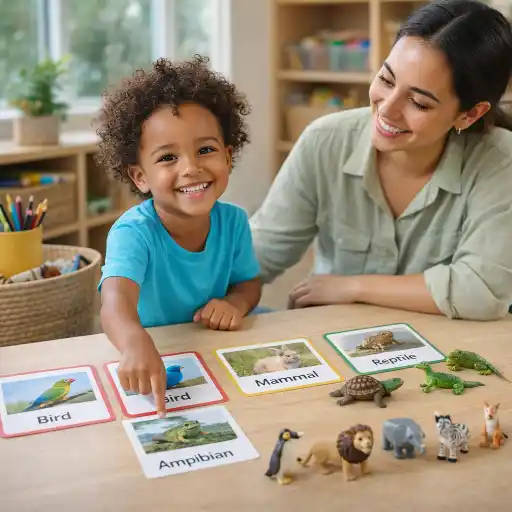
Animal investigations naturally create rich opportunities for #vocabulary and communication. Model words such as compare, group, similar, different, habitat, feather, fur, scale, evidence, and classify in meaningful sentences. Extend children’s statements rather than correcting them abruptly: if a child says, “Fish water,” respond, “Yes, the fish lives in water and uses fins to move.”
Multilingual children can participate through gestures, drawings, pointing, home-language discussion, peer interpretation, or picture-based communication. Pair spoken labels with photographs and symbols. Invite families to contribute animal names, stories, or observations from home so classroom science reflects children’s lived experiences.
Inclusive access means adapting the pathway without lowering the scientific goal. Consider:
- Large, sturdy cards and objects for children with motor differences.
- Magnetic pieces, Velcro, tongs, or pre-cut images as alternatives to cutting.
- Reduced choices and additional processing time for children who need them.
- A quiet workspace for children who are sensitive to noise or visual clutter.
- Seated, standing, floor-based, and partner options for participation.
- Communication devices, eye gaze, gestures, or pointing as valid responses.
For further support in adapting materials and lesson design, Planning for Every Child: Responsive Strategies in Action Buy Now $55.00 addresses individualized, culturally responsive planning and accessibility. State requirements vary - check your state licensing agency when connecting professional learning to local requirements.
How can observation and documentation extend the learning?
Assessment should capture the child’s thinking process rather than only the final placement of a card. Observe whether the child notices relevant characteristics, maintains a category rule, explains a decision, collaborates with peers, and revises an idea after new information. A child who changes a classification after discussing habitat is demonstrating important scientific flexibility.
Useful documentation might include:
- “Maya grouped the duck and fish because both move in water.”
- “Luis identified fur and feathers but needed photographs to distinguish scales.”
- “Amina created a second sort for animals that fly.”
- “Jordan revised the bear’s placement after discussing forest habitat.”
Use photographs, dictated explanations, work samples, and brief objective notes. The research on preschool science assessment emphasizes the value of supporting and assessing science learning during everyday interactions, including performance-based observations and attention to children’s dispositions toward inquiry.
Revisit the same materials weeks later. Ask children whether they would keep the original groups or change them. Families can extend the investigation by sorting animal books, noticing wildlife on walks, or discussing pets and their needs. Directors can support consistency by providing a shared documentation template and scheduling short staff reflections about misconceptions, effective prompts, and participation supports.
What common mistakes should educators avoid?
The first mistake is treating classification as a right-or-wrong quiz. Immediate correction can discourage children from explaining unconventional ideas. Instead, ask, “What is your rule?” or “What do these animals have in common?” If the rule is reasonable, acknowledge it and invite another classification.
A second mistake is introducing too many categories at once. Young children often benefit from one clear attribute before comparing two attributes or using nested categories. Begin with a small collection, then increase complexity as children show readiness.
A third mistake is relying only on animal names. Naming is useful, but scientific thinking grows when children describe traits, connect animals to habitats, and use evidence. Add one brief reasoning prompt after each card rather than turning the experience into a vocabulary drill.
Finally, avoid inaccurate generalizations. Not every bird flies, not every animal lives in one habitat, and “wild” does not simply mean dangerous. When a question exceeds the group’s knowledge, model scientific humility: “We do not know yet. How could we find out?”
Conclusion: How do animal classification activities build early science thinking?
Animal classification activities build early science thinking by giving children repeated practice with the core actions of inquiry: observing, comparing, grouping, explaining, questioning, and revising. The activity becomes especially powerful when educators use real or realistic materials, invite multiple classification systems, connect categories to habitat and animal needs, and document children’s reasoning.
The most effective approach is intentionally simple: begin with children’s interests, offer a manageable collection of animals, ask evidence-based questions, and welcome more than one thoughtful solution. With inclusive materials and responsive scaffolding, every child can participate as a capable young scientist. To deepen your planning and inquiry practice, consider Children at the Wheel: Emergent Curriculum Buy Now $25.00, which focuses on using children’s questions and interests to guide meaningful learning.
Five practical takeaways
- Use familiar animals and observable attributes as the starting point.
- Make the classification rule visible and invite children to create new rules.
- Ask “How do you know?” more often than “Is that right?”
- Adapt materials and response options so every child can investigate.
- Document explanations, revisions, and questions—not just completed sorts.
- 3 Hour Aide Orientation
- Moving About the Classroom: Effective Transitions for Everyday
- 24 Hour Texas Pre-Service
- Staff Supervision, Observation & Feedback
- Texas Director Credential
- Building Early Science Foundations
- Montessori Cultural Activities: Exploring the World Through Play and Learning
- Technology as a Classroom Tool
- Rooted in History: Early Childhood
- 👶 ¿Cuáles son las proporciones y grupos requeridos en Dakota del Norte? 🏫
- 🚌❄️ Ideas de excursiones en Dakota del Norte
- Recursos en Español sobre el Sueño Seguro del Bebé
- Actividades de Motricidad Gruesa que Desarrollan el Equilibrio, la Coordinación y la Fuerza
- Capacitación en Salud y Seguridad Preventiva en Línea para Proveedores de Cuidado Infantil
- Lista para Guardería en Casa en Texas: Cómo Iniciar una Guardería en el Hogar
- Las Mejores Ideas de Excursiones para Guarderías en Dakota del Norte
- Las Mejores Ideas de Excursiones para Guarderías en Georgia
- Calabazas, hojas y manzanas: actividades de otoño para preescolares
- Cómo simplificar la capacitación para sus empleados de daycare
- What’s Happening Outside? Fall Science Adventures for Preschoolers
- How Can Fun Bingo Games Teach Colors, Shapes, and Animals to Preschoolers?
- Why Is Animal Bingo a Great Way to Introduce Habitats and Classification?
- Why Is Wild vs. Farm Animal Sorting a Favorite Preschool Activity?
- How Can Day vs. Night Sorting Help Children Understand Time and Routine?
- How Can Living vs. Non-Living Sorting Spark Early Science Thinking?
- How Do Animal Classification Activities Build Early Science Thinking?
- How Do Classification Questions Build Marine Science Vocabulary?
- How Can Child Care Providers Introduce Reptiles Through Art, Observation, and Conversation?
- How Can We Explore Animal Habitats Beyond Farm-and-Wild Labels?
