Small, playful moments—catching a balloon, placing a puzzle piece, or pouring water—give children meaningful practice coordinating what they see with how they move. Explore practical classroom ideas and build your planning skills with ChildCareEd’s How Preschoolers Develop  Buy Now $32.00 course, which supports age-appropriate instruction and understanding developmental differences. For a focused next step in designing purposeful activities, consider Lesson Planning for Preschoolers Buy Now $24.00; the course can help you turn everyday play into thoughtful learning experiences.
What is hand-eye coordination, and why does it matter?
Hand-eye coordination—also called eye-hand coordination or visual-motor coordination—is the ability to use visual information to guide hand movements. A child watches a rolling ball and reaches to stop it, aligns a bead with a string, or guides a crayon along paper. Eyes, attention, planning, and movement work together in these everyday actions.
In early childhood classrooms, these experiences support participation well beyond art or sports. Children use coordinated movements to build, manipulate classroom tools, feed themselves, turn pages, and begin drawing and writing. They also practice persistence and problem-solving as they adjust a movement, try again, or ask for support. Development varies, so the aim is not to make every child perform the same task in the same way. Rather, educators can offer inviting opportunities and notice each child’s growing confidence and control.
Good activities are playful, brief, and connected to children’s interests. The ChildCareEd article increasing fine motor skills in the early childhood classroom highlights the value of varied manipulatives, art materials, and purposeful practice in routines. This kind of intentional approach helps providers strengthen the #coordination children use throughout the day.
Which simple activities build coordination through play?
Choose activities that invite children to look, reach, grasp, place, aim, or adjust. Familiar, low-cost materials are often enough. Offer a choice of options and let children repeat an activity as long as they remain engaged.
- Roll and stop: Sit facing a child and roll a large, soft ball slowly. Invite them to stop it with two hands, then roll it back.
- Balloon keep-up: Tap a balloon gently upward and encourage children to track and tap it. Its slower movement can offer extra time to respond; supervise closely and remove broken balloon pieces immediately.
- Target toss: Place a basket or hoop nearby and invite children to toss soft bean bags. Adjust the distance rather than emphasizing speed or competition.
- Build and balance: Stack blocks, nest cups, or build a short structure from large, safe construction pieces. Children watch how pieces fit and make small corrections.
- Find, sort, and place: Use age-appropriate large objects, tongs, or scoops to transfer items into separate containers by color or shape.
- Thread and lace: Offer large beads and a stiff lace or pipe cleaner to children who can safely use them under supervision.
- Make marks: Provide chunky crayons, stickers, or stamps. Invite children to place marks on large paper or follow a broad path without requiring a perfect result.
These ideas echo activity collections such as preschool eye-hand coordination activities, which include scooping, pouring, balloons, balls, threading, and puzzles. Keep the experience open-ended: the learning lies in children’s attempts, not in producing identical outcomes.
How can educators weave practice into the classroom day?
Coordination practice does not need to be a separate lesson. Short, repeated opportunities throughout the day help children use skills in meaningful contexts. During arrival, children can place name cards in a pocket chart; at the sensory table, they can scoop and pour; in the block area, they can stack and connect pieces. During snack preparation, children can use utensils or pour water from a small pitcher with close adult support.
Set up centers so children can see what to do and access materials safely. A shallow tray, a small number of tools, and a simple picture cue can make an activity easier to begin and tidy. Demonstrate one action—such as guiding a scoop into a cup—then give children time to explore. Keep practice playful and responsive rather than turning every attempt into a test.
Look for ways to combine movement with other learning goals. Children can sort objects by color, count successful bean-bag tosses, describe how a tower changed, or use new words while threading. These combinations make coordination practice feel purposeful and engaging. As described in ChildCareEd’s resource on incorporating fine motor practice into daily activities, mealtimes, play, dressing, and classroom routines can all provide natural occasions for hands-on practice.
- Pick one or two activities to add to an existing center instead of redesigning the schedule.
- Offer time for repetition, choice, and cooperative play.
- Notice children’s strategies and effort; describe what you see rather than correcting every movement.
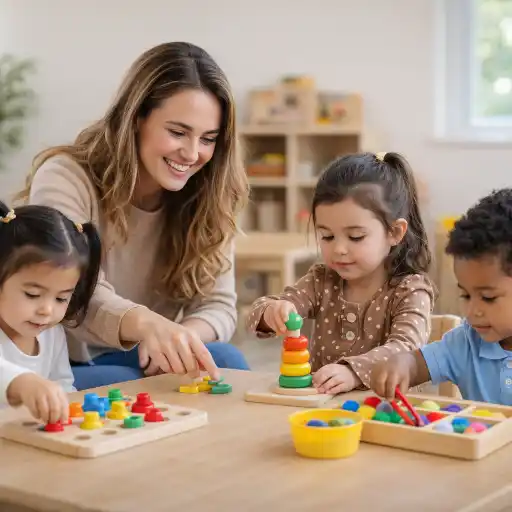
How can activities be adapted for different ages and abilities?
Start with the action the child is ready to try, then adjust the materials, distance, size, or amount of support. A younger child may enjoy reaching for a large, lightweight object or placing a big block on a wide base. A preschooler who is ready for greater precision might thread larger beads, complete a simple puzzle, or toss a bean bag toward a farther target. These are flexible starting points, not age-based tests or expectations.
When a task feels difficult, make one change at a time. Use larger objects, a wider target, a slower-moving object, or a more stable work surface. If a child is successful and interested, gradually introduce a small challenge, such as a narrower container or a slightly greater distance. Offer adaptive tools where helpful, and allow children to participate by choosing, pointing, stabilizing materials, or working alongside a peer. Avoid taking over; a brief model or gentle cue can be enough.
Observe patterns over time in more than one context. A child may find a puzzle challenging but confidently pour water or build with blocks. If concerns persist across daily activities, communicate observations respectfully with the family and follow program procedures for discussing additional support. Classroom observations do not diagnose a developmental condition. The ChildCareEd guide to helping children develop fine motor skills also emphasizes adapting materials, observing functional actions, and collaborating when appropriate.
- For beginners: use large, light materials and close, wide targets.
- For a next step: vary the object, pathway, or target while keeping the activity enjoyable.
- For inclusion: provide alternatives and allow different ways to participate.
How can providers keep activities safe and purposeful?
Safety begins with choosing materials that suit children’s ages, abilities, and mouthing behaviors. Small beads, buttons, and other tiny objects may pose choking risks, especially for younger children. Use them only when appropriate under close supervision, and store them securely when not in use. Inspect materials for damage, use child-safe tools, and maintain active supervision during movement and sensory activities. Check your program’s policies and applicable rules; state requirements vary - check your state licensing agency.
Purposeful planning can remain simple. Decide what actions you want to invite—such as reaching, tracking, grasping, or placing—then select one activity and identify how you might make it easier or harder. Observe how children approach it: Do they watch the object? Use one or both hands? Adjust their aim? Stay engaged? A short note about the action and helpful supports is more informative than labeling a child as “good” or “poor” at coordination.
Common pitfalls include making activities too competitive, expecting a polished product, or moving to a harder level too quickly. Instead, celebrate attempts, give children time, and adjust the challenge to support success. Balloon play needs special care: latex allergies and choking risks from popped balloon fragments require attention, and balloons should never be left with children unsupervised.
😃 Keep the tone encouraging: “You watched the ball all the way to your hands,” or “You changed how you held the scoop and got it into the cup.” Specific feedback helps children notice their strategies and feel capable.
What should educators remember about strengthening coordination?
Simple classroom activities can give children repeated, meaningful practice coordinating vision and movement. Rolling and catching a ball, tossing a bean bag, building with blocks, scooping and pouring, threading large materials, and making marks all invite children to look closely and guide their hands. These experiences can be incorporated into centers, routines, outdoor play, and shared projects without elaborate supplies.
Keep activities developmentally responsive: adjust materials and challenge, offer alternatives, supervise carefully, and value effort as much as accuracy. Observe progress across different tasks and partner with families when ongoing concerns warrant a conversation. The central question—what simple ways can strengthen hand-eye coordination in the classroom?—has a practical answer: provide playful opportunities, make them accessible, and let children practice at their own pace. Consistent, supportive experiences help children build #confidence and participate more fully in their learning.
Five ChildCareEd courses to explore
- How Preschoolers Develop Buy Now $32.00 — deepen understanding of preschool development and age-appropriate instruction.
- Lesson Planning for Preschoolers Buy Now $24.00 — strengthen planning for purposeful, developmentally appropriate activities.
- Preschool Assessments & Observations Buy Now $24.00 — build observation and assessment knowledge for responsive learning experiences.
- Tailoring Instruction to Children's Needs Buy Now $24.00 — explore differentiation and scaffolding to include individual learners.
- Spicing Up the Classroom: Learning Centers Buy Now $16.00 — learn about purposeful learning centers and planning.
Check with your employer or state registry about whether any course meets your specific professional-development requirements.
- CDA Home Visitor Subject Area 3 Part 3 Birth to 5
- CDA Home Visitor Subject Area 2 Part 3 Birth to 5
- Beyond the Classroom: Connecting Families to Essential Services
- Birth to Five CDA Credential with Portfolio Review
- Pediatric RSV First Aid & CPR/AED
- 45 Hour School Age Methods and Materials
- Art from the Heart for Preschoolers: Open Ended Art Projects that Build Self-Esteem
- Texas Director Credential
- Access for All: Inclusion and the ADA
- Moving About the Classroom: Effective Transitions for Everyday
- How to boost fine motor skills: Holiday Edition
- Increasing Fine Motor Skills in the Early Childhood Education Classroom
- Ready, Set, Kindergarten!
- Actividades de Motricidad Gruesa que Desarrollan el Equilibrio, la Coordinación y la Fuerza
- How can childcare providers support fine motor development with simple activities?
- How can I build gross motor skills indoors and outdoors for the children in my program?
- How can child care programs build prewriting skills without worksheets?
- How can child care providers support fine motor development through simple activities?
- How Can Cut, Sort, and Glue Activities Strengthen Early Learners’ Development?
- How Do Clip Cards Build Fine Motor Strength and Focus?
- How Can Child Care Providers Strengthen Fine Motor Development Through Play and Daily Routines?
- How Can Clip Cards Prepare Little Hands for Writing?
- How Can Clip Cards Build Focus and Fine Motor Skills?
- How Can Halloween Fine-Motor Activities Be Fun Without Being Scary?
- How Do Dot-to-Dot Activities Support Number Order and Pencil Control?
- How Do Cut-and-Paste Activities Build Fine-Motor Control and Planning?
- How Can Teachers Support Children Who Become Frustrated During Fine-Motor Activities?
- How Can Simple Fall Activities Support Kindergarten Readiness Through Play?
- How Can Providers Plan Creative Sensory and Fine-Motor Activities for Young Children?
- What Are Simple Ways to Strengthen Hand-Eye Coordination Through Classroom Activities?
