Cut-and-paste activities turn simple paper pieces into meaningful practice for hand strength, coordination, decision-making, and follow-through. The Art from the Heart for Preschoolers: Open Ended Art Projects that Build Self-Esteem Buy Now $35.00 course can help you extend this work beyond a finished craft by strengthening classroom practices that support creativity, confidence, and independent choices.
Why do cut-and-paste activities matter in early childhood?
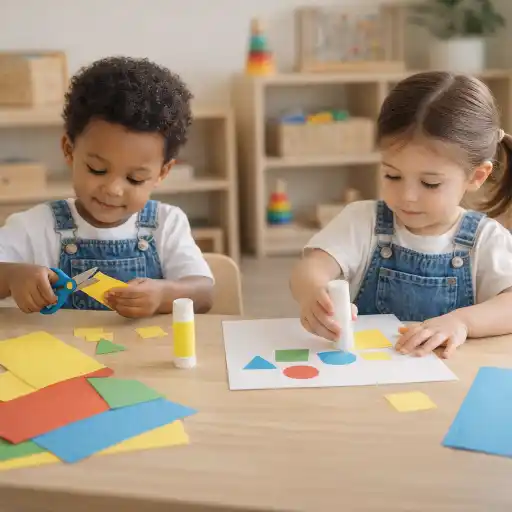
Cutting, arranging, and gluing may look like a short art project, but the experience integrates several developmental systems at once. Children stabilize paper with one hand while guiding scissors with the other, track visual information, judge space, and coordinate a sequence of actions. These demands make cut-and-paste work especially valuable for developing #fineMotor control in purposeful, engaging contexts.
The activity also gives children a concrete reason to plan. Before gluing, they must decide which pieces belong on the page, where each item should go, and whether the arrangement communicates their idea. When a piece is misplaced or glue does not work as expected, children have opportunities to revise rather than simply start over.
- Scissor use strengthens hand and wrist control.
- Picking up small paper pieces supports precision and visual-motor integration.
- Arranging pieces builds spatial reasoning and sequencing.
- Gluing develops pressure control and task completion.
- Talking about choices expands language and #communication.
These benefits are consistent with guidance on cut, sort, and glue activities, which connects hands-on manipulation with classification, reasoning, independence, and persistence.
How does cutting strengthen fine-motor control?
Scissor use requires more than opening and closing the blades. Children must position their fingers, maintain a stable wrist, orient the paper, and coordinate both hands. The cutting hand manages the tool while the assisting hand rotates or advances the paper. This bilateral coordination supports later tasks such as drawing, fastening clothing, using utensils, and writing.
Progress should be gradual. Begin with short strips and wide, straight lines. As children gain confidence, introduce curves, simple shapes, and more detailed pictures. The goal is not perfect accuracy; it is increasing control, endurance, and willingness to try.
- Offer child-safe scissors that fit comfortably in the child’s hand.
- Use thicker paper when lightweight paper tears too easily.
- Provide a starting snip for children who need help beginning.
- Invite children to rotate the paper rather than twisting their wrists.
- Allow short practice periods and breaks when hands become tired.
Active supervision remains essential, particularly in mixed-age settings. Small paper pieces, scissors, and glue should be selected according to age, ability, and program policy. State requirements vary - check your state licensing agency.
How do cut-and-paste activities develop planning and executive function?
Planning becomes visible when children pause before gluing. They may sort pieces, compare sizes, imagine the finished scene, and select an order of operations. This sequence supports executive-function processes such as working memory, cognitive flexibility, sustained attention, and self-monitoring.
Providers can make planning explicit without taking control. Ask, “What will you place first?” or “Where might the large pieces fit?” Encourage children to arrange materials temporarily before applying glue. This simple “plan, place, paste” routine gives children a predictable structure while preserving ownership.
 The Picnic Table Cut and Paste Buy Now $0.99 resource offers an accessible example. Children choose favorite foods, cut them out, and paste them onto a picnic table. Because the food choices and arrangement can vary, the activity supports both fine-motor practice and personal decision-making. It is available as a $0.99 one-time resource with lifetime download access.
- First: identify and name the available pieces.
- Next: choose which pieces to use.
- Then: arrange them on the table before gluing.
- Finally: paste, describe, and review the completed design.
How can providers make the Picnic Table activity developmentally responsive?
Begin by introducing the invitation rather than demonstrating one “correct” picnic. Say, “You can choose the foods you would like to bring. How will you arrange them?” This language communicates that children’s ideas matter and allows the activity to remain creative while still targeting specific skills.
Differentiate the materials and expectations. Younger or less experienced children may need larger pieces, bold cutting lines, or some pre-cut items. Children who are ready for more challenge can cut independently, create a pattern, add drawn foods, or explain why particular items belong together.
- Beginning: match pieces to the table and practice gluing.
- Developing: choose, cut, and arrange several foods independently.
- Extending: plan a balanced picnic, create categories, or add labels.
- Inclusive option: use adaptive scissors, larger handles, visual directions, or a nonslip mat.
Children who communicate in multiple languages can benefit from picture labels, gestures, peer modeling, and home-language vocabulary. For additional support with adapting lessons, explore Inclusive Lessons for Preschoolers  Buy Now $16.00. Its focus on materials, equipment, and welcoming lesson design can help staff make participation more equitable.
How can educators connect cut-and-paste work to open-ended art?
Cut-and-paste activities can include structure without becoming cookie-cutter crafts. The template may provide a starting context, while children retain meaningful choices about selection, placement, color, texture, and additions. This balance makes the activity useful for teaching tool skills while still honoring #creativity.
Invite children to extend the Picnic Table scene with drawings, collage materials, or dictated stories. One child may create a family picnic, another may design a restaurant menu, and another may invent an imaginative meal. Displaying these different interpretations communicates that the learning is found in the process, not in identical results. For more strategies that connect creative experiences with children's confidence, explore ways to support children's self-esteem.
Use descriptive feedback instead of evaluating products:
- “You turned the paper to follow the curved line.”
- “You placed the large foods first and filled the open spaces.”
- “You changed your plan when the piece covered another food.”
- “Tell me about what your picnic group is sharing.”
The ChildCareEd course Power of Art: Building Self-Esteem and Positive Behavior for All Abilities ONLINE Buy Now $24.00 is another relevant professional-learning option. It explores open-ended art, self-esteem, positive guidance, and participation for children with differing abilities.
How should directors and teachers observe progress?
Assessment can be brief and embedded in the activity. Focus on what children do, the strategies they use, and the amount of assistance required rather than judging the appearance of the finished picnic. A short anecdotal note may provide more useful information than a completed worksheet alone.
- Does the child hold and orient scissors safely?
- Can the child stabilize and rotate the paper?
- Does the child arrange pieces before gluing?
- Can the child maintain attention through several steps?
- Does the child explain or revise a plan?
Document observations with language such as, “Jordan cut along three straight lines with one verbal reminder and arranged six foods before gluing.” Save occasional work samples or photographs, following program permissions, to show growth across time. Compare performance across materials because familiarity with one template does not necessarily represent generalized skill.
Directors can support consistency by adding cutting, bilateral coordination, planning, and persistence to center observation forms. Staff meetings can then examine which adaptations helped children participate and which materials offered an appropriate challenge. Families may enjoy hearing that a child not only completed a craft but also planned, revised, and communicated an idea.
What common mistakes should providers avoid?
Even well-intended activities can become frustrating when the task is too difficult or the adult focuses primarily on the final product. Providers can protect engagement by adjusting the challenge, modeling briefly, and allowing children adequate time to work.
- ⚠️ Too much assistance: support the next step without completing the child’s work.
- Overly narrow models: demonstrate tool use, not an identical finished example.
- Too many pieces: begin with a manageable selection and add complexity gradually.
- Premature correction: ask children to explain their arrangement before deciding it is incorrect.
- Unsafe materials: supervise scissors and small pieces and follow program procedures.
Cut-and-paste work should complement, not replace, broader fine-motor experiences. Pair it with playdough, puzzles, lacing, stickers, construction, self-care routines, and open-ended collage. The ChildCareEd collection of 25 easy fine-motor activities offers additional ways to distribute practice across the day.
Conclusion: How do cut-and-paste activities build fine-motor control and planning?
Cut-and-paste activities build fine-motor control by requiring children to grasp, cut, rotate, position, and glue materials with increasing precision. They build planning by asking children to select materials, imagine an arrangement, sequence actions, monitor results, and revise decisions. The learning is strongest when providers balance clear structure with meaningful choice.
Use the Picnic Table Cut and Paste resource as a low-preparation invitation, then extend it through conversation, differentiation, observation, and open-ended additions. For deeper professional learning, consider these relevant ChildCareEd courses:
- Art from the Heart for Preschoolers Buy Now $35.00
- Power of Art ONLINE Buy Now $24.00
- Inclusive Lessons for Preschoolers Buy Now $16.00
- Lesson Planning for Preschoolers Buy Now $24.00
- CDA Subject Area 2 Buy Now $80.00
With thoughtful preparation and encouraging language, each snip and paste can become a small but meaningful step toward independence, confidence, and capable learning.
- Moving About the Classroom: Effective Transitions for Everyday
- CDA Infants/Toddlers: Lesson Planning Made Easy
- Art from the Heart for Preschoolers: Open Ended Art Projects that Build Self-Esteem
- 45-Hour Infant and Toddler Curriculum
- Texas Director Credential
- Building Bridges for Dual Language Learners
- CDA Infants/Toddlers: Stages of Development
- Montessori Cultural Activities: Exploring the World Through Play and Learning
- Developing Skills Through Fall Crafts in Childcare
- Fine Motor Skills in Kids: From Finger Painting to Chopstick Mastery
- Crayons, Chopsticks, and Cheerios: Surprising Ways to Boost Fine Motor Skills in Kids
- How to boost fine motor skills: Holiday Edition
- 10 Fine Motor Activities to Keep Tiny Hands Warm this Winter
- How to Incorporate Fine Motor Skills Practice Into Daily Activities
- Small Hands, Big Achievements: Why Fine Motor Skills Are More Than Just Fun and Games
- Pascua En El Aula: Actividades Sencillas Para Aprender y Celebrar Con Seguridad
- What are 25 easy fine motor activities I can use in my preschool?
- Actividades de Motricidad Gruesa que Desarrollan el Equilibrio, la Coordinación y la Fuerza
- Capacitación en Salud y Seguridad Preventiva en Línea para Proveedores de Cuidado Infantil
- Lista para Guardería en Casa en Texas: Cómo Iniciar una Guardería en el Hogar
- Las Mejores Ideas de Excursiones para Guarderías en Georgia
- Calabazas, hojas y manzanas: actividades de otoño para preescolares
- How can child care providers support fine motor development through simple activities?
- How Can Child Care Providers Strengthen Fine Motor Development Through Play and Daily Routines?
- What Should Child Care Providers Look For in Fine Motor Skills by Age?
- How Do Mazes Strengthen Pencil Control and Problem-Solving in Preschool?
- How Do Cut-and-Paste Activities Build Fine-Motor Control and Planning?
