A simple clothespin activity can help children practice careful looking, controlled hand movements, and persistence while they learn. For a deeper foundation in developmentally appropriate planning, explore How Preschoolers Develop  Buy Now $32.00, which can strengthen your professional knowledge and help you connect classroom experiences to children’s developmental needs.
Clip cards are small, flexible learning tools: a card presents a question or visual prompt, and the child clips the answer. With thoughtful design, the routine combines fine-motor practice, visual discrimination, early academic learning, and self-monitoring. The goal is not to make children complete repetitive drills, but to offer a brief, meaningful challenge that feels playful and achievable.
Why do clip cards matter in early childhood classrooms?
Clip cards integrate several actions into one purposeful experience. A child looks at a prompt, compares choices, makes a decision, grasps a clothespin, positions it, and releases it. This sequence invites visual attention, hand-eye coordination, motor planning, and cognitive engagement.
The physical act is valuable because fine-motor development supports everyday participation: turning pages, using utensils, fastening clothing, drawing, cutting, and handling classroom tools. Clothespins provide resistance, but the learning context gives that resistance meaning. Children may be matching colors or counting objects while also practicing the #pincer grasp and controlled release.
NAEYC’s guidance on developmentally appropriate teaching emphasizes active agency, play, intentional teaching, and adaptations based on children’s development, interests, language, and culture. Clip cards are most effective when they reflect those principles.
- They offer brief, repeatable practice.
- They connect movement with literacy, mathematics, science, or social-emotional learning.
- They can become independent after explicit modeling.
- They give educators opportunities to observe strategy, effort, and persistence.
How does squeezing a clothespin support fine-motor development?
Opening a clothespin requires the thumb and fingers to apply graded pressure. The child must maintain control while moving the clip toward a target and then release it accurately. Repetition can support hand strength and endurance, although strength is only one part of fine-motor development.
Clothespin play also involves bilateral coordination: one hand may stabilize the card while the other manipulates the clip. The activity can encourage radial-finger control, motor planning, proprioceptive feedback, and visual-motor integration. These capacities appear later in tasks such as scissor use, pencil manipulation, construction, dressing, and self-care.
Choose materials according to current ability rather than assuming every child should use the same tool.
- Begin with large, softer, or plastic clips for children developing initial control.
- Offer standard wooden clothespins when children can squeeze and release comfortably.
- Introduce mini-clips only when children demonstrate safe, coordinated handling.
- Use a stable surface or nonslip mat so the non-dominant hand can support the card.
Watch for excessive force, awkward wrist positioning, or fatigue. The aim is controlled movement and confidence—not speed or the strongest possible squeeze. Providers can also vary the fine-motor experience with playdough, lacing, puzzles, tongs, stickers, drawing, and practical self-care routines.
How can clip cards strengthen focus and early executive function?
A clip-card task asks children to sustain attention long enough to inspect the prompt and choices, remember the rule, inhibit an impulsive response, and complete a physical action. These demands engage early executive-function processes such as working memory, inhibitory control, and flexible problem solving.
Research should be interpreted carefully. A study of preschool children found weak relationships between specific motor and executive-function measures rather than evidence that one motor activity automatically improves every cognitive skill. Clip cards should therefore be treated as one useful experience within a balanced curriculum, not as a stand-alone intervention.
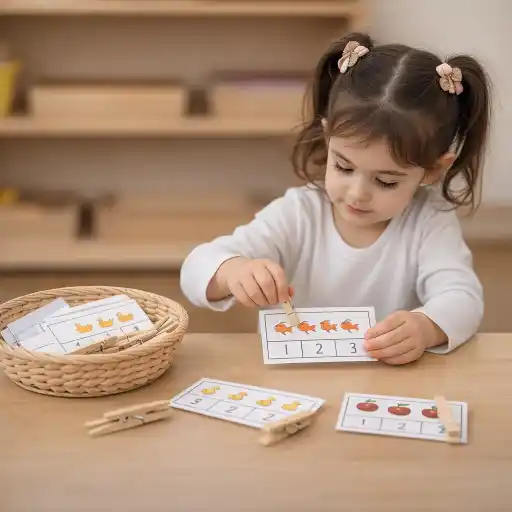
Educators can make the task more accessible by reducing unnecessary distractions and making the routine predictable:
- Present three to five cards instead of an entire stack.
- Use a consistent cue such as “Look, think, clip, check.”
- Provide a quiet tray or defined work area.
- Allow children to pause, reposition, and try again.
- Praise careful thinking and persistence rather than rapid completion.
Some children focus more successfully when the tactile feedback anchors attention. Others may need movement breaks, fewer choices, a larger card, or adult co-regulation first. Responsive teaching means observing what helps each child participate.
How can providers connect clip cards to literacy and mathematics?
The academic objective should be clear, brief, and developmentally appropriate. Clip cards can supplement—rather than replace—stories, conversations, manipulatives, music, open-ended play, and teacher-guided exploration.
Literacy cards might invite children to match a beginning sound to a picture, identify uppercase and lowercase letters, recognize rhymes, or clap syllables. Mathematics cards might connect numerals with quantities, compare groups, identify shapes, or continue a pattern. Children can also build oral language by naming pictures, explaining choices, and describing how they checked an answer.
- 🔹 Clip the picture that begins with the target sound.
- Clip the numeral representing the quantity shown.
- Clip the object that belongs in a color, size, or shape category.
- Clip the image that completes an AB or ABC pattern.
- Clip the feeling that matches a character’s expression in a story.
Self-checking cards add another layer. When children clip, flip, and compare their response with an answer cue, they practice early self-monitoring. Model the process explicitly and use emotionally safe language: “You checked your thinking. What could you try next?” Immediate feedback is useful only when pictures, vocabulary, and answer keys are accurate and unambiguous.
For literacy-focused professional learning, consider Science of Reading Foundations in the Pre-K Classroom Buy Now $16.00, which addresses phonological awareness, alphabet knowledge, vocabulary, comprehension, and emergent writing.
How can clip cards be differentiated for diverse learners?
Differentiation begins with observation. A child may understand the concept but lack the hand strength to operate a particular clothespin. Another child may have adequate strength but need fewer visual choices, more processing time, language support, or an alternative response method.
- Beginning: use large cards, two choices, familiar pictures, and larger or lighter clips.
- Developing: offer three choices, standard clips, and simple matching or counting tasks.
- Extending: add more choices, multi-step patterns, sound contrasts, or explanation prompts.
Preserve the thinking goal while adjusting the motor or visual demand. Children might point, place a counter, use a dry-erase marker, cover an answer with playdough, or select a larger clip. Angled surfaces, nonslip mats, thicker cardstock, and picture directions can improve access.
Model the action slowly, provide brief assistance, and fade support. Avoid prolonged hand-over-hand prompting when a child can attempt the movement independently. Include home languages, familiar images, and culturally meaningful content so the activity is linguistically and socially responsive.
Document observations neutrally: “clipped four cards independently,” “needed support stabilizing the card,” or “waited and checked before selecting.” If concerns persist across routines, collaborate with families and follow referral procedures. State requirements vary - check your state licensing agency.
How should teachers introduce, organize, and assess clip cards?
Start with a short demonstration. Name the concept, show how to hold the clothespin, model one example, and explain how children can check their work. Place a small set in a labeled tray with a picture direction card. Practice with an adult or peer before expecting independent use.
- Choose one skill children have encountered in instruction.
- Prepare three to six cards with uncluttered choices and reliable answer cues.
- Model both a correct response and a thoughtful correction.
- Invite children to practice while you observe.
- Revise the cards when images, vocabulary, or difficulty create barriers.
Assessment should consider process as well as outcome:
- Can the child orient and squeeze the clothespin?
- Does the child stabilize the card with the other hand?
- Can the child visually compare choices?
- Does the child persist after an incorrect attempt?
- Can the child explain or demonstrate the concept?
Use brief anecdotal notes or a checklist rather than turning every attempt into a formal test. The course Preschool Assessments & Observations Buy Now $24.00 can help providers strengthen objective observation and use evidence from children’s participation to plan individualized next steps.
For safety, inspect materials regularly, supervise small clips and loose parts, and follow program sanitation procedures. Clip cards should complement—not replace—developmental screening, rich play, or professional evaluation when concerns arise.
Conclusion: How can clip cards build focus and fine-motor skills?
Clip cards build #focus and fine-motor skills by combining controlled squeezing, visual comparison, decision-making, language, and repeated opportunities to check and revise. Their value depends on thoughtful implementation: choose an appropriate clip, limit distractions, clarify the learning goal, and adapt the card so every child can participate successfully.
Use clip cards as one component of a rich program that includes playdough, blocks, lacing, puzzles, drawing, cutting, construction, outdoor movement, and self-care. Keep sessions short, observe carefully, and celebrate gradual progress. When children are absorbed in a meaningful challenge, they may be strengthening #coordination, persistence, independence, and confidence without experiencing the activity as a drill.
Five ChildCareEd courses to explore
- CDA Home Visitor Subject Area 2 Part 3 Birth to 5
- CDA Infants/Toddlers: Health and Safety
- Creating Engaging and Meaningful Learning Experiences
- Texas Director Credential
- Building Early Science Foundations
- Wellness in Action: Teaching Healthy Habits to Children
- Mind's Medicine: Music in Early Childhood
- Montessori Cultural Activities: Exploring the World Through Play and Learning
- Environments That Inspire Independence and Exploration
- How to boost fine motor skills: Holiday Edition
- Increasing Fine Motor Skills in the Early Childhood Education Classroom
- CDA Certification en Español: Recursos y Consejos para Educadores Bilingües
- 🔍 ¿Qué ves cuando observas a un niño aprender?
- 👶 ¿Cuáles son las proporciones y grupos requeridos en Dakota del Norte? 🏫
- What are 25 easy fine motor activities I can use in my preschool?
- Proporciones de Cuidado Infantil y Tamaños de Grupo por Edad en Virginia (Guía Rápida para Centros y Hogares)
- Actividades de Otoño Fáciles para Preescolares esta Temporada
- Celebrando la amistad en el cuidado infantil durante el Día de los Mejores Amigos
- Canciones, juegos y preguntas de círculo para niños
- Easy Pool Noodle Sea Creatures for Ocean Theme Activities
- Cómo simplificar la capacitación para sus empleados de daycare
- How can childcare providers support fine motor development with simple activities?
- How Do Clip Cards Build Fine Motor Strength and Focus?
- Why Are Self-Checking Clip Cards Great for Independent Practice?
- How Do Clip Cards Build Fine Motor Strength and Focus?
- How Can Clip Cards Prepare Little Hands for Writing?
- How Can Clip Cards Build Focus and Fine Motor Skills?
- What Should Child Care Providers Look For in Fine Motor Skills by Age?
