Every day, child care providers can strengthen children’s balance, coordination, endurance, and confidence by offering short, purposeful movement experiences indoors and outdoors. This practical guide helps directors and educators plan safe, inclusive, and low-preparation activities that build gross motor skills through running, jumping, climbing, balancing, throwing, dancing, obstacle courses, and cooperative games. It also explains how to adapt activities for different ages and abilities, organize movement-friendly spaces, supervise active play, and make physical activity a consistent part of classroom routines. To deepen staff knowledge, explore ChildCareEd’s self-paced online course Balancing Active Play in Child Care  Buy Now $16.00, which helps educators balance active, creative, and quieter play to support healthy child development. Programs can also use the ready-to-print Gross Motor Activities for All Ages Buy Now $0.00 and Gross Motor Games for Preschoolers Buy Now $0.00 resources for practical indoor and outdoor movement ideas. Adapt each activity to children’s developmental levels, maintain active supervision, and check your state licensing agency for applicable safety requirements.
1) Why do gross motor skills matter for children and my program?
Why it matters: gross motor development is foundational. It supports posture, coordination, visual-motor skills, self-regulation, and school readiness. The CDC links regular physical activity to improved attention, behavior, and healthy growth; meeting milestones is important for later learning (CDC Milestones). For a concise review of the benefits of physical activity and practical strategies to promote active play in early childhood settings, see Let’s Get Physical!. Use these points to make the case with staff and families:
- 🟢 Physical foundation: running, jumping, climbing, and balance strengthen large muscle groups and core stability (see Balance, Coordination, and Strength).
- 🔵 Cognitive and attention benefits: short movement breaks improve focus and motor planning—skills children need for classroom tasks.
- 🟠 Social and emotional growth: games teach turn-taking, frustration tolerance, and confidence.
- 🔴 Program quality: embedding movement supports developmentally appropriate practice and shows families your intentional approach (see resources at Nurture Me: Child Development).
State guidance and licensing matter, so remember: state requirements vary - check your state licensing agency. Framing gross motor time as short, frequent, and curriculum-linked helps staff prioritize it without losing instructional minutes.
2) What easy indoor activities build strength, balance, and coordination?
Indoor options let you keep movement going when space or weather limits outdoor time. Use clear floor space, painter’s tape, soft props, and short rotations to keep children active and safe. Below are low-prep, classroom-tested ideas you can try tomorrow (many are drawn from ChildCareEd’s practical lists).
- 🎯 Tape Stepping Stones: place tape shapes for children to step, hop, or tiptoe between; add learning (colors, letters) as dual goals (Indoor and Outdoor Gross Motor Activities).
- ⚽ Soft Ball or Beanbag Toss: set baskets at progressive distances; change distances to adapt difficulty (10 Gross Motor Games).
- 🎈 Balloon Keep‑Up / Freeze Dance: short bursts (2–5 minutes) that build coordination and listening.
- 🧭 Simple Obstacle Course: crawl under a table, step over cushions, walk a tape “beam,” finish by tossing a beanbag into a target—rotate small groups to avoid waiting.
- 🐧 Penguin Waddle Relay: hold a beanbag between knees and waddle—great for core strength and focus (Gross Motor Games for Preschool).
Setup & safety checklist (quick): 1) clear hard hazards; 2) demonstrate moves; 3) set one stop signal (clap/bell); 4) position adults for full sight lines. For more indoor lesson plans, see ChildCareEd’s printable resources like Turkey Trek Trot Buy Now $0.00.
3) What outdoor activities best use space, nature, and playgrounds?
Outdoor play expands possibilities—natural surfaces and playground structures offer varied balance and strength challenges. Use the outdoors for free play, structured games, and purposeful chores to build real-world strength and coordination.
- 🌳 Nature Obstacle Course: Use logs, rocks, cones, hills, and tape. Change the order weekly so skills are practiced in new sequences (Indoor and Outdoor Gross Motor Activities).
- ⚽ Ball & Target Games: kick, throw, and aim at larger targets, then make smaller—progression supports skill growth (Balance and Strength).
- 🌱 Garden & Active Tasks: carrying watering cans, digging small holes, and wheelbarrow walks build purposeful strength and help children see practical outcomes.
- 🚲 Active Travel: trike time, short neighborhood walks, and scooter circuits grow stamina and spatial awareness (see outdoor safety tips at the CDC Outdoor Play and Safety).
- 🏞️ Free play on varied surfaces: grass, mulch, and small slopes promote ankle and balance development.
Safety reminders: inspect surfaces and equipment, use soft fall zones under climbing sets, maintain helmet rules for wheeled toys, and supervise closely. For playground safety guidance, see Nemours Playground Safety.
4) How do I adapt activities so every child can succeed?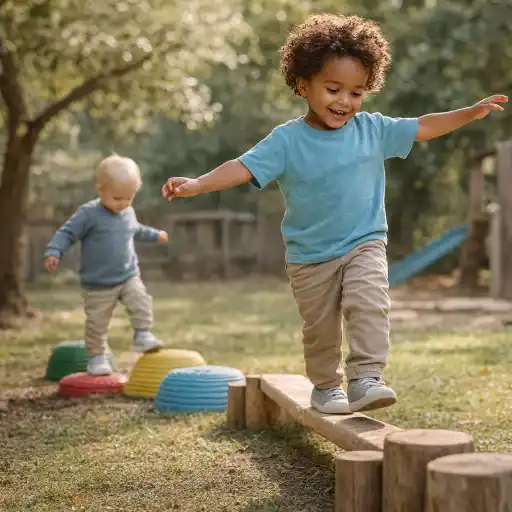
Inclusion is practical and simple when you plan two-level goals and use supports. ChildCareEd’s guidance on adaptations explains how small changes in rules, equipment, and expectations let children of varied abilities join safely (Adaptations That Support Children's Learning).
- 🔧 Two-level choices: always offer “easier OR harder” (e.g., “hop OR step”) so children self‑select success.
- 🤝 Buddy system and peer models: pair children intentionally so the confident child models and the other receives praise and encouragement.
- 🪑 Seated or supported options: convert standing tasks into seated arm actions or use a chair/wall for balance.
- 📋 Visual supports: picture cards, taped paths, and simple checklists reduce verbal load and improve follow-through.
- 🎒 Equipment swaps: larger, softer balls; lighter beanbags; shorter distances; or slower tempos to match ability.
Simple progress tracking: use a short checklist (e.g., one-leg balance 5 sec, hop 3 times), photos or notes with parent permission, and celebrate effort. If a child appears far behind peers, document observations and follow your referral policy—CDC milestone tools can help you decide when to act (CDC: Learn the Signs).
5) How do I fit movement into our day and avoid common mistakes?
Short, frequent movement bursts beat one long block. Use transitions, jobs, and timers to make movement predictable and manageable for staff. The Minnesota guidance and ChildCareEd suggest integrating both structured and unstructured activities throughout the day (MN Early Care and Education Physical Activity).
- 🕒 Sample daily rhythm:
- Morning (5–10 min): Tape stepping stones or animal walks.
- Mid-morning (2–3 min): Freeze Dance as a brain reset.
- Outdoor block (15–30 min): Free play or obstacle course.
- Afternoon (5 min): Balance relay or quiet movement before rest.
- 📆 Use short rotations/stations to reduce lines and keep kids active.
- 🔔 Teach and model one stop signal and practice it daily so transitions are calm.
- 📌 Common mistakes & fixes:
- ❌ Too hard too soon → ✅ Start simple & add one challenge.
- ❌ Long waits → ✅ Stations and small groups.
- ❌ Weak supervision → ✅ Position adults with full sight lines.
- ❌ Comparing children → ✅ Celebrate effort and individual progress.
Quick FAQ (practical):
- Q: How long should breaks be? A: 1–10 minutes, several times a day.
- Q: What if space is tiny? A: Use tape lines, balloons, seated marches, or movement jars with 2–3 minute actions (Gross Motor Truth).
- Q: When to refer? A: If a child is notably behind peers in walking, balance, or catching—document and follow referral steps.
Conclusion
Practical takeaways:
- Prioritize short, frequent movement moments across the day.
- Use low‑prep indoor and outdoor activities from ChildCareEd and public health sources to build #balance, strength, and coordination.
- Adapt and track progress—celebrate effort and use simple checklists.
You’re already doing the most important work: giving children chances to move, explore, and succeed. For lesson plans, printable activities, and deeper training, visit ChildCareEd’s gross motor resources like Gross Motor Games for Preschoolers Buy Now $0.00 and the free resource hub (Nurture Me: Child Development). Remember: state requirements vary - check your state licensing agency. Keep it playful, inclusive, and short—movement adds up to big gains.
- Safe and Sound: Creating Healthy Environments for Every Child
- Healthy Starts: Safety, Nutrition, and Wellness in Child Care
- 45 Hour School Age Methods and Materials
- CDA Bridge Bundle: Family Child Care without Portfolio Review
- Texas Director Credential
- CDA Subject Area 1
- Preventative Health and Safety
- Safeguarding Young Lives: A Comprehensive Guide to Child Care Safety
- Family Child Care: Building, Premises, and Outdoor Safety
- Mindful Supervision: Balancing Safety & Independence in Montessori
- Bye Bye Winter: The Role of Outdoor Play in Early Childhood Development
- CDA Certification en Español: Recursos y Consejos para Educadores Bilingües
- 🔍 ¿Qué ves cuando observas a un niño aprender?
- 👶 ¿Cuáles son las proporciones y grupos requeridos en Dakota del Norte? 🏫
- Recursos en Español sobre el Sueño Seguro del Bebé
- Actividades de Motricidad Gruesa que Desarrollan el Equilibrio, la Coordinación y la Fuerza
- Lista para Guardería en Casa en Illinois: Cómo Iniciar una Guardería en el Hogar
- Celebrando la amistad en el cuidado infantil durante el Día de los Mejores Amigos
- Canciones, juegos y preguntas de círculo para niños
- Indoor and Outdoor Activities for School-Age Children
- Cómo simplificar la capacitación para sus empleados de daycare
- Why Should Early Childhood Programs Prioritize Outdoor Play?
- How can I build gross motor skills indoors and outdoors for the children in my program?
- How Does Play Support Children’s Physical, Cognitive, and Social Growth?
- How can I keep Children Active Indoors On Cold Days?
- How can child care programs create safe climbing and movement experiences for toddlers?
- How can childcare programs create high-quality outdoor classrooms and nature-based care?
- How can I bring a Forest Preschool (nature-based learning) to my program?
- How Can Child Care Providers Support Gross Motor Development in Every Child?
