Halloween can strengthen little hands without overwhelming young children. These playful, low-fright ideas help providers build grasp, coordination, cutting, and visual-motor control while keeping the classroom welcoming; for a deeper foundation in age-appropriate planning, explore Lesson Planning for Preschoolers  Buy Now $24.00, which can help you design purposeful experiences and earn applicable professional training hours. For inclusive adaptations, Inclusive Lessons for Preschoolers Buy Now $16.00 offers practical guidance for making activities accessible to varied learners.
Why do Halloween fine-motor activities matter?
Fine-motor development involves the coordinated use of the small muscles in the hands and fingers with vision. Children rely on these abilities when they manipulate clothing fasteners, turn pages, use utensils, draw, and eventually write. Seasonal activities can make repeated practice feel meaningful rather than remedial.
The strongest Halloween invitations are playful, flexible, and emotionally safe. A pumpkin, friendly ghost, colorful monster, or smiling spider can provide the theme without requiring frightening imagery. This matters because children differ in their responses to masks, dark colors, loud sounds, and unfamiliar decorations. A low-fright approach respects children’s cues while preserving the joy of discovery.
References describe lacing, threading, tearing, squeezing, play dough, stickers, tweezers, and cutting as practical ways to develop hand strength and coordination. These activities also create opportunities for language, counting, problem solving, and peer collaboration.
How can providers choose materials that feel festive and safe?
Begin with materials children already know and introduce only one new challenge at a time. Cardboard shapes, yarn, paper, washable crayons, play dough, large pom-poms, stickers, clothespins, and child-sized scissors can support a rich activity menu without expensive purchases.
- Choose friendly visual cues: smiling pumpkins, stars, leaves, bats with expressive faces, and colorful webs.
- Offer a range of resistances, such as thick yarn, paper strips, soft dough, and cardboard, so children can experience success and challenge.
- Use trays or shallow bins to define workspaces and simplify cleanup.
- Inspect materials for sharp edges, breakage, loose parts, and age-related choking hazards.
- 🧡 Provide a quiet alternative, such as drawing, sticker placement, or a book, for children who prefer less sensory stimulation.
Supervision remains essential, especially with beads, small pom-poms, googly eyes, pipe cleaners, and scissors. Adapt or remove small pieces according to children’s ages, abilities, and program policies. State requirements vary - check your state licensing agency. For broader precautions around costumes, trick-or-treating, and home safety, review these Halloween safety tips.
Which lacing, threading, and wrapping activities build coordination?
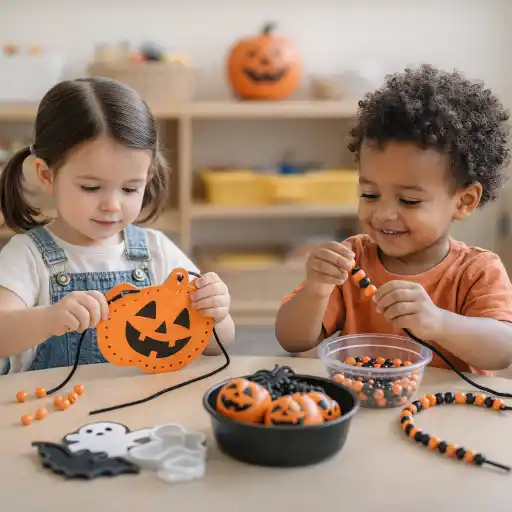
Lacing is a particularly useful Halloween variation because it combines bilateral coordination, visual tracking, and controlled hand movements. Prepare a pumpkin, friendly ghost, or smiling cat from sturdy cardboard. Punch large holes around the edge, then provide yarn with a taped or capped end. Children can lace around the shape, move from hole to hole, or create their own pattern.
For younger toddlers, begin with a few widely spaced holes and thicker yarn. Older preschoolers may follow numbered holes, alternate colors, or explain their design to a partner. Avoid treating completion as the goal; the developmental value is in planning, reaching, pulling, and adjusting.
Wrapping activities offer another accessible option. Children can wrap orange yarn around a pumpkin, white strips around a friendly mummy, or green yarn around a cardboard leaf. The provider can stabilize the shape initially, then gradually invite the child to hold it independently.
- Ask, “Where will your yarn go next?” to encourage planning.
- Invite children to compare tight and loose wrapping.
- Count holes, wraps, or color changes for an early-math extension.
- Use descriptive words such as smooth, rough, stretchy, thick, and thin.
These experiences echo activity collections that organize Halloween ideas by lacing, threading, and wrapping while emphasizing skill development rather than a particular craft product.
How can cutting, tearing, and sticking become playful practice?
Cutting practice is most successful when the materials are manageable and the purpose is clear. Offer wide paper strips marked with short, bold lines. Children can cut between friendly pumpkin faces, make fringe for a monster’s hair, or snip paper “grass” for a fall collage. Begin with single snips and progress toward continuous cutting as control improves.
Tearing is an excellent alternative for children who are not ready for scissors. Invite them to tear orange paper for a pumpkin collage, white paper for a smiling ghost, or tissue paper for a candy-corn design. Tearing requires children to use both hands together and adjust force, supporting hand strength and bilateral coordination.
Sticking adds precision and decision-making. Children can place stickers inside shapes, add paper eyes to a pumpkin, or arrange torn pieces to create a one-of-a-kind character. Process-oriented work is preferable to identical products: the child’s choices are evidence of planning, creativity, and emerging control.
- Use glue sticks or small amounts of liquid glue to limit frustration.
- Offer pre-cut shapes alongside cutting materials so every child can participate.
- Place materials from left to right when supporting a child’s visual organization.
- Describe effort specifically: “You turned the paper to follow the line.”
For additional context on purposeful creative experiences, see the ChildCareEd article on creative daycare activities.
Which sensory and tool-based activities keep the theme gentle?
Sensory invitations can make fine-motor work inviting, but they should be predictable and optional. A calm “pumpkin patch” bin might include dyed pasta, large scoops, cups, fabric leaves, and oversized plastic pumpkins. Children can scoop, pour, sort, and transfer materials with their hands or tongs. If loose materials are inappropriate for a group, substitute large felt pieces, foam shapes, or sealed sensory bags.
Play dough supports squeezing, rolling, pinching, flattening, and pressing. Offer orange, green, purple, or white dough and invite children to make pumpkins, leaves, friendly ghosts, or abstract autumn designs. Add large craft sticks for lines and texture rather than tiny decorative parts.
Tool-based stations can include jumbo tweezers and large pom-poms. Children might “feed” a smiling monster, rescue pom-poms from a paper web, or sort items into colored cups. These tasks strengthen the pincer grasp while also encouraging counting and color vocabulary.
- Model one action, then allow children to explore.
- Offer tools in different sizes and grips.
- Keep a dry alternative available for children who dislike messy textures.
- Use visual boundaries and small quantities to reduce sensory overload.
Watch for signs of fatigue or discomfort. A child may need a break, a different tool, or a simpler version—not pressure to finish.
How can providers adapt activities for different learners?
Differentiation begins with observing what each child can already do. The same pumpkin lacing card can be adapted by changing hole size, yarn thickness, the number of holes, or the amount of adult assistance. A child who is developing hand strength may need a thicker marker, larger stickers, or spring-loaded scissors. Another child may be ready for a multi-step pattern or a written name label.
Use graduated support:
- First, demonstrate slowly with clear language.
- Next, provide partial assistance, such as holding the cardboard steady.
- Then, pause and let the child complete the movement.
- Finally, invite the child to teach or explain the process.
Children who are sensitive to Halloween imagery can choose neutral fall colors and symbols. Children with motor differences may participate through selecting materials, directing a peer, pressing large stamps, or using adaptive tools. Dual language learners benefit from picture labels and repeated words such as cut, pull, pinch, roll, and match.
Document observable actions rather than judgments: “Maya used both hands to pull yarn through three holes” is more useful than “Maya did well.” For further support with inclusive lesson design, explore Building Equity: Inclusionary Practices in Preschool Buy Now $10.00.
What common mistakes should providers avoid?
Seasonal enthusiasm can unintentionally make an activity too difficult, too crowded, or too frightening. The goal is not to complete a decorative product; it is to create repeated, meaningful opportunities for children to practice controlled movement.
- Mistake: Using tiny pieces with a mixed-age group. Better: Choose oversized materials and follow supervision and choking-prevention procedures.
- Mistake: Expecting every child to use scissors. Better: Offer tearing, stickers, stamping, or adaptive scissors.
- Mistake: Correcting children toward identical crafts. Better: Value experimentation and describe the strategies children use.
- Mistake: Filling the room with scary decorations. Better: Preview images, use friendly characters, and provide a calm choice.
- Mistake: Leaving cleanup until the end. Better: Use trays, labeled bins, and brief transitions between activities.
Keep rotations short enough to maintain engagement, and plan a quiet reset after messy or highly social stations. A simple visual schedule can help children anticipate what comes next.
How can Halloween fine-motor play become intentional curriculum?
One activity can support several domains when the provider plans a clear purpose. A pumpkin lacing card may address hand-eye coordination, counting, color patterns, and vocabulary. A play-dough station may support hand strength, symbolic representation, conversation, and self-regulation. The provider’s questions and observations help connect play to curriculum.
Before the activity, identify one or two observable goals. During play, use open-ended prompts:
- “What could you try if the yarn gets stuck?”
- “How many pom-poms fit in the pumpkin?”
- “What does your friendly monster need?”
- “Which tool helps you pick this up?”
Afterward, record a brief anecdote, photograph a process, or save a child’s work with a note about the strategy used. Share a simple home extension, such as threading large pasta onto a shoelace or tearing paper for a collage. This makes learning visible to families and helps staff plan the next level of challenge.
Intentional planning does not require elaborate documentation. A goal, a few materials, an invitation, and one observation can transform a seasonal center into meaningful early learning.
Conclusion: How can Halloween fine-motor activities stay fun without being scary?
Halloween fine-motor activities are most effective when they combine familiar materials, playful themes, manageable challenges, and genuine choice. Lacing, wrapping, cutting, tearing, sticking, play dough, sensory transfers, and tool work can strengthen the small muscles children use for self-care, drawing, and writing while also supporting language, early math, creativity, and collaboration.
Keep the atmosphere gentle by using friendly imagery, previewing sensory experiences, supervising small materials, and offering alternatives. Adapt the same invitation through larger tools, fewer steps, visual supports, or peer participation. When providers observe and document children’s strategies, seasonal fun becomes purposeful curriculum—without asking children to tolerate fear in order to learn.
Five practical takeaways
- Choose low-fright themes such as pumpkins, leaves, friendly ghosts, and colorful monsters.
- Offer multiple ways to practice the same skill, including lacing, tearing, squeezing, and transferring.
- Differentiate tools, materials, and levels of assistance.
- Use open-ended questions and brief observations to connect play with learning goals.
- Prioritize supervision, accessibility, and children’s emotional comfort.
Related ChildCareEd courses:
- Playful Learning: Infant & Toddler Activities
- 45 Hour School Age Methods and Materials
- CDA Bridge Bundle: Family Child Care without Portfolio Review
- CDA Bridge Bundle: Infant/Toddler without Portfolio Review
- CDA Bridge Bundle: Preschool without Portfolio Review
- Emergent Learning & Development
- Creating Environments that Nurture Growth and Community
- Building Early Science Foundations
- Mind's Medicine: Music in Early Childhood
- Mummy Races & Zombie Tag: Halloween-themed Gross Motor Games
- Spooky Spa Day for Little Ghouls, Halloween-Themed Spa Treatments!
- DIY Snow Globes: The Fine Motor Craft That’ll Keep Kids (and Adults) Busy for Hours
- How to Create a Sensory Bin for Exploration: A Guide for Early Childhood Educators
- CDA Certification en Español: Recursos y Consejos para Educadores Bilingües
- ❄️ ¿Qué actividades al aire libre funcionan bien para los niños de Illinois en cada estación? 🌷🍂
- Pascua En El Aula: Actividades Sencillas Para Aprender y Celebrar Con Seguridad
- Halloween Classroom Activities Kids Will Go Batty For
- ¿Cuáles son las mejores actividades del Día de la Tierra para niños en casa o en el aula?
- Actividades de Motricidad Gruesa que Desarrollan el Equilibrio, la Coordinación y la Fuerza
- Actividades de Fiesta para Niños de Preescolar y Primaria
- ¿Cuál es la Diferencia Entre la Crianza Respetuosa y la Crianza Permisiva?
- Temas y Actividades para el Día Nacional del Kindergarten para Proveedores
- Calabazas, hojas y manzanas: actividades de otoño para preescolares
- Celebrando la amistad en el cuidado infantil durante el Día de los Mejores Amigos
- National Ice Cream Day: Sweet Activities for Preschoolers
- Canciones, juegos y preguntas de círculo para niños
- Superhero Activities for Preschoolers: Play, Create, and Learn
- How Can Halloween Fine-Motor Activities Be Fun Without Being Scary?
- How Can You Plan October Classroom Activities for Children Who Do Not Celebrate Halloween?
