What if one small clothespin could turn a learning match into meaningful practice for a child’s hands, eyes, and attention? Clip cards offer a playful, low-cost way to strengthen fine motor control while children review letters, sounds, numbers, colors, or concepts. For deeper guidance on planning developmentally appropriate experiences, explore How Preschoolers Develop  Buy Now $32.00, which can help providers connect classroom activities with children’s developmental needs and earn professional learning hours where applicable.
Why do clip cards matter in early childhood classrooms?
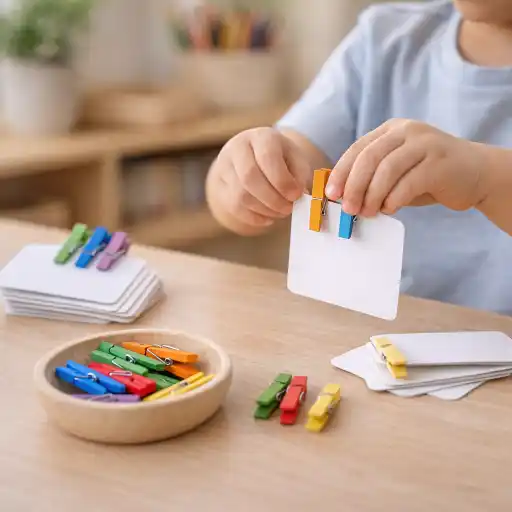
Clip cards are more than a quiet tabletop activity. Each card invites a child to look carefully, make a decision, grasp a clothespin, position it, and squeeze it open and closed. That sequence integrates visual perception, hand-eye coordination, motor planning, and cognitive engagement in one manageable task.
Fine motor development supports children’s participation in everyday routines, including using utensils, turning pages, fastening clothing, drawing, and handling classroom tools.
Clip cards are especially useful because they can be adapted without making children feel as though they are completing therapy exercises. A child may be matching animal pictures or counting dots, yet simultaneously practicing the #pincer grasp and controlled release needed for future tool use.
- They provide brief, repeatable practice.
- They combine physical movement with early academic learning.
- They can be used independently after a short demonstration.
- They allow educators to observe effort, strategy, and persistence.
When the task is playful and appropriately challenging, children often remain engaged longer because they have a clear purpose and immediate feedback.
How does squeezing a clothespin strengthen the hand?
Opening a clothespin requires resistance. The child activates the thumb and fingers to compress the clothespin, maintains control while moving it toward the card, and then releases it accurately. Repetition can support hand strength and endurance, although educators should remember that strength is only one part of fine motor development.
Occupational therapy resources describe clothespin activities as opportunities to address resistance, hand arches, radial-finger control, and stabilization of the ring and little fingers. These components contribute to later scissor use, pencil manipulation, and other tool-based tasks. The OT Toolbox also identifies bilateral coordination, motor planning, proprioceptive input, and eye-hand coordination as skills that can be incorporated through clothespin play.
To make the activity productive rather than exhausting, begin with materials that match the child’s current ability:
- Use larger or softer plastic clips for children who are developing initial strength.
- Offer standard wooden clothespins when children can squeeze and release comfortably.
- Introduce mini-clips only when the child demonstrates adequate control and safe handling.
- Place the card on a stable surface so the non-dominant hand can stabilize it.
Watch for excessive force, awkward wrist positioning, or signs of fatigue. The goal is controlled movement and confidence—not speed or the strongest possible squeeze.
How do clip cards support focus and executive function?
A successful clip-card task requires sustained attention. Children must inspect several choices, compare each option with the prompt, inhibit impulsive responses, and remember the rule while manipulating the clip. These demands engage early executive-function processes such as working memory, cognitive flexibility, and inhibitory control.
Fine motor and cognitive demands can reinforce one another. Research summaries reviewed by Growing Hands-On Kids describe relationships among fine motor skills, visual-motor integration, executive function, and early academic performance, while also cautioning that development is complex and no single activity determines a child’s achievement. Clip cards should therefore be viewed as one useful experience within a balanced curriculum.
Educators can intentionally support #focus by reducing unnecessary distractions and making the task predictable:
- Present three to five cards at first rather than an entire stack.
- Use a consistent visual direction, such as “Look, think, clip, check.”
- Offer a quiet tray or defined work area.
- Allow children to pause, reposition, and try again.
- Celebrate careful thinking rather than rapid completion.
For some children, the tactile feedback of squeezing and clipping helps anchor attention. For others, the task may need movement breaks, a larger card, fewer answer choices, or adult co-regulation before independent work is realistic.
How can providers connect clip cards to literacy and mathematics?
The academic content should remain meaningful, brief, and developmentally appropriate. Clip cards can reinforce skills without replacing conversations, stories, manipulatives, or open-ended play. A literacy card might ask children to match a beginning sound to a picture, identify uppercase and lowercase letters, or select a rhyming image. A mathematics card might connect numerals with quantities, compare groups, or continue a pattern.
Clip cards can also support oral language. Invite children to name the pictures, explain their choice, or describe how they checked their answer. Sound-matching and rhyme activities are particularly effective when children focus on spoken sounds before relying heavily on print, as explained in the phonological-awareness resources from No Time for Flash Cards and Fantastic Fun & Learning.
Try these classroom variations:
- 🔹 Clip the picture that begins with the target sound.
- Clip the numeral showing the quantity represented by dots or objects.
- Clip the item that belongs in a color, size, or shape category.
- Clip the image that completes an AB or ABC pattern.
- Clip the facial expression that matches a story character’s emotion.
Use self-checking marks on the back only after children have had opportunities to reason aloud. The physical clip should support learning, not turn the experience into guessing.
How can you differentiate clip cards for diverse learners?
Differentiation begins with observation. Some children may understand the concept but lack the hand strength to operate a particular clothespin. Others may have adequate strength but need fewer visual choices, language support, or additional time to process the prompt. Separating the physical demand from the thinking demand helps educators identify the support that is actually needed.
Consider offering a progression:
- Beginning: large cards, two choices, larger clips, and picture-based directions.
- Developing: three choices, standard clips, simple counting or matching tasks.
- Extending: smaller targets, multi-step patterns, sound contrasts, or explanation prompts.
Children may also use alternatives such as a large clothespin, a self-inking marker, a reusable dot, or playdough to cover the answer. These options preserve the reasoning component while reducing motor barriers. Provide a nonslip mat, an angled surface, or a clipboard when positioning is difficult. Model the action slowly, then fade assistance rather than maintaining hand-over-hand support longer than necessary.
Document observations neutrally: “clipped four cards independently,” “needed help stabilizing the card,” or “waited and checked before selecting.” If concerns persist across routines, share specific observations with families and follow program referral procedures. State requirements vary - check your state licensing agency.
How should clip cards be introduced, organized, and assessed?
Begin with a short demonstration. Name the picture or concept, show how to hold the clothespin, model one example, and explain how children can check their work. Avoid presenting too many rules at once. A clear tray, a small card set, and a picture direction card can make the activity accessible for independent practice.
Clip cards work well in a fine motor or literacy center, but they can also be used during a brief small-group lesson. Rotate themes to maintain interest and connect them with current studies. Laminating cards may improve durability and allow cleaning, but follow your program’s sanitation procedures and inspect materials regularly for damaged edges or loose parts.
Assessment should focus on both process and outcome:
- Can the child orient and squeeze the clothespin?
- Does the child stabilize the card with the other hand?
- Can the child visually compare choices?
- Does the child persist after an incorrect attempt?
- Can the child explain or demonstrate the concept?
Use a simple checklist or anecdotal note rather than turning every attempt into a formal test. The course Assessing through Observation Buy Now $35.00 can help providers strengthen objective observation and use evidence from children’s activity participation to inform individualized planning.
Conclusion
So, how do clip cards build fine motor strength and focus? They combine repeated resistance-based hand movements with visual discrimination, decision-making, language, and early academic practice. When educators adjust the clip, card, choices, and pacing to each child, the activity becomes an inclusive opportunity to build #coordination, persistence, independence, and confidence.
Use clip cards as one part of a rich motor curriculum that also includes playdough, blocks, lacing, puzzles, drawing, cutting, self-care, and active play. Keep sessions short, observe carefully, and celebrate steady progress. The most powerful learning often happens when children are so absorbed in a meaningful challenge that they do not realize how much they are practicing.
Five additional ChildCareEd courses to explore
- How Preschoolers Develop Buy Now $32.00 — developmental foundations for preschool practice.
- 45 Hour Child Growth and Development Buy Now $399.00 — broad training across developmental domains.
- The Best Promotion is Play Buy Now $35.00 — strategies for meaningful, play-based learning.
- Classroom Setup for Child Care Buy Now $24.00 — intentional environments and accessible materials.
- Assessing through Observation Buy Now $35.00 — practical observation and assessment strategies.
- Many Colors, One Canvas: MD ECE Conference
- CDA Home Visitor Subject Area 2 Part 3 Birth to 5
- SIDS: Saving Babies: A Change of Position, A Change in Tradition
- Power of Art: Bldg Self-Esteem & Positive Behavior for ALL Abilities
- CDA Infants/Toddlers: Health and Safety
- Birth to Five CDA Credential with Portfolio Review
- Texas Director Credential
- How to boost fine motor skills: Holiday Edition
- Cuáles Son las Señales de Alerta en el Desarrollo Infantil que Todo Educador Debe Conocer?
- Pascua En El Aula: Actividades Sencillas Para Aprender y Celebrar Con Seguridad
- Celebra El Cumpleaños de Dr. Seuss En Tu Guardería Con Actividades Fáciles y Divertidas!
- Recursos en Español sobre el Sueño Seguro del Bebé
- What are 25 easy fine motor activities I can use in my preschool?
- ¿Cuáles son las mejores actividades de primeros auxilios para adultos?
- Actividades de Motricidad Gruesa que Desarrollan el Equilibrio, la Coordinación y la Fuerza
- 10 Ejemplos de Cómo la Cultura Influye en el Desarrollo Infantil
- Capacitación en Salud y Seguridad Preventiva en Línea para Proveedores de Cuidado Infantil
- Lista para Guardería en Casa en Illinois: Cómo Iniciar una Guardería en el Hogar
- Lista para Guardería en Casa en Texas: Cómo Iniciar una Guardería en el Hogar
- Cómo Ser Maestra de Preescolar en Dakota del Norte
- Capacitación Previa al Servicio para Proveedores de Cuidado Infantil en Dakota del Norte
- Cómo simplificar la capacitación para sus empleados de daycare
- How Do Clip Cards Build Fine Motor Strength and Focus?
- Why Are Self-Checking Clip Cards Great for Independent Practice?
- How Do Clip Cards Build Fine Motor Strength and Focus?
- How Can Clip Cards Prepare Little Hands for Writing?
- How Can Clip Cards Build Focus and Fine Motor Skills?
