Small hand movements become the foundation for children’s independence, communication, and participation in the classroom. Build more intentional practice into your program with How Preschoolers Develop  Buy Now $32.00, and consider Lesson Planning for Preschoolers Buy Now $24.00 to turn fine motor goals into developmentally appropriate learning experiences and professional training hours.
Why does fine motor development matter in early childhood?
Fine motor development refers to the increasingly precise coordination of the hands, fingers, wrists, and eyes. Children use these abilities to manipulate toys, feed themselves, dress, draw, turn pages, use tools, and eventually write. The skills are not isolated from the rest of development: stable posture, visual perception, attention, language, and problem-solving all influence how children participate in hand-based activities.
For providers, the goal is not to make every child perform an identical task at a particular age. Rather, it is to offer frequent, meaningful opportunities that allow children to practice, adapt, and experience success. Research summarized in Fine Motor Skills, Executive Function, and Academic Achievement connects fine motor competence with executive functioning and school achievement, while the CDC developmental milestones provide a framework for observing progression.
- Fine motor practice supports independence in self-care.
- Manipulating materials strengthens hand-eye coordination and planning.
- Open-ended activities promote creativity, persistence, and confidence.
- Short, repeated practice is usually more effective than occasional drills.
These connections make fine motor development a program-wide responsibility rather than an isolated art-table objective.
Which play-based activities build strength, precision, and coordination?
Children develop hand control through active manipulation. Low-cost materials such as playdough, clothespins, cardboard, recycled containers, crayons, and large beads can provide rich practice without requiring specialized equipment. Choose activities that match the child’s current ability, then gradually increase complexity.
- 🧵 Threading and lacing: Use large beads, pasta, or lacing cards to encourage pincer grasp and bilateral coordination.
- Playdough work: Invite children to pinch, roll, flatten, poke, and cut dough. Hide larger objects inside for children to find and remove.
- Tongs and tweezers: Transfer pom-poms, foam shapes, or large natural objects between containers; add sorting or counting for an integrated learning goal.
- Construction: Offer blocks, interlocking materials, nuts and bolts, or simple puzzles to develop grasp, release, rotation, and visual-spatial planning.
- Art tools: Provide stickers, dot markers, eye droppers, hole punches, paintbrushes, and child-safe scissors.
- Vertical drawing: Tape paper to an easel or wall so children practice wrist extension and shoulder stability while making marks.
Use ideas from 25 easy fine motor activities as a planning menu. Let children make choices, talk about their strategies, and repeat activities across several days so skill development remains playful rather than performance-driven.
How can providers embed fine motor practice into routines and centers?
The strongest classroom plans do not depend on a single daily worksheet or isolated lesson. Fine motor opportunities appear naturally during arrival, meals, dressing, cleanup, outdoor exploration, and free play. Embedding practice into familiar routines increases repetition and helps children transfer skills to functional tasks.
During meals, invite children to use utensils, open containers, spread soft foods with appropriate tools, pour from small pitchers, or pick up manageable foods. At arrival and departure, provide dressing frames, doll clothing, zippers, snaps, and large buttons. During cleanup, children can use tongs to collect materials, sort objects into labeled bins, or fold small cloths. Outdoor experiences can include planting seeds, scooping soil, fastening fabric to a low clothesline, collecting natural objects, or drawing with sidewalk chalk.
For centers, prepare labeled tubs with one activity and a simple picture direction card. Rotate three or four options, such as:
- Fine Motor Table: clothespin matching, stickers, or bead threading.
- Sensory Transfer Center: scoops, funnels, tongs, and appropriately sized materials.
- Art and Tool Center: cutting, gluing, painting, or hole-punch designs.
- Construction Center: blocks, puzzles, connecting toys, or modeling materials.
The guidance in How to Incorporate Fine Motor Skills Practice Into Daily Activities reinforces a practical principle: ordinary classroom responsibilities can become authentic learning experiences when adults plan for independence and provide adequate time.
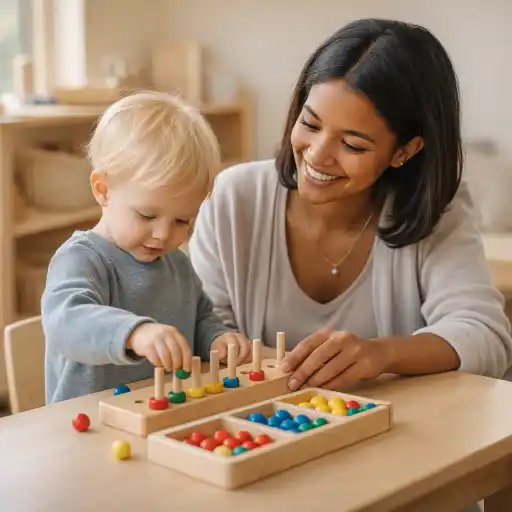
How should activities be adapted for age, ability, and inclusion?
Children develop at different rates, and the same activity may need several entry points. Begin with the underlying goal—such as grasp strength, bilateral coordination, or tool control—then adjust materials, positioning, number of steps, and adult support.
- Beginning level: Offer large beads, chunky crayons, thick paper, wide cutting paths, and larger-handled tools.
- Developing level: Introduce medium-sized manipulatives, simple patterns, standard tongs, short cutting lines, and two-step directions.
- Advanced level: Add smaller materials when safe, more detailed designs, complex puzzles, pattern creation, or combined motor-and-math challenges.
Support participation with non-slip mats, stable seating, slanted or vertical surfaces, pencil grips when appropriate, spring-assisted scissors, and larger handles. Model the movement, offer verbal or visual cues, and reduce assistance as soon as the child can continue independently. Avoid physically forcing a grasp or treating one pencil grip as the only sign of success.
For infants and young toddlers, prioritize reaching, transferring objects, grasping, banging, and releasing safe large materials. For preschoolers, add pre-writing patterns, fasteners, cutting, and construction. Children with persistent difficulties may benefit from collaboration with families, early intervention, or occupational therapy. State requirements vary - check your state licensing agency, especially when activities involve small parts, food, tools, or mixed-age groups.
How can observation and assessment guide fine motor instruction?
Assessment should help teachers make better decisions, not pressure children to demonstrate skills on demand. Observe children during authentic play and routines, documenting what they do, the materials they use, the support required, their endurance, and how they respond to challenge.
Useful observation targets include:
- How the child reaches, grasps, releases, and manipulates objects.
- Whether both hands work together or one hand stabilizes while the other manipulates.
- Accuracy and control when using scissors, crayons, tongs, or utensils.
- Ability to follow a sequence, persist, and recover from frustration.
- Functional progress with eating, dressing, opening containers, or cleaning up.
Set one or two measurable goals at a time. For example: “During the next month, Maya will thread six large beads with no more than one verbal prompt” is more useful than “improve fine motor skills.” Record brief anecdotal notes, work samples, checklists, or counts of successful transfers. The ChildCareEd course Observations and Goal Setting in Childcare Buy Now $24.00 can help directors and providers connect observation data to individualized planning.
Use milestone resources as guides rather than diagnostic tools. If a child loses previously acquired skills, shows persistent difficulty across settings, or continues to struggle despite thoughtful adaptations, share specific observations with the family and recommend consultation with the child’s health provider or relevant early intervention system.
What common mistakes should providers avoid?
Fine motor instruction can become frustrating when adults focus too narrowly on finished products. A developmentally responsive approach values effort, exploration, and gradual progress.
- Only using worksheets: Replace repetitive tracing with playdough, construction, sensory transfer, art tools, and real self-care tasks.
- Making activities too difficult: Start with larger materials and fewer steps, then increase challenge slowly.
- Correcting constantly: Demonstrate once, offer a useful cue, and allow children time to experiment.
- Ignoring fatigue: Use short sessions and provide movement or rest when hands and attention tire.
- Using unsafe small materials: Match materials to age and supervision capacity, store them securely, and follow applicable licensing guidance.
- Comparing children: Track individual growth and recognize different strategies, interests, and rates of development.
Another common pitfall is confusing a developmental variation with a diagnosis. Classroom observations can identify patterns and guide support, but they do not replace formal screening or evaluation. Likewise, screen-based tracing activities may supplement learning but should not replace tactile, hands-on opportunities. Children need to feel capable, so praise specific strategies: “You held the paper steady with your helper hand,” or “You kept trying a new way to turn the puzzle piece.”
Conclusion: How can fine motor development become a daily strength?
Child care providers can strengthen fine motor development by offering frequent, playful, and purposeful opportunities across the entire day. The most effective approach combines hands-on materials, authentic routines, thoughtful adaptations, and observation-based planning.
- Choose three activities that target different skills, such as grasp strength, bilateral coordination, and tool control.
- Embed practice into meals, dressing, cleanup, outdoor learning, and creative work.
- Offer multiple difficulty levels so every child can participate successfully.
- Document functional progress with brief observations and measurable goals.
- Prioritize safety, supervision, and developmentally appropriate materials.
- Partner with families and specialists when concerns persist.
Fine motor development is not about producing perfect crafts or rushing children toward handwriting. It is about helping young children become increasingly capable, confident, and independent. When providers make room for joyful repetition and responsive support, small movements become meaningful steps toward participation in school, self-care, and everyday life.
Additional ChildCareEd courses for professional learning
- 45 hour Growth and Development Birth-age 12 ONLINE Buy Now
$399.00$275.00 — broad developmental knowledge for providers and directors. - Classroom Setup for Child Care Buy Now $24.00 — strategies for arranging materials and learning spaces intentionally.
- Tailoring Instruction to Children's Needs Buy Now $24.00 — differentiation and scaffolding for diverse learners.
- CDA: Curriculum Alignment & Materials Buy Now $16.00 — guidance for selecting age-appropriate classroom resources.
- Tracking Progress, Shaping Futures: Observation & Assessment Skills Buy Now $55.00 — observation, documentation, and goal-setting practices.
- 45 Hour Child Growth and Development
- Teacher-Child Interactions for Stronger CLASS® Outcomes
- Building Equity: Inclusionary Practices in Preschool
- Language and Literacy Foundations in Pre-K
- Early Childhood Education
- Sensitive Periods in Montessori: Guiding Natural Learning
- Texas Director Credential
- Building Vocabulary
- Every Moment Matters: Schedules and Transitions
- Terrible Two's Can Be Terribly Fun!
- Helping children develop Fine Motor Skills
- Fine Motor Skills in Kids: From Finger Painting to Chopstick Mastery
- Pumpkin Spice and Sensory Delight: Easy Autumn Sensory Bins for Early Learners
- DIY Snow Globes: The Fine Motor Craft That’ll Keep Kids (and Adults) Busy for Hours
- Increasing Fine Motor Skills in the Early Childhood Education Classroom
- How motor skills shape child development and creative ways educators can foster them.
- Ready, Set, Kindergarten!
- 10 Ejemplos de Cómo la Cultura Influye en el Desarrollo Infantil
- How can we prepare preschoolers for kindergarten success?
- How Do Art Activities Support Cognitive Growth in North Dakota Preschoolers?
- What should Georgia preschool educators notice during play and routines?
- How can classroom activities support early learning?
- What Kindergarten Readiness Skills Should My Program Build?
- How Does Play Support Children’s Physical, Cognitive, and Social Growth?
- How can we best prepare preschool children for kindergarten?
- Why Do Pre-Writing Skills Still Matter in Early Childhood?
- How Can Child Care Providers Support Healthy Brain Development in Young Children?
- How Can Child Care Providers Strengthen Fine Motor Development Through Play and Daily Routines?
