Fall materials can turn everyday play into meaningful practice for the skills children will use in kindergarten—from language and early math to self-regulation and cooperation. Explore Lesson Planning for Preschoolers  Buy Now $24.00 to strengthen your ability to plan developmentally appropriate experiences, then continue with The Best Promotion is Play Buy Now $35.00 for practical strategies that keep learning child-centered. These courses can help you connect seasonal activities to intentional classroom goals while preserving the joy and discovery that make play powerful.
Why do simple fall activities matter for kindergarten readiness?
Kindergarten readiness is not a checklist of letter names and numbers alone. Children also benefit from communicating needs, managing transitions, trying new strategies, working with peers, and participating in everyday routines. A short fall activity can invite practice across several of these areas without turning play into a test.
Consider a group gathering leaves. Children notice differences, make choices, and explain what they see. They may count their collection, negotiate who carries the basket, or persist when a leaf tears. Those moments offer real opportunities to build vocabulary, early math, flexible thinking, fine- and gross-motor coordination, and social-emotional skills.
Research on outdoor play has found positive associations with preschoolers’ school-readiness indicators, including early learning, self-regulation, and social-emotional development. Because the cited study is observational, it does not establish that outdoor play alone causes these outcomes; it does reinforce the value of offering children time to move and explore. See the study on outdoor play and school readiness.
Fall activities can be low-cost and flexible, too. Leaves, apples, pumpkins, and changing weather provide a familiar context for questions and conversation. The goal is not to produce identical crafts or perfect answers. It is to create inviting opportunities for #play, meaningful practice, and confidence as children approach #kindergarten.
How can leaf play build language, math, and observation?
Leaves are versatile materials for playful investigations. Begin outdoors with a simple invitation: “Find a leaf you want to tell us about.” Children can point, gesture, describe, or use a home-language word. Offer vocabulary such as smooth, brittle, curled, edge, vein, and pattern in the moment, pairing words with what children are seeing and touching.
- Leaf detectives: Collect a few leaves from the ground, then compare color, shape, size, and texture. Use magnifiers if available.
- Sort and count: Invite children to group leaves by one feature, count each group, or arrange leaves from smallest to largest.
- Leaf rubbings: Place a leaf under paper and rub with a crayon. Talk about the lines and textures that appear.
- Story leaves: Ask children what a leaf might have seen or where it might travel. Record their words or invite them to dictate a short group story.
These invitations support classification, one-to-one counting, descriptive language, early writing, and fine-motor control. Adapt the challenge to children’s interests and developmental levels: one child may match two colors, while another may explain why two leaves belong in different groups.
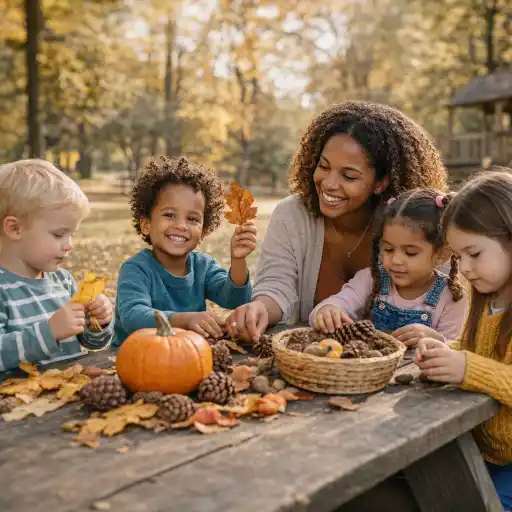
Let children choose materials and decide how to represent their discoveries. A collection can become a class display, a drawing, or a pretend forest. For more inspiration, see fall science adventures and preschool leaf science activities.
Which pumpkin and apple activities encourage early STEM thinking?
Real seasonal objects give children concrete ways to predict, compare, test, and explain. Keep the investigation brief and let children handle safe materials whenever possible. The adult’s role is to prepare the environment, model curiosity, and ask questions—not to rush to the answer.
- Apple sink-or-float: Before testing an apple in a tub of water, invite children to predict what will happen. Try other large, safe fall objects and record results with drawings or a picture chart.
- Pumpkin comparison: Compare pumpkins by size, shape, and weight. Ask which seems heavier and how children might check. Use a balance scale if one is available.
- Seed counting: With adult preparation and close supervision, examine pumpkin seeds. Sort or count them, compare groups, and draw what children notice.
- Rolling investigation: Roll a small pumpkin or ball down a low, stable ramp. Change the ramp’s height and observe what happens.
Children practice early math through counting, sorting, estimating, and comparing. They also develop scientific habits when they make a prediction, observe a result, and revise an idea. Prompts such as “What do you notice?” and “What could we try next?” invite reasoning without making children feel they must guess the teacher’s preferred answer.
Use food only with family permissions and allergy information in mind, and do not let children eat materials used for experiments. Avoid small loose items with children who may mouth them. ChildCareEd’s pumpkin, leaf, and apple activity ideas offer additional low-prep starting points. A course such as Basic Science in Early Childhood Buy Now $25.00 can further support providers in planning purposeful, age-appropriate inquiry.
How can movement, art, and pretend play strengthen school-ready skills?
Kindergarten classrooms ask children to move through spaces, use tools, communicate with peers, and follow simple routines. Fall play can offer relaxed practice in these skills while still feeling like play. Outdoors, set up a short leaf-color hunt or invite children to walk like different fall animals. Indoors, use paper leaves as stepping spots for a path that children can follow, adapt, or redesign.
- Movement game: Call out a color or shape for children to find, or invite them to travel like a squirrel gathering food. Offer walking, seated, or supported ways to join.
- Open-ended art: Provide paper, washable paint, crayons, and large leaves for printing or collage. Focus on children’s decisions and process rather than a matching finished product.
- Pretend harvest market: Use play apples or large pretend produce. Children can take turns as shoppers and sellers, make signs, count items, and solve small problems together.
- Animal shelter building: Use blocks, fabric, and large natural materials to create a pretend shelter. Ask what a toy animal might need and how the group could make the structure stable.
Games that involve stopping, starting, waiting, and changing actions can give children practice with attention and self-regulation. Research on a play-based program for preschoolers reported improvements across measured executive-function, language, and motor domains after children participated in a set of interactive games; results from a particular program should not be treated as a guarantee for every setting. Read the study on play-based games and executive function.
How can educators make fall play inclusive, safe, and intentional?
Thoughtful planning helps children participate with confidence. Before outdoor play, scan for hazards such as sharp sticks, slippery areas, standing water, unknown plants, animal waste, and traffic risks. Maintain active supervision, establish clear boundaries, and check weather and clothing needs. Wash hands after collecting natural materials, and do not allow children to taste plants, seeds, or other items found outside. State requirements vary - check your state licensing agency.
Inclusion begins with offering more than one way to take part. A child may prefer to observe rather than touch leaves, use tongs instead of hands, point to a choice, or contribute a word in a home language. Provide large tools, visual directions, stable seating, and quiet alternatives as needed. Keep small objects away from children who may put them in their mouths, and follow program policies and family information related to allergies.
To make play intentional without over-directing it, use a simple planning cycle:
- Observe: What are children noticing or repeating?
- Choose a goal: Identify a skill to support, such as comparing quantities or taking turns.
- Prepare: Set out a few safe materials and consider adaptations.
- Join briefly: Offer a question, new word, or tool, then allow children to lead.
- Reflect: Record a short observation and decide what might extend the play.
Avoid common pitfalls: too many materials can make supervision harder; a craft with one required result can limit children’s choices; and lengthy adult explanations can interrupt discovery. A photograph and a child’s comment can document learning more clearly than a finished product alone. For guidance on readiness domains and everyday classroom practices, see ChildCareEd’s overview of skills preschoolers need for school.
How can providers turn fall play into a strong start for kindergarten?
Simple fall activities can support much more than seasonal fun. Leaf sorting can invite classification and language; pumpkin investigations can build prediction and comparison; movement games can give practice with coordination and self-regulation; and pretend play can strengthen communication, cooperation, and flexible thinking. These skills grow through repeated, responsive experiences—not through pressure to make every child perform in the same way.
Choose one activity, connect it to a meaningful developmental goal, and notice how children engage. Offer variations so children with different interests, abilities, and communication styles can participate. Share a brief observation with families, such as a child’s prediction, new word, or strategy for solving a problem. Small moments of progress matter, and educators are already creating many of them in the everyday rhythm of care.
So, how can simple fall activities support kindergarten readiness through play? They give children joyful, concrete opportunities to practice the social, language, thinking, and physical skills that help them enter new learning environments with confidence. Keep the materials simple, the questions open, and the play child-centered.
For additional professional learning, explore Reading Aloud and Storytelling Buy Now $16.00 to strengthen language-rich routines, or Are They Ready for Kindergarten? Buy Now $35.00 to deepen your understanding of readiness skills.
- Moving About the Classroom: Effective Transitions for Everyday
- Early Mathematics Through Play
- Theory of Learning
- CDA Home Visitor Subject Area 3 Part 3 Birth to 5
- From Play to Planning: Building Culturally Competent, Child-Centered Curriculum
- Are They Ready for Kindergarten?
- Creating Engaging and Meaningful Learning Experiences
- Lesson Planning for Preschoolers
- Letter & Number Planning in Child Care
- Montessori Cultural Activities: Exploring the World Through Play and Learning
- CDA Certification en Español: Recursos y Consejos para Educadores Bilingües
- Ready, Set, Kindergarten!
- 💛🧩 ¿Cómo puedo hacer que mi enseñanza sea inclusiva para los niños con autismo?
- ¿Cómo puedo usar escenarios de juego de roles de primeros auxilios en mi aula?
- Actividades de Motricidad Gruesa que Desarrollan el Equilibrio, la Coordinación y la Fuerza
- 10 Ejemplos de Cómo la Cultura Influye en el Desarrollo Infantil
- Cómo Celebrar el Día Nacional del Kindergarten
- Actividades de Otoño Fáciles para Preescolares esta Temporada
- How can we prepare preschoolers for kindergarten success?
- Calabazas, hojas y manzanas: actividades de otoño para preescolares
- Celebrando la amistad en el cuidado infantil durante el Día de los Mejores Amigos
- Canciones, juegos y preguntas de círculo para niños
- Is Your Child Ready for Kindergarten? A Kindergarten Readiness Checklist
- Is My Preschooler Ready for Kindergarten? Milestones Beyond ABCs and 123s
- How Can Child Care Programs Build Meaningful School Readiness?
- How Can Teachers Support Children Starting Kindergarten This Fall?
- How Can Child Care Providers Support Kindergarten Emotions on the First Day of School?
- How Can Fall Activities Build Kindergarten Readiness Skills?
- How Can Simple Fall Activities Support Kindergarten Readiness Through Play?
- How Can November Classroom Activities Help Preschoolers Build School Readiness Skills?
