When children declare that a rock is “heavy” or a feather is “light,” they are beginning to reason about measurable attributes through direct experience. Child care providers can turn these everyday discoveries into purposeful learning with Early Mathematics Through Play Buy Now $24.00, a course that offers practical strategies for integrating measurement, comparison, and problem-solving into routines and play while supporting professional learning goals. And Sorting Mat - Light or Heavey Buy Now $1.49 a ready-made ChildCareEd resource that teachers can use in their classroom.
Why do light and heavy experiences matter in early childhood?
Weight is one of the most accessible measurement concepts for young children because they can feel it in their hands, see it on a balance scale, and observe how it affects movement. A child lifting a full bucket, carrying a basket of blocks, or comparing two classroom objects is developing an intuitive understanding of mass and force. These experiences are not merely physical play; they are opportunities to build mathematical language, prediction, classification, and reasoning.
Research from DREME emphasizes that young children encounter measurement throughout daily life as they compare objects by size, length, capacity, and weight. Early measurement develops most effectively when children have rich materials, meaningful problems, and conversations that encourage them to explain their thinking. The kindergarten Common Core standards similarly expect children to describe measurable attributes such as weight and directly compare objects to determine which has more or less of an attribute.
For providers, this means measurement does not need to be isolated at a math table. It can be embedded in cleanup, dramatic play, outdoor work, block building, cooking, and sensory exploration. These contexts make #measurement purposeful because children have a reason to compare: Which container is easier to carry? Which object will make the scale tip? How can we make both sides equal?
How do light activities build foundational measurement skills?
Light materials invite children to notice subtle differences, make estimates, and manipulate objects with less physical effort. Feathers, fabric squares, cotton balls, pompoms, plastic lids, paper tubes, and empty containers are useful because children can gather, sort, transfer, and combine them. A light object may not visibly change a balance scale very much, prompting children to test combinations or compare it with another item.
Begin with sensory language. Invite children to hold one object in each hand and describe what they notice. Avoid expecting technically precise explanations; statements such as “This one hardly pushes my hand” reveal emerging reasoning. Introduce words such as light, lighter, lightest, less, empty, soft, and easy to carry in context.
- 🌬️ Light-object sort: Children classify safe objects as light, lighter, or lightest and explain their choices.
- Feather and fan investigation: Children predict which light materials will move farthest when gently fanned.
- Equal-count comparison: Place the same number of cotton balls, buttons, or blocks into containers and compare their weights.
- Light carrying challenge: Children select materials that can be transported safely in a small basket and discuss why some are easier to carry.
These activities connect weight with counting, comparison, motor coordination, and #vocabulary. They also make room for children who prefer gentle sensory experiences or need less physically demanding entry points.
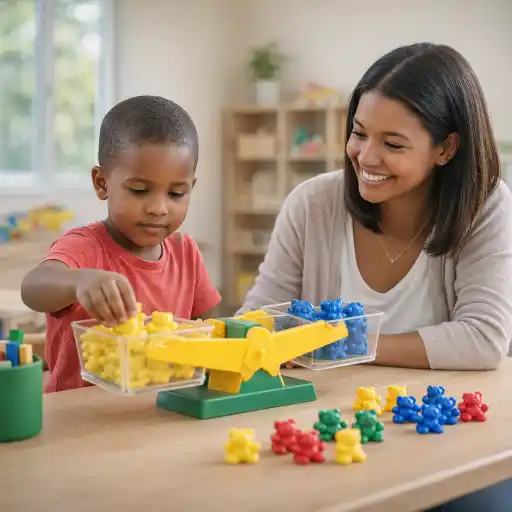
How do heavy activities deepen comparison and reasoning?
Heavy materials provide powerful feedback: muscles work harder, containers may require two hands, and a balance scale moves visibly. Appropriate examples include large wooden blocks, filled water bottles, smooth stones, sealed containers of sand, and sturdy pans. Heavy does not mean unsafe or oversized; educators should select materials children can handle without strain and supervise lifting, carrying, and pouring.
Outdoor play is especially useful. Children may fill buckets with sand, push a wheelbarrow, move logs, or compare a dry and wet sponge. These experiences help them understand that weight can change when materials are added, removed, or saturated. A dry sponge may feel light, while the same sponge filled with water feels heavier. This creates an authentic reason to use comparative language and test predictions.
A balance scale makes invisible differences more visible. Ask children to predict which side will go down, test their ideas, and then arrange several objects from lightest to heaviest. Encourage them to compare indirectly: If the stone is heavier than the block, and the block is heavier than the shell, what might we predict about the stone and shell?
- Use “heavier,” “lighter,” and “the same weight” rather than relying only on “big” and “small.”
- Ask, “How do you know?” and accept pointing, gestures, demonstrations, drawings, or words as evidence.
- Invite children to discover that size does not always determine weight; a small rock may outweigh a large empty box.
Heavy-material investigations strengthen #reasoning, persistence, and scientific habits of observing, predicting, testing, and revising.
How can providers connect light and heavy activities to other measurement concepts?
Weight should be taught alongside, not separated from, other measurable attributes. Young children often use the word “big” to describe something that is tall, wide, long, or heavy. This is a productive starting point, but educators can help children identify the specific attribute being compared. Ask, “Are we comparing how tall it is, how long it is, or how heavy it feels?”
Water and sensory play offer natural bridges among weight, capacity, and volume. Children can compare an empty cup with a full cup, predict whether a container will be heavier after adding water, and observe how the same amount of material may look different in containers of different shapes. In block play, children can build towers and discuss both height and stability: Does a heavier block make the base stronger? In cooking, children can scoop ingredients, compare full and empty containers, and notice that different materials can have different weights even when they fill the same space.
Measurement also connects to data. Children can create a simple chart showing which objects they predicted would be heavy or light, then mark whether testing confirmed their predictions. The purpose is not formal graphing accuracy; it is helping children represent experiences and revisit ideas.
- Weight and length: Compare a long feather with a short stone.
- Weight and capacity: Compare empty and filled containers.
- Weight and movement: Test which ball rolls farthest or which cart is hardest to push.
- Weight and number: Discover how many light objects may balance one heavier object.
These integrated experiences reflect DREME’s observation that everyday life is a form of data gathering and measurement.
How should teachers scaffold inclusive, meaningful investigations?
Effective scaffolding begins with observation. Notice whether a child is exploring weight, carrying, filling, balancing, or simply enjoying the sensory qualities of materials. Then offer one prompt or one additional tool rather than directing every step. Useful questions include “What do you notice?” “Which feels heavier?” “What could we test?” and “What changed when you added one more?”
Provide multiple ways to participate. Some children may hold objects; others may point to picture cards, use a scoop, watch the scale, dictate a prediction, or record results with marks. Adapt handles, container sizes, seating, and the amount of material according to individual motor, sensory, communication, and attention needs. A child who avoids heavy lifting can still make predictions, compare objects on a scale, or document peers’ findings.
Keep the environment organized and safe:
- Inspect materials for sharp edges, breakage, splinters, and choking hazards.
- Use sealed containers for sand, water, rice, or other loose fillers when appropriate.
- Teach children to carry one object at a time and keep materials within the investigation area.
- Position adults for active supervision during water play, lifting, and tool use.
- Use trays, washable mats, and child-sized cleanup tools to make exploration manageable.
State requirements vary - check your state licensing agency. For additional support in planning developmentally appropriate science investigations, providers can explore Basic Science in Early Childhood Buy Now $25.00 and Math Foundations in Early Childhood  Buy Now $16.00.
What common mistakes can programs avoid?
One common mistake is teaching weight as a vocabulary drill. Children may repeat “heavy” and “light” without understanding the comparison. The stronger approach is to let them handle objects, predict, test, and explain. Another mistake is assuming that larger objects are always heavier. Intentionally include contrasting materials so children discover that size, volume, and weight are different attributes.
Educators may also introduce standard scales or numerical units too quickly. Nonstandard comparisons—hands, balance pans, containers, or one object against another—are often more meaningful for preschoolers. Standard tools can be introduced gradually once children understand the purpose of measuring and comparing.
- Too much adult explanation: Offer a short invitation and allow children time to investigate.
- Only one correct prediction: Treat unexpected results as useful information.
- Materials that are too heavy: Choose objects that challenge thinking without creating physical risk.
- Overcrowded centers: Provide a focused selection and rotate materials intentionally.
- No documentation: Capture one photograph, quote, tally, or drawing to make learning visible.
Directors can strengthen practice by inviting teachers to share observations during planning meetings. A simple reflection—“What did children compare, and what might we offer next?”—keeps the curriculum responsive. The course Tracking Progress, Shaping Futures: Observation & Assessment Skills Buy Now $55.00 can further support objective documentation and using observations to guide instruction.
Conclusion: How do light and heavy activities build early measurement skills?
Light and heavy activities build early measurement skills by giving children repeated opportunities to feel, compare, classify, predict, test, communicate, and represent what they discover. Light materials support careful sensory comparison and combination, while heavy materials provide strong physical feedback about force, balance, and effort. Together, they help children distinguish weight from size, develop precise #language, and connect measurement to counting, data, science, motor development, and problem-solving.
The most effective experiences are playful, accessible, and connected to real purposes. A basket to carry, a scale to balance, a bucket to fill, or a block tower to stabilize can become a meaningful investigation when educators pause, listen, and ask thoughtful questions. Start with familiar objects, document children’s ideas simply, and extend learning through one small change at a time.
For continued professional learning, consider Enhancing STEM Education for Infants and Toddlers Buy Now $16.00, especially when adapting measurement and inquiry experiences for younger children.
References
- 45 Hour Child Growth and Development
- Moving About the Classroom: Effective Transitions for Everyday
- Early Mathematics Through Play
- BBP (Bloodborne Pathogens)
- CDA Bridge Bundle: Family Child Care without Portfolio Review
- CDA Bridge Bundle: Infant/Toddler without Portfolio Review
- Texas Director Credential
- Moving About the Classroom: Effective Transitions for Everyday
- CDA Certification en Español: Recursos y Consejos para Educadores Bilingües
- 🔍 ¿Qué ves cuando observas a un niño aprender?
- 👶 ¿Cuáles son las proporciones y grupos requeridos en Dakota del Norte? 🏫
- Recursos en Español sobre el Sueño Seguro del Bebé
- Curso de Comunicación de 9 Horas de Maryland
- Que es Título 22 en California?
- Actividades de Motricidad Gruesa que Desarrollan el Equilibrio, la Coordinación y la Fuerza
- Capacitación en Salud y Seguridad Preventiva en Línea para Proveedores de Cuidado Infantil
- Actividades de Fiesta para Niños de Preescolar y Primaria
- ¿Cómo solicito la licencia para una guardería en California?
- Proporciones de Cuidado Infantil y Tamaños de Grupo por Edad en Virginia (Guía Rápida para Centros y Hogares)
- Lista para Abrir una Guardería en Casa en Virginia: Cómo Empezar
- Lista para Guardería en Casa en Illinois: Cómo Iniciar una Guardería en el Hogar
- Lista para Guardería en Casa en Texas: Cómo Iniciar una Guardería en el Hogar
- Ejemplos de Crianza Respetuosa vs. Crianza Permisiva
- Calabazas, hojas y manzanas: actividades de otoño para preescolares
- Celebrando la amistad en el cuidado infantil durante el Día de los Mejores Amigos
- Canciones, juegos y preguntas de círculo para niños
- Cómo simplificar la capacitación para sus empleados de daycare
- How Do Light vs. Heavy Activities Build Early Measurement Skills?
