When families see play as “just fun,” they may miss the complex learning happening in block building, pretend conversations, sensory exploration, and outdoor movement. Clear, respectful communication can help families recognize those moments while strengthening the home-school partnership; Community Partnerships  Buy Now $24.00 offers practical strategies for building productive relationships and earning professional development credit. For a deeper focus on culturally responsive collaboration, explore Bridging Cultures: Family Communication & Collaboration Buy Now $55.00.
Why does helping families understand play matter?
Families want children to be successful, and many understandably associate success with visible academic products: worksheets, completed pages, or teacher-directed lessons. Providers can honor that concern while explaining that play is not the absence of teaching. It is a developmentally appropriate context in which children actively use language, test ideas, negotiate relationships, and apply emerging knowledge.
The National Association for the Education of Young Children describes playful learning as active, engaging, meaningful, socially interactive, and iterative. Similarly, Head Start explains that play supports relationships, language, problem solving, physical development, and social skills. These sources give educators a strong foundation for family conversations, but the most persuasive evidence is often a specific example from the child’s day.
Family understanding matters because shared expectations create consistency. When educators and families both recognize the learning value of #play, they can extend children’s interests across settings rather than treating home and school as separate worlds.
What exactly should families know about learning through play?
Begin with a concise definition: play-based learning occurs when children explore, imagine, create, move, communicate, and solve problems while adults intentionally prepare environments and provide responsive support. The child may lead the activity, but the experience is not necessarily accidental or unplanned. For a broader overview of how play supports child development, explore this guide.
Use familiar examples to make the learning visible:
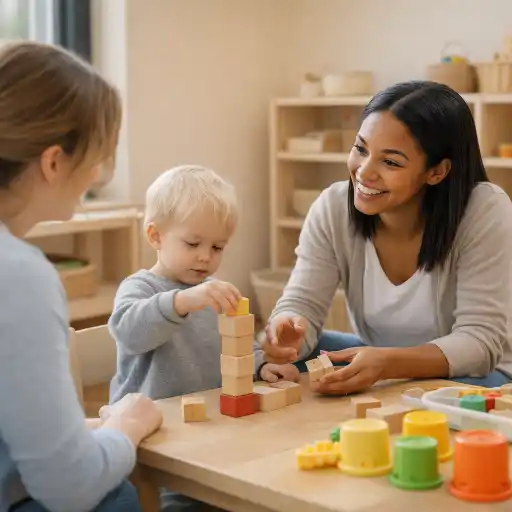
- 🧱 Blocks: Children count, compare height, explore balance, use spatial language, and collaborate.
- Dramatic play: Children practice vocabulary, storytelling, sequencing, perspective taking, and social negotiation.
- Art and sensory experiences: Children strengthen fine-motor coordination, describe properties, make choices, and represent ideas.
- Outdoor play: Children develop physical coordination while investigating nature, risk, measurement, and cause and effect.
- Games with rules: Children practice memory, attention, turn-taking, flexibility, and self-regulation.
The goal is not to persuade families that every playful moment must be converted into a lesson. Rather, educators can show that children’s natural activity provides rich opportunities for growth across domains. NAEYC’s guidance for families recommends using accessible language and avoiding unnecessary professional terminology.
How can educators explain play without sounding defensive?
Start by listening. A family member who asks, “When will my child do academics?” may be expressing care, uncertainty, or a previous experience with school. Responding defensively can create distance; responding with curiosity builds trust. Try, “You want to be sure your child is developing the skills needed for school. Let me show you what those skills look like during play.”
Replace broad claims with observable evidence. Instead of saying, “Play builds executive function,” say, “During the restaurant game, Jordan remembered three orders, waited for a turn, and changed the plan when a peer asked for a different role.” Then connect the observation to a broader concept: attention, working memory, language, and social problem solving.
Useful communication strategies include:
- Use plain language before introducing technical terms.
- Describe what the child did, said, tried, or changed.
- Connect the example to a developmental or curriculum goal.
- Invite the family’s interpretation and cultural knowledge.
- Offer one easy way to continue the interest at home.
Families do not need to adopt identical play practices. Their knowledge, values, languages, and routines are assets. Effective engagement is reciprocal: providers explain classroom intentions while learning how children play and communicate within their families and communities.
How can documentation make play-based learning visible?
Documentation should illuminate children’s thinking rather than merely display attractive products. A photograph of a child constructing a bridge becomes more meaningful when paired with the child’s words and the teacher’s interpretation. For example: “Maya tested two designs, noticed that the narrow base tipped, and added wider blocks. She used the words ‘stronger’ and ‘balance’ while explaining her plan.”
A brief documentation format can include:
- Context: What materials or situation engaged the child?
- Evidence: What did the child say or do?
- Meaning: What learning or development was demonstrated?
- Next step: How might the experience be extended?
Directors can support consistency by creating shared templates for learning stories, photo captions, portfolios, or family messages. Teachers do not need lengthy reports; a precise sentence can be more informative than a generic paragraph.
When sharing images, programs must follow privacy policies and applicable regulations. State requirements vary - check your state licensing agency. Obtain required permissions, protect confidential information, and ensure that documentation represents children respectfully rather than portraying them as performers for adults.
How can families continue play-based learning at home?
Home extensions should be simple, affordable, and flexible. Families do not need specialized toys or large blocks of free time. Everyday routines offer meaningful opportunities for conversation, classification, counting, movement, and imaginative thinking.
- During meals: Count plates, compare amounts, describe textures, or invent a restaurant menu.
- While shopping: Search for colors, compare sizes, notice letters, or sort groceries.
- During outdoor time: Collect and classify leaves, observe insects, follow movement patterns, or play “I Spy.”
- With household materials: Build with boxes, create a pretend office, make a fort, or use containers for pouring and sorting.
- During reading: Predict what may happen, retell the story with toys, or invent a different ending.
Invite families to share what they notice at home. A message such as “We tried sorting socks by size” gives teachers information about the child’s interests and communicates that family experiences are valued. For infants and toddlers, ZERO TO THREE emphasizes independent play with an attentive adult nearby, physical play, quiet play, and stable routines.
Offer choices rather than assignments. “If your child enjoys building, try adding cardboard tubes” is more supportive than “Complete this activity.” This approach respects family time, resources, culture, and preferences.
How can programs build an ongoing family partnership around play?
One family newsletter cannot establish lasting understanding. Programs can create repeated, two-way opportunities for families to observe, discuss, and contribute to play-based learning. Consider hosting a short play-and-learn event, displaying annotated photographs, inviting families to contribute culturally relevant props, or sending home a monthly “learning through play” idea.
Directors can also align staff practice around a shared message: “Play is children’s context for active learning, and teachers make that learning visible.” Staff meetings might include time to review observations, practice family-friendly explanations, and identify materials that reflect children’s homes and communities.
Useful questions for team reflection include:
- What learning did we observe, and what evidence supports that interpretation?
- Whose play traditions, languages, and experiences are represented?
- How did adults support children without taking control?
- How can families contribute knowledge or ideas?
- What adaptation would make this experience more accessible?
Strong family engagement is collaborative rather than promotional. The CDC describes positive parenting and family engagement as shared work between early care providers and parents. When families are treated as knowledgeable partners, conversations about play become opportunities for mutual learning, not attempts to defend a program.
Conclusion: How can providers help families understand play-based learning?
Providers help families understand play-based learning by making children’s thinking visible, using respectful and accessible language, listening to family perspectives, and offering practical ways to continue learning at home. Explain the purpose behind experiences, document specific evidence, and connect play to language, mathematics, problem solving, physical development, relationships, and self-regulation.
Keep the message consistent: play is not separate from learning. It is one of the primary ways young children investigate the world and build confidence. For further professional growth, consider Role of Play in Learning Buy Now $16.00, The Best Promotion is Play Buy Now $24.00, and Family Voices Matter: Tools for Meaningful Collaboration Buy Now $55.00. Thoughtful communication helps families see what educators already see every day: children are building powerful knowledge through joyful, purposeful #learning.
- 45 Hour Child Growth and Development
- Beyond the Classroom: Connecting Families to Essential Services
- 45 Hour School Age Methods and Materials
- Effective Approaches for Autism and Inclusion
- CDA Home Visitor Credential Birth to 5
- Texas Director Credential
- Families, Communities, and Classrooms: Working Together for Children
- Bridging Cultures: Family Communication & Collaboration
- Family Child Care: Building, Premises, and Outdoor Safety
- Supporting Families and Caregivers in Language and Literacy
- CDA Certification en Español: Recursos y Consejos para Educadores Bilingües
- 10 Ejemplos de Cómo la Cultura Influye en el Desarrollo Infantil
- Proporciones de Cuidado Infantil y Tamaños de Grupo por Edad en Maryland (Guía Rápida para Centros y Hogares)
- Proporciones de Cuidado Infantil y Tamaños de Grupo por Edad en Virginia (Guía Rápida para Centros y Hogares)
- Cómo Trabajar en el Cuidado Infantil en Carolina del Norte: Requisitos y Pasos
- Capacitación Previa al Servicio para Proveedores de Cuidado Infantil en Georgia
- Capacitación CDA gratuita en Illinois
- Celebrando la amistad en el cuidado infantil durante el Día de los Mejores Amigos
- Canciones, juegos y preguntas de círculo para niños
- What Makes a Great Home Daycare? 10 Things Parents Notice First
- How Can Child Care Providers Help Families Understand Play-Based Learning?
- How Can Child Care Providers Turn Everyday Routines into Learning Opportunities?
- How Can Child Care Providers Support Preschool Development?
- How Can Child Care Providers Strengthen Language and Literacy Development?
- How Can Child Care Providers Create Effective Learning Centers in Small Spaces?
- How Can Providers Show Families the Learning Behind Play?
- What Can Providers Say When Families Compare Their Child With Another Child?
- What Should a 3-Year-Old Be Learning at Preschool?
- How Can Child Care Providers Help Children Understand How Community Helpers Contribute?
- How Can You Keep a Learning Center Useful After the Novelty Wears Off?
