How can a simple sorting activity help children notice sounds, understand word meanings, and use language more confidently? The Science of Reading Foundations in the Pre-K Classroom Buy Now $16.00 course gives providers a broader framework for connecting phonological awareness, vocabulary, print knowledge, and emergent literacy to daily practice. Pair that professional learning with the ready-to-use Ice Cream Shop Word Sort Buy Now $1.99 to create an engaging small-group experience children can read, discuss, sort, and revisit.
Why does word sorting matter in early childhood?
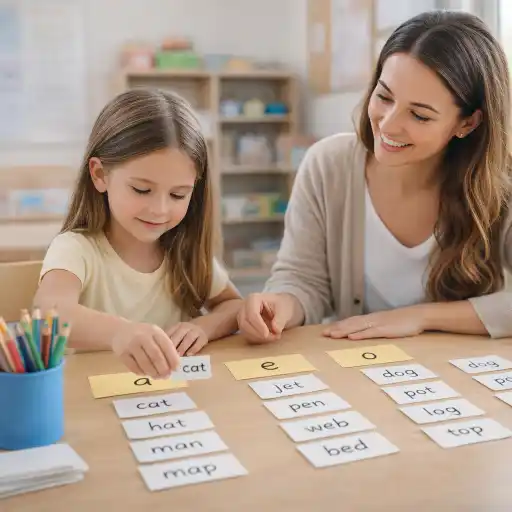
Word sorting is more than a worksheet task. When children compare words and place them into meaningful categories, they are practicing a form of analysis that supports early #literacy development. They listen closely, inspect letters or word forms, notice similarities and differences, and explain why items belong together.
For preschoolers, sorting can begin orally with objects, pictures, or spoken words. A provider might ask children to group words that begin with the same sound, rhyme, describe an action, or name a person, place, or thing. As children gain print knowledge, the same activity can include simple written words and visual word patterns.
This matters because early reading develops through connected skills rather than one isolated lesson. Phonological awareness helps children hear and manipulate sound structures; phonics connects those sounds to letters; vocabulary gives children words and meanings to recognize, discuss, and use. Word sorting can bring these dimensions together in a playful, concrete format.
- Children strengthen auditory attention and comparison skills.
- Children practice categorizing and retrieving new vocabulary.
- Children develop language for explaining relationships.
- Educators gain an accessible opportunity to observe emerging skills.
Sorting also respects young children’s need to learn through movement and manipulation. Handling cards, placing scoops on cones, and revising a sort make abstract language concepts visible and memorable.
How does sorting support phonics development?
Phonics instruction depends on children understanding that spoken sounds are represented by written symbols. A word sort creates repeated opportunities to look at a word, say it, listen for its sounds, and compare it with another word. This sequence supports the development of the alphabetic principle without requiring long drills.
Begin with a clearly defined feature. For example, children might sort words by initial sound, short-vowel sound, rhyme, or a familiar spelling pattern. In the Ice Cream Shop Word Sort, the primary categories are parts of speech—noun, adjective, verb, and adverb—so the activity emphasizes grammar and vocabulary. Providers can extend the experience by saying each word aloud, identifying its first sound, and noticing letters or word endings when developmentally appropriate.
Keep the instructional focus manageable. Preschool children do not need to analyze every sound in every word at once. A brief discussion such as “Scoop starts with /s/. Which other word begins with /s/?” can connect oral sound awareness to print. For children ready for more challenge, invite them to compare words such as run and running, or identify words with a shared beginning or ending.
Research-informed word study emphasizes explicit modeling, guided practice, and gradual release. Model your thinking: “I read sweet. It tells us about something, so I will place it with the describing words.” Then invite children to justify their decisions and revise them when new information emerges.
- Say the word clearly before asking children to inspect the print.
- Connect a sound to a letter only after children have had time to listen.
- Use a small number of contrasting categories.
- Repeat target words across books, play, and routines.
How does word sorting strengthen vocabulary and grammar?
Vocabulary grows when children encounter words repeatedly, in meaningful contexts, and with opportunities to use them. Sorting supports this process because children do not merely hear a word once; they name it, compare it, classify it, and often use it in a sentence. These actions deepen the word’s semantic representation.
The Ice Cream Shop Word Sort offers an especially useful context because its categories—noun, adjective, verb, and adverb—invite children to think about what words do in sentences. A noun may name an object or flavor, an adjective may describe it, a verb may show an action, and an adverb may describe how an action occurs. Young children may not master formal grammatical definitions immediately, but they can meaningfully discuss questions such as “What is this word naming?” or “What does this word tell us about the action?”
After sorting, ask children to build playful sentences: “The creamy ice cream melts quickly.” Then change one word and discuss how the meaning changes. This supports oral language, syntax, comprehension, and expressive confidence.
Directors can encourage staff to select a few target words each week and recycle them across the classroom. Place them in dramatic-play menus, use them during read-alouds, and invite children to draw or act them out. Multiple encounters are particularly valuable for children learning English and for children who need additional processing time.
- Define new words with child-friendly language.
- Pair words with gestures, objects, photographs, or actions.
- Ask children to use target words in authentic conversation.
- Invite home-language connections when families share them.
A sorting activity becomes more powerful when children understand that categories help organize knowledge. They are learning not only individual words, but also relationships among words.
How can providers use the Ice Cream Shop Word Sort effectively?
Begin by preparing the activity so children can focus on language rather than managing materials. Review the words in advance, check that the print is readable, and decide whether children will work independently, with a partner, or in a small teacher-led group. The resource includes children cutting, reading, sorting, and gluing ice cream scoops onto the correct cone, followed by creating an ice cream flavor using all four parts of speech.
Before sorting, introduce the categories with concrete examples. You might say, “A noun names something, like cone. An adjective tells about something, like cold. A verb shows an action, like scoop.” Use gestures and real objects whenever possible. If adverbs are too abstract for some children, focus on oral modeling rather than expecting independent mastery.
- Preview the pictures or words and clarify unfamiliar vocabulary.
- Model one or two sorts while thinking aloud.
- Invite children to place each scoop and explain their reasoning.
- Read the completed categories together.
- Have children create and share a silly flavor or sentence.
🍦 For children who are not yet ready to read the words, add pictures, read the words aloud, or offer a choice between two cones. Children with stronger skills can generate additional examples, write a sentence, or sort words by a second feature after completing the first sort.
Keep the lesson brief—approximately 10 to 15 minutes for a focused small group—and stop before fatigue replaces curiosity. Cutting and gluing can be offered as a follow-up center so the teacher-led conversation remains intentional.
How can educators differentiate, assess, and extend sorting?
Differentiation begins with observing what the child is actually finding difficult. Is the challenge vocabulary knowledge, hearing the word, reading the print, understanding the category, cutting, or explaining the choice? The answer determines the most useful support.
- For emerging learners: use fewer cards, read each word aloud, provide pictures, and sort between two contrasting categories.
- For multilingual learners: preview vocabulary, use gestures and realia, invite home-language discussion, and accept pointing or drawing as communication.
- For children with motor needs: provide larger pieces, adaptive scissors, pre-cut cards, or digital/pointing alternatives.
- For advanced learners: ask for original examples, sentence creation, word substitutions, or a second sort by sound or spelling.
Assessment should be brief and embedded in the activity. Record whether a child can name the word, identify its meaning, place it in a category, explain the decision, and use it in a sentence. One concise note can guide the next lesson: “Maya classified nouns and verbs independently but needed modeling for adjectives.”
Avoid treating an incorrect sort as failure. Respond with prompts such as, “Let’s say the word in a sentence,” or “What does this word tell us?” Immediate, supportive feedback preserves confidence while making the thinking visible.
Extend learning beyond the table by adding a pretend ice cream shop. Children can write menus, take orders, describe flavors, and act out serving customers. This transfers word knowledge into dramatic play, where language becomes purposeful and social.
What common mistakes should providers avoid?
Word sorting is most effective when the task is connected to a clear learning goal. Several common mistakes can reduce its value, but each is easy to address.
- Too many categories: Begin with two or three categories and add complexity gradually.
- Unfamiliar words: Teach the meaning first; otherwise, children may sort based on guessing.
- Focusing only on correct placement: Ask children to explain their thinking and use the word orally.
- Overemphasizing worksheets: Combine sorting with objects, movement, books, conversation, and dramatic play.
- Expecting all children to work identically: Adjust print size, response options, group size, and amount of adult support.
- Confusing phonological awareness with phonics: Remember that hearing sounds is oral, while phonics connects sounds to print.
Directors can strengthen implementation by giving teachers planning time to identify target words, share observations, and align activities across classrooms. A common vocabulary routine helps children encounter words repeatedly without making instruction feel repetitive.
Professional development can support this work. The Understanding Print Knowledge in Preschool  Buy Now $16.00 course can help providers connect children’s interactions with print to early reading development. For staff who want to deepen intentional vocabulary instruction, Building Vocabulary Buy Now $16.00 offers relevant professional learning. State requirements vary - check your state licensing agency before counting any course toward required training.
Conclusion: How does word sorting build phonics and vocabulary skills?
Word sorting builds phonics and vocabulary skills by asking children to listen, look, compare, categorize, explain, and use language. When sorting is brief, explicit, playful, and connected to meaningful contexts, it helps children notice sound and print patterns while expanding their understanding of word meanings and grammatical roles.
The Ice Cream Shop Word Sort provides a motivating structure for this work. Providers can begin with the resource’s parts-of-speech categories, then extend learning through oral sound play, sentence building, read-alouds, environmental print, and dramatic play. The goal is not to rush children into formal reading, but to build the knowledge, attention, language, and confidence that support future reading success.
Key takeaways:
- Use sorting to make language relationships visible and discussable.
- Teach vocabulary before expecting children to classify unfamiliar words.
- Connect oral sound awareness to print gradually and explicitly.
- Differentiate materials and responses so every child can participate.
- Use observations to plan the next small, meaningful step.
For a complete foundation in early literacy planning, explore the Science of Reading Foundations in the Pre-K Classroom Buy Now $16.00. Additional professional learning options include Reading Aloud and Storytelling Buy Now $16.00, Assessment of Language and Literacy Skills Buy Now $24.00, and Language and Literacy Foundations in Pre-K Buy Now $16.00.
- Understanding Print Knowledge in Preschool
- Science of Reading Foundations in the Pre-K Classroom
- Reading Aloud and Storytelling
- Language and Literacy Foundations in Pre-K
- Building Early Science Foundations
- Creating Environments that Nurture Growth and Community
- Texas Director Credential
- Building Vocabulary
- Classroom Tools for Emergent Literacy
- Montessori Cultural Activities: Exploring the World Through Play and Learning
- CDA Certification en Español: Recursos y Consejos para Educadores Bilingües
- 🔍 ¿Qué ves cuando observas a un niño aprender?
- Curso Gratis De Cuidado Infantil Con Certificado
- Cómo Abrir Una Quardería En Casa Sin Dinero?
- Celebra El Cumpleaños de Dr. Seuss En Tu Guardería Con Actividades Fáciles y Divertidas!
- Cómo Trabajar en una Guardería Sin Experiencia en Cuidado Infantil
- Normas de Licenciamiento de Cuidado Infantil en Virginia para Centros Diurnos Infantiles y Hogares Diurnos Familiares
- How can child care providers use the science of reading to boost early literacy in New York?
- Celebrando la amistad en el cuidado infantil durante el Día de los Mejores Amigos
- Canciones, juegos y preguntas de círculo para niños
- How can child care programs build strong readers before kindergarten?
- How Can Child Care Providers Teach Beginning Sounds with Tracing, Pictures, and Repetition?
- How Can Familiar Summer Vocabulary Make Syllable Instruction More Meaningful?
- How Does Word Sorting Build Phonics and Vocabulary Skills?
- How Can Child Care Providers Move Children from Letter Recognition to Beginning-Sound Awareness?
- How Can Themed Vocabulary Strengthen Beginning-Sound Awareness in Preschool?
- What Should Effective Beginning-Sound Practice Include?
- How Can Providers Connect Letter Formation, Sound, and Vocabulary in Phonics Instruction?
- How Can Food and Kitchen Words Build Early Reading Skills?
- Teaching Syllables Through Play: What Should Preschoolers Notice?
