A child who calls a toy car “alive” because it moves is offering a clue about how they understand the world. Use the Sorting Mat – Living or Non-Living Buy Now $1.49 to invite children to explain their choices, then extend the conversation through observations of real plants, animals, and everyday objects. Questions such as “Does it grow?” and “What does it need?” can help children consider several clues as they develop their ideas. For practical strategies in planning investigations and supporting scientific reasoning, explore Basic Science in Early Childhood Buy Now $25.00. Read on for ways to build on children’s explanations through thoughtful questions and hands-on discovery.
Why does this everyday science question matter?
When children sort a plant, rock, toy dog, and picture of a bird, they do more than name objects. They notice features, compare examples, form a rule, and explain their choices. If a new example does not fit, they may reconsider the rule. These are early forms of scientific classification and reasoning, and they naturally connect science with language, mathematics, and collaboration.
Children’s initial ideas offer a valuable view into their thinking. A child may focus on visible movement and decide a toy car is living, while another wonders how a plant can be alive if it appears still. Rather than correcting quickly, invite children to examine more evidence. Research on early biological concepts suggests that children can reason about properties such as growth and change even while they are still figuring out how to group plants and animals.
The aim is not instant agreement or a flawless sort. It is to support children as they observe, explain, listen to one another, and revise ideas. A playful investigation can build #curiosity and #reasoning while helping children see themselves as capable science thinkers.
- Notice what features children use to make a choice.
- Encourage them to describe and compare, not just name.
- 🌱 Include a plant to challenge the idea that living things must visibly move.
- Make room for children to change their minds when new evidence appears.
What clues help children distinguish living from nonliving?
Start with familiar contrasts: a child, a classroom plant, a stone, and a toy vehicle. Invite children to look closely before supplying a definition. In simple classroom language, explain that living things generally grow and change, need resources such as water and nutrients, and respond to their surroundings. No single clue—especially movement—is enough to classify an object.
A battery-powered toy may move, but it does not grow or need food. A plant is living, although its changes and movements may take time to notice. Research on children’s concepts of living things also cautions educators that the word “alive” may not always match the concept children understand. Asking about specific characteristics can reveal more than relying on a yes-or-no question.
Try open-ended prompts that ask children to show how they reached a conclusion:
- “What do you notice about this?”
- “What does it need to live and grow?”
- “Does it change over time? What might we observe?”
- “Does it move by itself, or does something make it move?”
- “What clues helped you decide?”
When children are ready, introduce “once living” as a separate idea. A wooden block came from a tree, but the block itself is not alive. Begin with clear examples, then return to more complex cases as children develop confidence with the basic distinction.
How can a sorting activity become a real investigation?
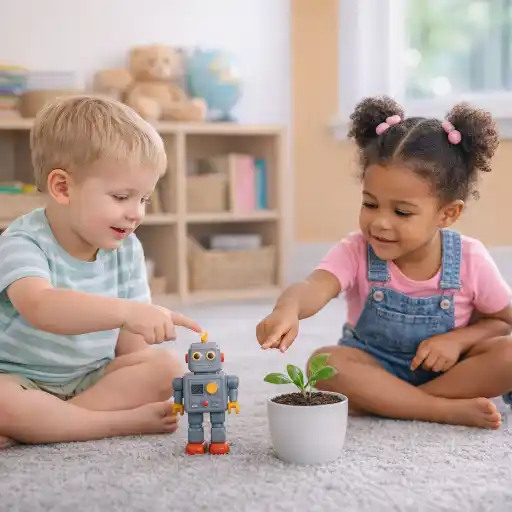
A sorting mat can organize children’s thinking, but it works best as an invitation to investigate rather than a quiz. Pair picture cards with safe, familiar objects or photographs: a classroom plant, a stone, a toy animal, and a picture of a car. Images offer an accessible starting point; real objects invite close observation.
Model your own thinking aloud once, without doing the whole activity for the children: “This toy dog looks like an animal, but it does not grow or need food. I’m going to place it with nonliving things. What clues do you notice?” Then let children sort and explain their choices. Treat a changed decision as a sign of active thinking, not a mistake.
- Start with a small group of familiar, contrasting examples.
- Ask children to name the clue behind each placement.
- Offer a “not sure yet” space for examples that prompt discussion.
- Invite children to suggest an object for the collection.
- After the first sort, ask whether the group wants to revisit any choices.
Make participation flexible. Children can place cards, point, direct a partner, draw, speak, or use a communication system. Large images, sturdy objects, picture labels, and a nonslip surface can support access without reducing the intellectual challenge. A supervised outdoor walk can extend the inquiry: photograph things children notice and later discuss what evidence supports each classification. Avoid collecting unknown or unsafe materials.
How can you recognize and document children’s thinking?
Listen for the rule a child is using, not only whether their final placement matches an adult’s expectation. One child may sort by visible movement; another may focus on what an object needs or how it changes. Follow up with questions such as, “What do these two have in common?” or “What helped you decide?” These prompts make children’s ideas visible and give you a clearer sense of what example might deepen their thinking.
Studies of young children’s scientific thinking describe how children form and refine ideas through observation, informal testing, and learning from others. In classroom practice, an initial misconception can therefore be a starting point for inquiry. Document the process briefly and objectively. For example: “Nia placed the toy car with living things because it moves. After comparing it with the plant, she said the car moves only when someone turns it on.”
- Record children’s words, gestures, comparisons, and questions.
- Notice whether they maintain or revise their sorting rule.
- Capture collaboration, turn-taking, and responses to peers.
- Revisit the same examples later to see how explanations develop.
Use these observations to plan a meaningful next step, rather than assigning a simple right-or-wrong score. A child who focuses on motion may benefit from comparing a plant with a moving machine; another may be ready to discuss growth or needs. This kind of careful #observation helps you respond to children’s current ideas.
How can educators make the activity inclusive and avoid common pitfalls?
Children do not need to participate in identical ways to explore the same scientific question. Pair spoken language with photos, symbols, gestures, and objects. Welcome home-language discussion, pointing, drawing, demonstration, and communication devices. Offer seated or standing options, adaptive tools, and a smaller number of choices when useful. These adjustments support #inclusion while keeping the investigation meaningful.
A common pitfall is treating classification as a test. Immediate correction can make children less willing to share tentative ideas. Ask for their reasoning first, then offer a contrasting example and time to reconsider. Another pitfall is defining life only by movement; include both plants and moving machines so children can compare how movement happens and consider other evidence.
- Use a few clear examples before introducing ambiguous ones.
- Keep materials safe and age-appropriate, and supervise exploration closely.
- Let children explain their own sorting rule, then explore it together.
- Use a sorting mat to support observation and conversation—not replace them.
Seeds, fallen leaves, paper, fire, and robots can raise complex questions. Save these examples for when children have a foundation, and model scientific humility when a question needs more investigation. State requirements vary - check your state licensing agency when connecting activities, documentation, or training to local expectations.
Conclusion: What does sorting reveal about children’s science thinking?
Children decide whether something is living or nonliving by using the clues and category rules they currently understand. A hands-on sort makes those rules visible: children observe, compare, classify, explain, and sometimes revise their ideas. The most productive outcome is not a perfectly completed mat; it is a child who can share a clue, consider another example, or ask a new question.
Begin with familiar objects, include a plant, and ask about growth, needs, change, and how movement happens. Offer flexible ways to participate, document children’s explanations, and revisit the examples as their ideas develop. When educators treat early theories as invitations to investigate, children can build stronger science concepts—and confidence in their own ability to think like scientists.
For additional professional learning, explore these relevant ChildCareEd courses:
- Basic Science in Early Childhood Buy Now $25.00 — strategies for inquiry and scientific reasoning.
- Building Early Science Foundations
 Buy Now $16.00 — developmentally appropriate exploration and discovery.
 - Creating the Natural Outdoor Classroom Buy Now $16.00 — ideas for nature-rich learning environments.
- A Closer Look into Developmental Theories Buy Now $24.00 — perspectives on children’s learning and development.
- Observing & Assessing in Child Care Buy Now $16.00 — ways to use observation to plan responsive experiences.
- CDA Certification en Español: Recursos y Consejos para Educadores Bilingües
- 🔍 ¿Qué ves cuando observas a un niño aprender?
- 👧 ¿Cómo iniciar y abrir una guardería en Texas? Lo que necesitas saber
- Qué capacitación se requiere para ser director de cuidado infantil en Texas?
- Requisitos Para Ser Maestra Principal En Un Daycare: Lo Que Necesitas Para Empezar
- Que es Título 22 en California?
- Capacitación en Salud y Seguridad Preventiva en Línea para Proveedores de Cuidado Infantil
- ¿Cómo solicito la licencia para una guardería en California?
- Regulaciones de Licenciamiento de Cuidado Infantil en California para Centros y Hogares de Cuidado Infantil Familiar
- Lista para Abrir una Guardería en Casa en Virginia: Cómo Empezar
- Lista para Abrir una Guardería en Casa en Carolina del Norte: Cómo Empezar
- Actividades de Otoño Fáciles para Preescolares esta Temporada
- Lista para Guardería en Casa en Illinois: Cómo Iniciar una Guardería en el Hogar
- Lista para Guardería en Casa en Texas: Cómo Iniciar una Guardería en el Hogar
- Cómo Trabajar en el Cuidado Infantil en California: Requisitos y Pasos
- Cómo Ser Maestra de Preescolar en Wisconsin
- Cómo simplificar la capacitación para sus empleados de daycare
- How Can You Teach Young Children the Difference Between Living and Nonliving Things?
- How Do Children Decide Whether Something Is Living or Nonliving?
- How Do Children Decide Whether Something Is Living or Nonliving?
