A child’s question about whether a bottle belongs in the recycling bin can open the door to science, language, mathematics, and shared problem-solving. Build that curiosity into a practical classroom investigation with the Project-Based Learning for Children course  Buy Now $16.00, which helps providers plan hands-on projects rooted in real-world questions. As you read, you’ll find ways to start small, keep the inquiry developmentally appropriate, and turn a simple sorting activity into learning children can revisit and share.
Why can a recycling question become more than a sorting activity?
“Does this go in the recycling?” may sound like a quick request for an answer, but it can reveal a child’s observations, prior knowledge, and developing theories about materials. Rather than ending the conversation with a bin label, educators can invite children to examine an object, compare it with others, and wonder what happens after it is collected. This turns an everyday classroom moment into a meaningful investigation grounded in children’s experience.
A recycling inquiry can connect several learning domains naturally. Children classify objects by material or purpose, count and compare items, use new vocabulary, negotiate decisions with peers, and represent discoveries through drawing, construction, or dramatic play. The emphasis is not on expecting young children to solve environmental problems. It is on helping them see themselves as curious, capable members of a community that makes thoughtful choices.
This approach reflects the active, collaborative learning described in research on sustainability education in early childhood. A study of preschool programs in Spain found that recycling learning was most useful when embedded in everyday routines and supported through collaboration among children, educators, families, and program leaders. For providers, the key is to make the experience concrete, positive, and connected to the classroom’s actual waste practices.
- Start with a question children have genuinely raised.
- Offer safe, familiar materials to inspect and sort.
- Make room for predictions, uncertainty, and changing ideas.
How can teachers turn children’s questions into a project plan?
Begin by listening and documenting. Write down a child’s words as accurately as possible and note what was happening when the question arose. Several children may ask about snack packaging, notice the recycling truck, or disagree about where a paper towel belongs. Those repeated observations can help the teaching team decide whether the interest is ready for a short investigation or a longer project.
Then shape the interest into an open but manageable driving question. For example: “How can we help our classroom sort items correctly?” or “What can we learn about the things we throw away?” Invite children to share what they already think, what they are unsure about, and how they might find out. A simple “What we think / What we found out” chart can make their ideas visible and help the group revisit them.
A project does not need a complicated timeline. Plan a few connected experiences and adjust them in response to children’s thinking:
- Notice and record questions, repeated interests, and children’s theories.
- Choose a focused question with a real connection to classroom life.
- Offer a sorting experience, local information, books, or a conversation with a knowledgeable community member.
- Document what children try and revisit their ideas together.
- Share learning through a class guide, display, or family conversation.
The Early Childhood PBL Project Bank offers examples of real-world project questions and public products that can inspire adaptations for your own group. Keep children’s voices central: the adult provides structure and resources, while children contribute questions, choices, and interpretations.
How can a sorting resource support hands-on investigation?
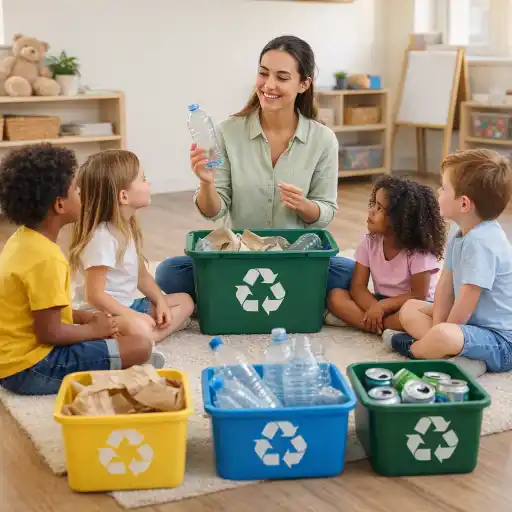
A sorting tool can give children a clear, inviting way to begin exploring. ChildCareEd’s Recycle or Trash Sort Buy Now $1.49 includes familiar item pictures—such as a plastic bottle, paper, cardboard, can, banana peel, napkin, food wrapper, and broken toy—for children to place in a Recycle or Trash category. The picture-based format can help make a first conversation concrete, especially when paired with real, safe examples or children’s own drawings.
Use the sort as a prompt for reasoning rather than a test with one universal answer. Ask, “What do you notice about this item?” “What do you think it is made of?” or “How could we check?” Community collection rules differ, so an item accepted locally may not be accepted elsewhere. Educators can model a responsible response when uncertain: check the local recycling guide rather than guessing.
Children can extend the sort by grouping items in additional ways—paper, metal, plastic, or food waste—or by considering whether something could be reused before it is discarded. Keep categories limited at first, then add complexity when children are ready. The Indiana preschool recycling lesson similarly uses sorting and discussion to help children consider materials and everyday waste choices.
- Use the resource for a brief small-group invitation, then return to it in routines.
- Invite children to explain a choice through words, gestures, drawings, or pointing.
- Do not treat the activity as a substitute for checking local disposal guidance.
How can the project include science, language, and mathematics?
Once children are interested in sorting, offer opportunities to look closely and compare. They might notice that a clean cardboard box is stiff while a wrapper is flexible, or that two objects made of plastic can have different shapes and uses. The goal is not to teach an oversimplified rule that every object of a given material is recyclable. Instead, support children in observing properties, making a prediction, and using reliable local information to refine their thinking.
Language grows through shared investigation. Introduce words such as material, reuse, reduce, recycle, compare, and predict as they become useful, and invite children to describe how they reached a decision. For mathematics, count sorted pictures, compare which category has more, or make a simple picture graph. Children can also dictate labels or draw a guide that explains what the class has learned.
Offer accessible ways for every child to participate. Some children may speak their ideas, while others point, sort, build, watch closely, draw, use a home language, or communicate with an assistive tool. Provide visual category labels, extra processing time, and adapted materials as appropriate. NAEYC’s inquiry resources highlight exploration and multimodal experiences as important ways to engage young learners in science.
- 🗣️ Try: “What helped you decide?” and give children time to respond.
- Count, compare, and graph the items children sorted.
- Invite children to represent a discovery with a drawing, model, or dictated explanation.
How can programs keep the project safe, inclusive, and connected to daily life?
Choose materials with safety and supervision in mind. If you use real examples, select clean, dry, intact items that are suitable for the children’s ages and abilities. Avoid sharp, dirty, broken, or small objects and anything that could present a choking or other safety hazard. Picture cards and teacher-held demonstrations are useful alternatives when an object is unsuitable for children to handle.
Make the investigation part of the day rather than a one-time Earth Day lesson. Children might revisit the class sorting guide at snack cleanup, add observations to a project chart, or help create clearer bin labels. Directors can support consistency by setting program-wide guidelines for approved materials, local disposal information, sanitation, supervision, and staff roles. State requirements vary - check your state licensing agency.
Family and community knowledge can deepen the work without creating pressure to donate materials or participate in a particular way. Share a short update and invite families to talk about how their community handles recycling, if they wish. Avoid assuming every household has the same collection service, resources, or practices. Recycled objects can also become open-ended play materials; the ChildCareEd course Beautiful Junk: Using Recycled Materials in the Classroom Buy Now $16.00 explores ways to use everyday items as learning tools.
How can educators avoid common project pitfalls and know what children learned?
A common pitfall is turning the experience into a right-answer quiz. If children are corrected immediately, they may stop sharing their reasoning. Instead, acknowledge the idea, ask how they reached it, and check local guidance together when needed. Another pitfall is presenting recycling rules as universal; collection systems differ, and local information should guide the classroom’s practical choices.
Projects can also become too ambitious. Not every question needs a multiweek investigation, and a short, repeated exploration can be valuable. Follow children’s interest, keep the scope manageable, and avoid adding categories or materials that overwhelm the group. Focus on care and agency rather than using fear or guilt to motivate participation.
Documentation can be concise and useful for planning. Capture a child’s question, a brief observation, or a photograph of a group’s sorting process, following program privacy procedures. Look for evidence such as children comparing objects, explaining a choice, revising a prediction, collaborating, or applying the routine during cleanup. These observations can guide the next step and help make learning visible to families.
- Ask one thoughtful question at a time and allow wait time.
- Use local disposal information and acknowledge uncertainty honestly.
- Observe the process—not only whether an item lands in the expected category.
Conclusion: How can recycling questions become meaningful learning?
Classroom recycling questions become a meaningful project when educators listen carefully, build on children’s own ideas, and offer safe, concrete ways to investigate. A sorting resource such as Recycle or Trash Sort Buy Now $1.49 can serve as a practical starting point; conversation, observation, local information, documentation, and revisiting children’s theories can extend it into deeper learning.
Keep the work manageable and inclusive. Connect sorting with language, early math, science, collaboration, and everyday routines, while making clear that local recycling rules vary. Most of all, treat children’s questions as useful invitations—not interruptions. With responsive guidance, a small classroom question can help children practice curiosity, thoughtful decision-making, and care for their shared environment.
- Beautiful Junk: Using Recycled Materials in the Classroom
- Building Early Science Foundations
- Birth to Five CDA Credential with Portfolio Review
- Art from the Heart for Preschoolers: Open Ended Art Projects that Build Self-Esteem
- Sensitive Periods in Montessori: Guiding Natural Learning
- Texas Director Credential
- Montessori Cultural Activities: Exploring the World Through Play and Learning
- Enhancing STEM Education for Infants and Toddlers
- Every Moment Matters: Schedules and Transitions
- CDA Certification en Español: Recursos y Consejos para Educadores Bilingües
- 🔍 ¿Qué ves cuando observas a un niño aprender?
- 💛🧩 ¿Cómo puedo hacer que mi enseñanza sea inclusiva para los niños con autismo?
- 🤯 ¿Por qué este niño está teniendo un comportamiento difícil de repente?
- 👶 ¿Cuáles son las proporciones y grupos requeridos en Dakota del Norte? 🏫
- Recursos en Español sobre el Sueño Seguro del Bebé
- 10 Ejemplos de Cómo la Cultura Influye en el Desarrollo Infantil
- Proporciones de Cuidado Infantil y Tamaños de Grupo por Edad en Nueva Jersey (Guía Rápida para Centros y Hogares)
- Proporciones de Cuidado Infantil y Tamaños de Grupo por Edad en Virginia (Guía Rápida para Centros y Hogares)
- Actividades de Otoño Fáciles para Preescolares esta Temporada
- Canciones, juegos y preguntas de círculo para niños
- How Can Child Care Programs Teach Sustainability Simply to Young Children?
- How Can Recycled Materials Create Engaging Learning Centers?
- How Can Loose Parts Play Turn Everyday Objects Into Powerful Learning Opportunities?
- How Can Simple Sorting Activities Build Sustainable Habits in Early Childhood?
- How Can Child Care Providers Help Children Understand How Community Helpers Contribute?
- ¿Todos los niños deben participar en el tiempo de círculo?
- How Can Child Care Providers Make Room for Floor Projects That Grow Beyond Their Starting Area?
- How Can You Choose Recycled Classroom Materials With a Real Purpose for Play?
- How Can Classroom Recycling Questions Grow into a Meaningful Learning Project?
